Edition 22 of 114 Medina Bureau 78 Verses

The Daily Revelation

Revelation. Reported. Truth.
الحج

Al-Hajj — The Pilgrimage
Force: Strong Tone: Warning Urgency: Urgent

THE PILGRIMAGE: Where the Earthquake Meets the Altar

Surah Al-Hajj is the Quran's most structurally daring chapter — a Medinan revelation that opens with apocalyptic terror, legislates the sacred rites of pilgrimage, authorises defensive warfare for the first time, defends every house of worship on earth, and closes with the call to strive for God with the striving due to Him. Seventy-eight verses. No single theme. Every theme at once.


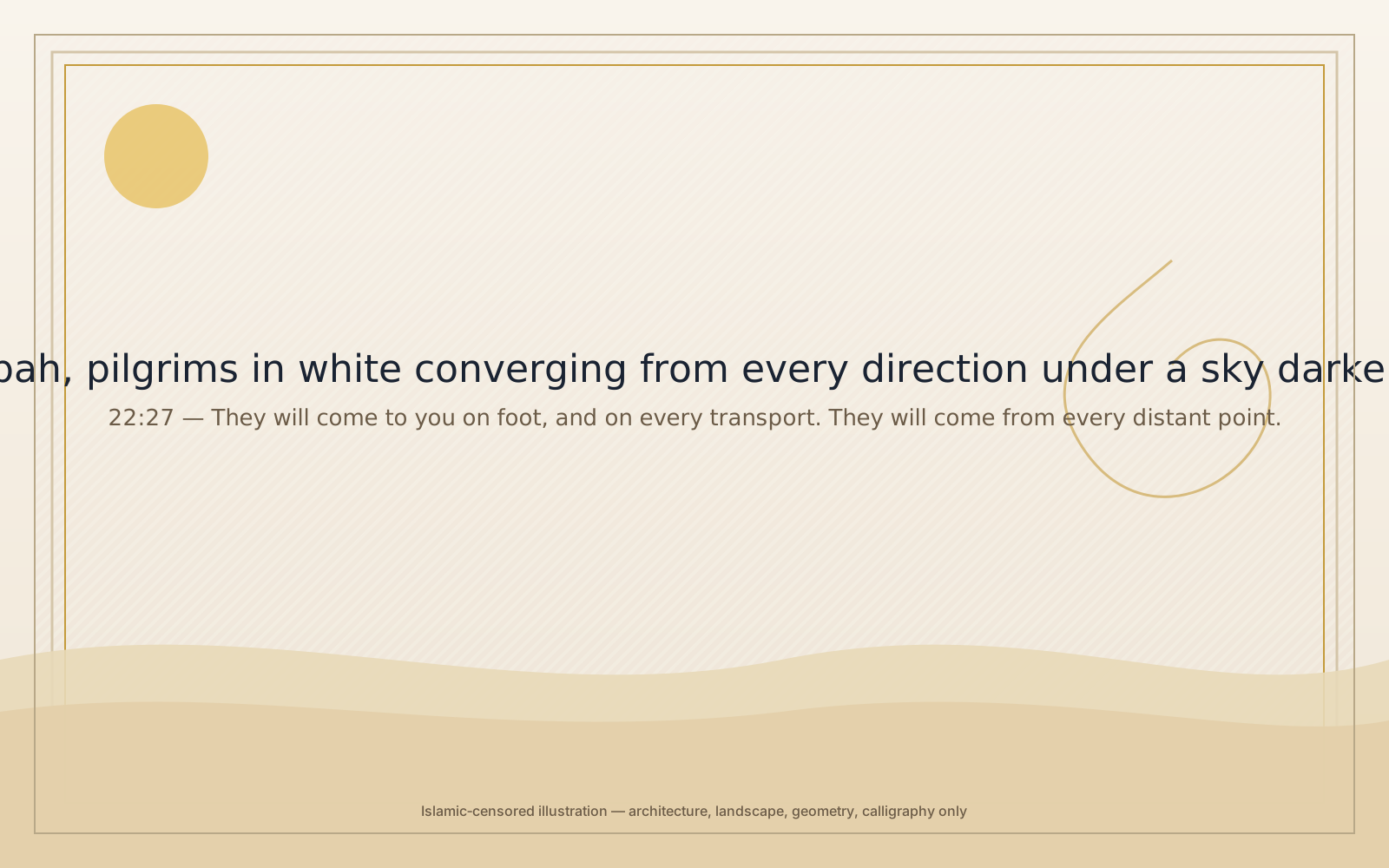
A vast desert plain stretching toward the Ka'bah, pilgrims in white converging from every direction under a sky darkened by apocalyptic clouds with cracks of golden light breaking through
22:27 — They will come to you on foot, and on every transport. They will come from every distant point.

There is no surah in the Quran that moves the way Al-Hajj moves. It opens with the end of the world — a seismic event so catastrophic that nursing mothers forget their children, pregnant women miscarry, and human beings stagger through the landscape looking drunk though they have not touched a drop. The punishment of God is severe, the verse warns. And then, without warning, the surah changes direction entirely. From the earthquake of the Hour, we are transported to the embryo in the womb — dust, then a drop, then a clot, then a lump of flesh — and then to the earth itself, dormant until the rain falls and it 'vibrates, and swells, and grows all kinds of lovely pairs.' From cosmic destruction to biological creation in five verses. This is the rhythm of Al-Hajj: terror and beauty in relentless alternation. By verse 26, Ibrahim is building the Ka'bah. By verse 37, we learn that the blood of sacrifice never reaches God — only the righteousness behind it. By verse 39, the most consequential military authorisation in Islamic history is issued: 'Permission is given to those who are fought against.' By verse 40, God is defending monasteries, churches, and synagogues alongside mosques. And by verse 73, the Almighty is daring all of creation to produce a single fly. The surah that begins with the collapse of all things ends by reminding us that we cannot even create the smallest thing. This is Al-Hajj — the Pilgrimage. Not a travelogue. A reckoning.

“O people, be conscious of your Lord. The quaking of the Hour is a tremendous thing.”
— God 22:1
Spiritual Barometer
Force
strong
Tone
warning
Urgency
urgent

The Daily Revelation Edition 22

Lead Investigation

THE OPENING EARTHQUAKE: The Most Terrifying Two Verses in the Quran and Why God Chose to Begin a Surah About Pilgrimage with the End of the World

No passage in the Quran starts harder. No passage in any scripture.

'O people, be conscious of your Lord. The quaking of the Hour is a tremendous thing' 22:1. The address is universal — not 'O believers,' not 'O Children of Israel,' not 'O people of Muhammad.' All people. Every human being who has ever drawn breath or will ever draw one. God is speaking to the species. And what He is describing is the last event in the species' history.

Then the scene unfolds, and it is unlike anything else in the Quran. 'On the Day when you will see it: every nursing mother will discard her infant, and every pregnant woman will abort her load, and you will see the people drunk, even though they are not drunk — but the punishment of God is severe' 22:2. Four images. Four escalations. Each one breaks a deeper bond than the last.

The nursing mother abandons her child. This is the most primal attachment in mammalian biology — the bond between a feeding mother and the infant at her breast. It is the last thing to break. In any disaster, in any catastrophe, you will find mothers clinging to their babies long after they have abandoned everything else. The Quran says: on that Day, even this bond shatters. The terror is so total that the deepest instinct in human nature — a mother's hold on her child — is overwhelmed.

The pregnant woman miscarries. This is not a choice. This is the body itself rebelling. The physical shock is so severe that the biological process of carrying life is interrupted. The body cannot sustain creation in the presence of this destruction.

The people appear drunk. They stagger, they lose coordination, their perceptions distort. But the Quran immediately clarifies: they are not drunk. Alcohol has not impaired them. Reality has. The world is collapsing around them and their nervous systems have simply overloaded. They have the symptoms of intoxication without the substance — because the cause is not chemical. It is cosmic.

Why does a surah about pilgrimage begin this way? The question is not rhetorical. The answer is architectural. Al-Hajj is about to describe the most physically demanding act of worship in Islam — the pilgrimage to Mecca, with its rituals of circling, standing, sacrificing, shaving, walking between hills. These are bodily acts. Earthly acts. And the surah opens by placing them against the backdrop of a Day when the earth itself will be destroyed. The implication is devastating in its clarity: everything you worship on earth will end. Every structure. Every monument. Every city. Only the worship itself — the relationship between the creature and the Creator — survives. Hajj is not a tourist destination. It is rehearsal for the Day when every destination ceases to exist.

The first two verses of Al-Hajj do not introduce the pilgrimage. They explain why the pilgrimage matters. They establish the stakes. When two million people stand on the plain of Arafat in their white shrouds, stripped of all worldly markers, facing the same direction, calling to the same God — they are not merely performing a ritual. They are practicing for 22:1-2. They are rehearsing for the Day when the earth quakes, and only those who already know how to stand before God will be able to stand at all.

22:1 22:2 22:3 22:4 22:5 22:6 22:7

The Daily Revelation Edition 22

Science & Creation

FROM DUST TO DUST AND BACK AGAIN: The Embryological Argument for Resurrection That Silences Every Doubt

Having shattered the reader with the earthquake of the Hour, the surah pivots to what is arguably the Quran's most sophisticated argument for resurrection. And it begins not in the heavens but in the womb.

'O people! If you are in doubt about the Resurrection — We created you from dust, then from a small drop, then from a clinging clot, then from a lump of flesh, partly developed and partly undeveloped' 22:5. The argument is not theological. It is observational. God does not say: believe because I command it. He says: look at the evidence you already have.

The verse traces human development through six stages — dust, drop, clot, lump, infant, adult — and then adds two more phases that most people would prefer not to discuss: old age, in which a person may be 'returned to the vilest age, so that he may not know, after having known,' and death. Eight stages. A complete biological timeline from raw material to decomposition. And the argument embedded in the sequence is lethal to the sceptic: if God can build a human being from dust the first time, through stages so intricate that modern embryology has only recently mapped them, then rebuilding that human being from the same dust a second time is not a greater feat. It is the same feat, repeated.

But the surah does not stop at the womb. It extends the argument to the earth itself. 'And you see the earth still; but when We send down water on it, it vibrates, and swells, and grows all kinds of lovely pairs' 22:5. The parallel is precise and intentional. The dead earth receives rain and comes alive. The dead body will receive the divine command and come alive. The mechanism is the same. The author is the same. The doubters are watching one resurrection happen every spring and refusing to believe in the other.

Verse 22:6 then delivers the thesis statement that the entire argument has been building toward: 'That is because God is the truth, and because He gives life to the dead, and because He is Capable of everything.' Three claims. God is real. God revives the dead. God has no limits. The embryo proves the first. The rain proves the second. The existence of anything at all proves the third.

What makes this passage remarkable among the Quran's many resurrection arguments is its tone. It is not a threat. It is not a warning. It is an invitation to observe. Look at how you were made. Look at how the earth comes back after drought. Now tell me — is the God who did both of those things incapable of doing it again? The question answers itself. And that, the surah implies, is the point. Resurrection is not the extraordinary claim. Denying it is.

22:5 22:6 22:7

The Daily Revelation Edition 22

Sacred Architecture

IBRAHIM BUILDS THE HOUSE: How a Father and Son Raised the Walls That Two Billion People Still Face in Prayer

The Ka'bah is the oldest and most visited structure on earth. Not the oldest surviving — the oldest in function. Other buildings have been rebuilt, repurposed, abandoned, turned into museums. The Ka'bah has been rebuilt too, multiple times, but its function has never changed. It was built to be circled in worship. It is still circled in worship. And this surah tells us who first raised its walls and why.

'We showed Abraham the location of the House: Do not associate anything with Me; and purify My House for those who circle around, and those who stand to pray, and those who kneel and prostrate' 22:26. The verse is remarkable for what it does not say. It does not say Ibrahim chose the location. It says God showed it to him. The site was pre-selected. Ibrahim was the builder, not the architect. The specifications were divine: no idolatry, and the space must be maintained in purity for worship — circling, standing, kneeling, prostrating. Four postures. The complete vocabulary of the body at prayer.

Then comes the announcement that established the pilgrimage as a permanent institution in human civilisation: 'And announce the pilgrimage to humanity. They will come to you on foot, and on every transport. They will come from every distant point' 22:27. God does not tell Ibrahim: people from your tribe will come. He says: humanity will come. From every distant point. This is a universal summons issued in the Bronze Age, when Ibrahim stood in a barren valley with no city, no infrastructure, no visible reason for anyone to travel there. He was told to call, and he was promised that the call would be answered from the ends of the earth.

Today, approximately two million people answer that call every year — from Jakarta and Johannesburg, from Toronto and Tokyo, from villages without running water and capitals with skylines. They fly, they sail, they drive, they walk. 'On foot, and on every transport.' The prophecy of 22:27 is renewed annually, visibly, verifiably, in the largest single gathering of human beings on the planet.

The rites that follow are described with striking physicality. 'That they may witness the benefits for themselves, and celebrate the name of God during the appointed days, for providing them with the animal livestock. So eat from it, and feed the unfortunate poor' 22:28. The pilgrimage is not purely spiritual. There are economic benefits to witness. There is meat to eat and to distribute. The Quran does not separate the sacred from the material — it weaves them together. Worship and charity. Prayer and food distribution. Circling the House and feeding the hungry. The same act, the same days, the same journey.

'Then let them perform their acts of cleansing, and fulfill their vows, and circle around the Ancient House' 22:29. The Ancient House — al-Bayt al-Atiq. Not the grand mosque. Not the holy mosque. The ancient house. The oldest house. The word atiq carries connotations of both antiquity and liberation. It is the house that has been there since the beginning, and it is the house that sets you free. Ibrahim built it. His descendants rebuilt it. Idolaters filled it with 360 idols. Muhammad cleared them all. And every year, millions of people dress in white shrouds that look remarkably like burial cloths, travel to a valley in the desert, and circle a structure that has stood, in one form or another, since a father and son stacked stones in the sand and called out to a world that had not yet arrived.

22:26 22:27 22:28 22:29 22:30 22:31 22:32 22:33

The Daily Revelation Edition 22

Theology

THE BLOOD THAT NEVER REACHES GOD: How One Verse Redefined the Meaning of Sacrifice for All Time

Every religion that practises animal sacrifice faces the same question: what does God do with the blood? The ancient world had clear answers. In Mesopotamia, the gods consumed the smoke. In Greece, the aroma of burnt offerings was thought to please the Olympians. In pre-Islamic Arabia, blood was smeared on the walls of the Ka'bah — a physical offering to physically present deities. The blood was the point.

The Quran demolishes this entire framework in a single verse. 'Neither their flesh, nor their blood, ever reaches God. What reaches Him is the righteousness from you' 22:37. This is not a reform. It is a revolution. God does not want the blood. God does not need the meat. God cannot be fed, cannot be bribed, cannot be placated by the destruction of something He created. What God wants is what the act of sacrifice represents: the willingness to give up something you value, for no material return, because you were asked to.

The verse redefines sacrifice from a transaction into a diagnostic. The question is no longer: did you perform the sacrifice correctly? The question is: what did the sacrifice reveal about your heart? Are you the kind of person who can let go of what you possess when your Creator asks? Or are you the kind of person who clings to your livestock, your wealth, your comfort, and performs the ritual mechanically while your soul remains locked in a vault?

The preceding verses establish the context. 'We have made the animal offerings emblems of God for you. In them is goodness for you. So pronounce God's name upon them as they line up' 22:36. The animals are emblems — sha'a'ir, from the same root as the word for awareness, consciousness. They are signs, not payments. Symbols, not currency. The physical act of sacrifice is a container. The content is taqwa — the righteousness, the God-consciousness, the internal posture of submission that the external act is designed to produce.

'Thus He subdued them to you, that you may glorify God for guiding you. And give good news to the charitable' 22:37. The animals were made subservient to humans not so that humans could assert dominance, but so that in the act of sacrificing them, humans could practice submission. The hierarchy is deliberate: God above the human, the human above the animal, and the act of sacrifice reminding everyone of their place in the chain. You are not the top of the food chain. You are the middle of the worship chain.

This verse has been cited by Islamic scholars for fourteen centuries as the foundational principle of intention in worship. No act of devotion — prayer, fasting, charity, pilgrimage — has value in itself. The value is in the internal state it produces. The prayer that reaches God is not the one performed with perfect Arabic pronunciation. It is the one performed with a present heart. The fast that reaches God is not the one where you abstained from food for the correct number of hours. It is the one where you abstained because you were asked to and you said yes. The sacrifice that reaches God is not the one where the animal's blood flowed in the prescribed direction. It is the one where your ego bled. Where something in you was given up. Where the knife touched not just the animal but the attachment.

Neither their flesh, nor their blood, ever reaches God. What a sentence. What a liberation. The entire sacrificial economy of the ancient world — the priests, the temples, the rituals designed to make the gods hungry and then feed them — collapses. God is not hungry. God does not receive meat. God receives you. And the sacrifice is just the instrument that pries you open enough for the offering to get through.

22:34 22:35 22:36 22:37

The Daily Revelation Edition 22

Military & Statecraft

PERMISSION GRANTED: The Two Verses That Changed the Laws of War — and Defended Every House of Worship on Earth

For thirteen years in Mecca, the Muslim community absorbed persecution without retaliation. They were beaten. They were boycotted. They were tortured. Bilal was laid on the burning sand with a boulder on his chest. Sumayyah was killed — the first martyr in Islam. The Prophet himself was pelted with stones in Ta'if until his sandals filled with blood. And through all of it, the divine instruction was patience. Endurance. No permission to fight back had been given. The Quran, in its Meccan phase, was a document of spiritual resistance, not military resistance.

Then the community emigrated to Medina. They left behind their homes, their property, their livelihoods. They were refugees — unjustly expelled, materially dispossessed, politically powerless. And the Quraysh pursued them. The threat of annihilation did not diminish with distance. It intensified.

It is in this context that two of the most consequential verses in the history of armed conflict were revealed.

'Permission is given to those who are fought against, and God is Able to give them victory' 22:39. This is the first military authorisation in the Quran. Scholars across all major schools of Islamic jurisprudence identify this as the moment when defensive warfare became permissible. The language is precise and the precision matters enormously. Permission is given. Not a command. Not an obligation. A permission. The default state in Islam is peace. Fighting is the exception, and the exception requires explicit divine authorisation.

And the authorisation is conditional: 'those who are fought against.' Not: those who wish to fight. Not: those who are angry. Not: those who disagree with their neighbours. Those who are fought against. The aggression comes first. The permission is responsive. This is not a licence to wage war. It is a right to self-defence, granted after thirteen years of absorbing violence without it.

Verse 22:40 then provides both the justification and the framework: 'Those who were unjustly evicted from their homes, merely for saying, Our Lord is God.' The cause is identified: forced exile on religious grounds. The crime is not political. It is theological. They were expelled for their beliefs. And then comes the passage that may be the most remarkable statement of religious pluralism in any scripture of the ancient world:

'Were it not that God repels people by means of others: monasteries, churches, synagogues, and mosques — where the name of God is mentioned much — would have been demolished' 22:40.

Read that again. The Quran — the scripture of Islam — is declaring that God defends monasteries. God defends churches. God defends synagogues. Alongside mosques. The list is deliberate. It is chronological — moving from Christian monastic communities, to general Christian worship, to Jewish worship, to Muslim worship. And the principle is universal: wherever the name of God is mentioned, that place is under divine protection. The permission to fight is not given to protect Islam alone. It is given to protect the freedom of worship itself.

This is not interfaith diplomacy. This is Quranic text. This is God, in His own revelation, listing four categories of worship spaces — only one of which is Islamic — and declaring all four worthy of defence. The fighter in Islam does not fight for the supremacy of the mosque. He fights so that every place where God's name is spoken — in whatever language, in whatever tradition — remains standing.

'God supports whoever supports Him. God is Strong and Mighty' 22:40. And then, immediately, the portrait of the supported: 'Those who, when We empower them in the land, observe the prayer, and give regular charity, and command what is right, and forbid what is wrong' 22:41. The test of power is immediate. The moment you have it, what do you do with it? Pray. Give. Command good. Forbid evil. That is the four-part mandate of governance in the Quran. Not conquest. Not expansion. Not wealth accumulation. Prayer, charity, justice, accountability.

22:38 22:39 22:40 22:41

The Daily Revelation Edition 22

Rhetoric & Philosophy

THE FLY CHALLENGE: How One Insect Destroyed Every Argument for Idolatry in Fourteen Words

The Quran deploys many arguments against idolatry. In Surah Al-Anbiya, Ibrahim smashes the idols and dares them to speak. In Surah Al-A'raf, the idolaters are asked: do your gods have legs to walk with, hands to strike with, eyes to see with? Throughout the Quran, the case against worshipping anything other than God is made with logic, with narrative, with threat, with promise. But no argument in the Quran is as devastatingly simple as the one in 22:73.

'O people! A parable is presented, so listen to it: Those you invoke besides God will never create a fly, even if they banded together for that purpose. And if the fly steals anything from them, they cannot recover it from it. Weak are the pursuer and the pursued' 22:73.

A fly. God reduces the entire theological debate between monotheism and polytheism to a fly. Your gods, He says — all of them, every idol, every partner, every intermediary you have set up beside Me — could band together, pool their collective power, coordinate their efforts, and they still could not produce a single fly. Not an eagle. Not a horse. Not a human being. A fly. The smallest, most insignificant, most commonly swatted creature in the daily human experience. Your gods cannot make one.

But the argument does not stop there. It escalates into absurdity. If the fly takes something from them — a grain of sugar, a crumb of food — they cannot even retrieve it. The gods you worship are not merely incapable of creation. They are incapable of retrieval. They cannot make the fly, and they cannot take back what the fly has stolen. They are weaker than the thief, and the thief is an insect.

'Weak are the pursuer and the pursued.' This final phrase is the blade. The pursuer — the idol-worshipper desperately seeking help from his fabricated gods. The pursued — the object of worship that cannot even defend itself against a fly, let alone offer protection to a human being. Both are weak. The one who prays is weak for praying to something powerless. The thing that receives the prayer is weak for being powerless to respond. The entire transaction is a farce, and the fly — the lowest creature in the room — is the proof.

The verse that follows drives the nail home: 'They do not value God as He should be valued. God is Strong and Powerful' 22:74. The juxtaposition is the argument. You worship things that cannot create a fly. God created the fly, and the creature that swats the fly, and the planet the creature lives on, and the solar system the planet orbits. The distance between what you worship and what you should worship is the distance between a fabricated idol that loses to a fly and the Being who designed the fly — its compound eyes, its flight mechanics, its six legs, its capacity to detect motion faster than the human brain can process it. Your gods cannot even build the thing you swat at breakfast. That is how far you have fallen.

In the history of theological rhetoric, across all scriptures and all traditions, it would be difficult to find a more efficient demolition of polytheism than the fly parable of 22:73. Fourteen Arabic words. One insect. The end of every argument for worshipping anything other than the Creator.

22:73 22:74 22:75

The Daily Revelation Edition 22

Historical Precedent

THE PATTERN OF DENIAL: From Nuh to Muhammad — Every Prophet Was Rejected, Every Civilisation Was Reprieved, Every Reprieve Ended

Surah Al-Hajj contains one of the Quran's sharpest historical surveys — a compressed chronicle of prophetic rejection that spans millennia and covers six civilisations in seven verses. The passage is not decorative. It is evidentiary. God is assembling a case file.

'If they deny you — before them the people of Noah, and Aad, and Thamood also denied. And the people of Abraham, and the people of Lot. And the inhabitants of Median. And Moses was denied' 22:42-44. Six predecessors. Six communities. Six identical crimes. The denial of Muhammad is not a novelty. It is a rerun. The script has been performed so many times that God can list the cast in a single breath.

But the purpose of the survey is not merely to console the Prophet. It is to warn his detractors. Because every listing comes with an outcome: 'Then I reprieved those who disbelieved, but then I seized them. So how was My rejection?' 22:44. The question is addressed to the present-day deniers, but the answer is written in the ruins of their predecessors. How was My rejection? Ask the people of Nuh, who drowned. Ask Aad, whose cities were buried in sand. Ask Thamood, whose mountains could not protect them. Ask the people of Lut, whose towns were overturned. Each one was given time — reprieved, the Quran says, granted a period of grace — and then seized.

Verse 22:45 makes the evidence physical: 'How many a town have We destroyed while it was doing wrong? They lie in ruins; with stilled wells, and lofty mansions.' Stilled wells — communities that once had water, trade, life, and are now dry. Lofty mansions — structures that once housed the powerful, now empty, their grandeur mocking their impermanence. The Quran is pointing at archaeological evidence. These are not abstract parables. These are places you can visit. Ruins you can touch. Wells you can peer into and see nothing but dust.

Then comes the diagnostic: 'Have they not journeyed in the land, and had minds to reason with, or ears to listen with? It is not the eyes that go blind, but it is the hearts, within the chests, that go blind' 22:46. The failure is not informational. The ruins are visible. The evidence is there. The problem is not that the deniers cannot see — it is that their hearts are sealed. Physical eyes function perfectly. Spiritual perception has shut down. They walk through the wreckage of previous civilisations and learn nothing, because the organ of learning — the heart — has gone dark.

The passage closes with a recalibration of time itself: 'A day with your Lord is like a thousand years of your count' 22:47. The reprieve that feels like forever to the denier is, in God's accounting, a moment. The delay between sin and consequence that the mockers mistake for immunity is, on the divine clock, a rounding error. God is patient. But God's patience has a terminus. And when it expires — 'How many a town have I reprieved, although it was unjust? Then I seized it. To Me is the destination' 22:48 — the arrival is absolute.

22:42 22:43 22:44 22:45 22:46 22:47 22:48

The Daily Revelation Editorial Edition 22

✸ ✸ ✸

Letter from the Editor: The Surah That Refuses to Be One Thing

Every other surah in the Quran can be summarised in a phrase. Al-Fatiha is the opening prayer. Al-Baqarah is the legislative constitution. Yusuf is the prophetic narrative. Ar-Rahman is the hymn to mercy. You can hold each chapter in your mind as a single idea, a single mood, a single thesis.

Al-Hajj refuses this. It will not be held. It opens with an earthquake and arrives at a fly. It legislates pilgrimage rites and authorises war. It describes the embryo in the womb and the garments of fire tailored for the damned. It defends churches and promises hellfire. It tells Ibrahim to build and tells the idolaters to think. It is Medinan in its practical legislation and Meccan in its cosmic terror. Some scholars, noting the tonal whiplash, have argued that parts of the surah were revealed in Mecca and parts in Medina — that it is, in fact, a composite. This may be true. But even if it is, the arrangement is not accidental. The juxtapositions are the message.

Consider the architecture. The surah begins with the destruction of everything — the Hour, when the earth quakes and all order collapses. It then moves to the creation of everything — the embryo developing stage by stage, the earth reviving after rain. Destruction and creation. End and beginning. These are not separate topics. They are the same topic viewed from two directions. The God who can destroy the cosmos is the God who created the embryo. The God who will end the world is the God who sends the rain. To fear the first without marvelling at the second is to misunderstand both.

Then the surah moves to worship — the pilgrimage, the Ka'bah, the sacrifice. And the worship is immediately followed by war — the permission to fight, the defence of religious spaces, the mandate to establish justice when given power. Worship and war. Prayer and combat. Again, not separate topics. The surah is arguing that you fight in order to worship. You defend the mosque — and the church, and the synagogue, and the monastery — so that people can continue to pray in them. The sword serves the prayer mat, never the reverse.

And at the end, the fly. After the earthquake, after the embryo, after Ibrahim, after the sacrifice, after the war, after the ruins of six civilisations — a fly. The mightiest surah in the Quran ends its argument with the most trivial creature in nature. And it works. Because if your gods cannot handle a fly, then the earthquake of the Hour, the rites of Hajj, the permission to fight, and the ruins of every civilisation that came before yours are all irrelevant to you. You are worshipping something that loses to an insect. Start there.

Al-Hajj is the Quran's most honest surah. Life is not one thing. It is earthquakes and embryos, worship and war, sacrifice and flies. And the surah that contains them all is the surah named after the pilgrimage — the one act of worship that forces you to confront everything at once. You leave your home, your comfort, your identity. You dress like the dead. You stand in the desert. You circle a building raised by a man who was willing to sacrifice his son. You throw stones at the devil. You slaughter an animal whose blood God does not want. And then you go home — if you are lucky — and try to live as though you meant all of it. That is Hajj. That is Al-Hajj. That is the surah that refuses to be one thing, because the journey it describes is everything.

For Reflection
Al-Hajj places the earthquake of the Hour and the ritual of pilgrimage in the same surah because both strip you of everything. In the Hour, the world is taken from you. In Hajj, you give it up voluntarily. Which is harder — having it torn away, or laying it down? Today, identify one comfort you cling to that you would struggle to release if asked. Sit with the discomfort. That is where the surah is pointing.
Supplication
O Allah, You opened this surah with the terror of the Hour to make us value the worship that follows. Help us to hear the earthquake in every prayer — the reminder that nothing lasts except what we offer You. When we sacrifice, let it be our pride on the altar, not merely our livestock. When we circle Your House, even in our minds, let us leave behind one attachment with each circuit. Make us among those who, when empowered, pray and give and command good and forbid wrong — not among those who cannot even outwit a fly. You are Strong and Mighty. We are weak. But with You, we are enough. Ameen.
✸ ✸ ✸

The Daily Revelation Edition 22

The Wavering Believer

THE MAN WHO WORSHIPS GOD ON EDGE: A Portrait of Faith That Breaks at the First Test

Among the Quran's many character studies, few are as psychologically precise as the portrait in 22:11. 'And among the people is he who worships God on edge. When something good comes his way, he is content with it. But when an ordeal strikes him, he makes a turnaround. He loses this world and the next. That is the obvious loss.'

On edge. The Arabic 'ala harf literally means on the edge, on the lip, on the margin. The image is of a person standing at the very boundary of faith — not in its centre, not rooted in its soil, but balanced on the rim, where the slightest push can send them tumbling in either direction. This is not a portrait of a disbeliever. A disbeliever has made a decision. This is a portrait of someone who has not decided. Someone whose faith is entirely transactional: it works when life works, and it collapses when life does not.

The diagnostic is clinical. When good arrives — health, wealth, a favourable outcome — this person is content. They interpret the good fortune as divine approval. They attribute their success to the correctness of their faith. Their religion is, at this stage, indistinguishable from superstition. They worship not because God is worthy of worship but because worship appears to be producing favourable results. The mechanism is not love. It is investment.

Then the ordeal strikes. Illness. Loss. Failure. Injustice. The circumstances that every human life inevitably encounters. And the person on the edge makes a turnaround — inqalaba 'ala wajhihi, literally 'turned on his face,' a phrase suggesting not just a change of direction but a fall, a collapse, a total inversion. The faith that was conditional on good outcomes evaporates the moment the outcomes change. The person does not doubt. They defect.

The consequence is devastating: 'He loses this world and the next.' Not one or the other. Both. In this world, he has no anchor — every trial shakes him loose, every hardship unmoors him, every setback sends him spiralling into the arms of whatever false god or false philosophy promises immediate relief. In the next world, he has no record — his worship was never worship, only a bet that did not pay off. He invested in religion the way a speculator invests in a volatile stock: buy when the market is up, sell in a panic when it drops. And like the speculator who buys high and sells low, he ends up with nothing.

'That is the obvious loss.' The word mubin — obvious, clear, self-evident. The Quran does not call it a tragic loss, or a surprising loss, or an understandable loss. It calls it an obvious loss. Because anyone watching from outside can see the pattern. Everyone except the person living it. The man on the edge thinks he is being rational — adjusting his beliefs to match his circumstances. The Quran says he is being blind. He is watching the surface — the outcomes, the results, the short-term data — and missing the structure beneath. The structure is: God tests. Tests are not punishment. Tests are the mechanism by which 'on the edge' becomes 'in the centre' — or off the cliff entirely. The ordeal is not God abandoning the worshipper. It is God finding out whether the worshipper will abandon Him.

22:11 22:12 22:13

The Daily Revelation Back Page Edition 22

Today's Action
Today, perform one act of worship when things are going badly. Not when you feel grateful — when you feel tested. Pray when you are frustrated. Give charity when you feel financially anxious. Read a verse when you would rather complain. Train yourself to worship not on the edge but in the centre, where the ground does not shift with your circumstances.
Weekly Challenge
Study the Hajj rites this week, even if you have not been. Learn the stations: Tawaf (circling), Sa'i (walking between Safa and Marwah), Wuquf at Arafat (standing), Rami (stoning), Nahr (sacrifice). For each station, write one sentence about what it symbolises. Hajj is not just for those who travel to Mecca. Its lessons belong to everyone who reads 22:27: 'They will come from every distant point.'
Related Editions
Edition 2 Ibrahim and Ismail build the Ka'bah (2:127-129) — the founding story whose legacy Al-Hajj legislates into permanent practice
Edition 14 Ibrahim's prayer after settling his family in the barren valley of Mecca (14:35-41) — the backstory to 22:26-29
Edition 3 The first House established for mankind at Bakkah (3:96-97) — a parallel account of the Ka'bah's sanctity and the obligation of pilgrimage
Edition 21 Ibrahim's trial by fire (21:68-70) — the same prophet who builds the House in Al-Hajj survived the fire in Al-Anbiya
Edition 9 The purification of Hajj from polytheism (9:1-5, 9:28) — the political aftermath of the religious legislation in Al-Hajj
Characters in This Edition
Allah Ibrahim Believers Disbelievers Muhammad Iblis Nuh Musa Lut Angels
Coming Next
NEXT EDITION: Surah Al-Mu'minun — The Believers. What does successful faith actually look like? God opens by listing the traits of believers who have 'already succeeded' — humility in prayer, avoidance of idle talk, active charity — and then takes the reader on a journey through prophetic history to prove that this blueprint has always worked. From the womb to the grave, from Nuh's ark to the final judgment, Surah 23 is the Quran's answer to the question: what kind of person inherits paradise?
Page 1 of 11
Ed. 21 Ed. 23