Edition 51 of 114 Mecca Bureau 60 Verses

The Daily Revelation

Revelation. Reported. Truth.
الذاريات

Adh-Dhariyat — The Scatterers
Force: Moderate Tone: Warning with embedded gentleness Urgency: Timeless

THE SCATTERERS: God Swears by the Wind — Then Tells You Why You Exist

A surah that opens with four cosmic oaths no human can see, pivots to the most intimate domestic scene in Abraham's life, catalogues the ruins of five defiant civilisations, pauses to note that the universe is expanding, and then — in a single verse that has shaped fourteen centuries of Islamic theology — declares the sole reason anything was ever created at all.


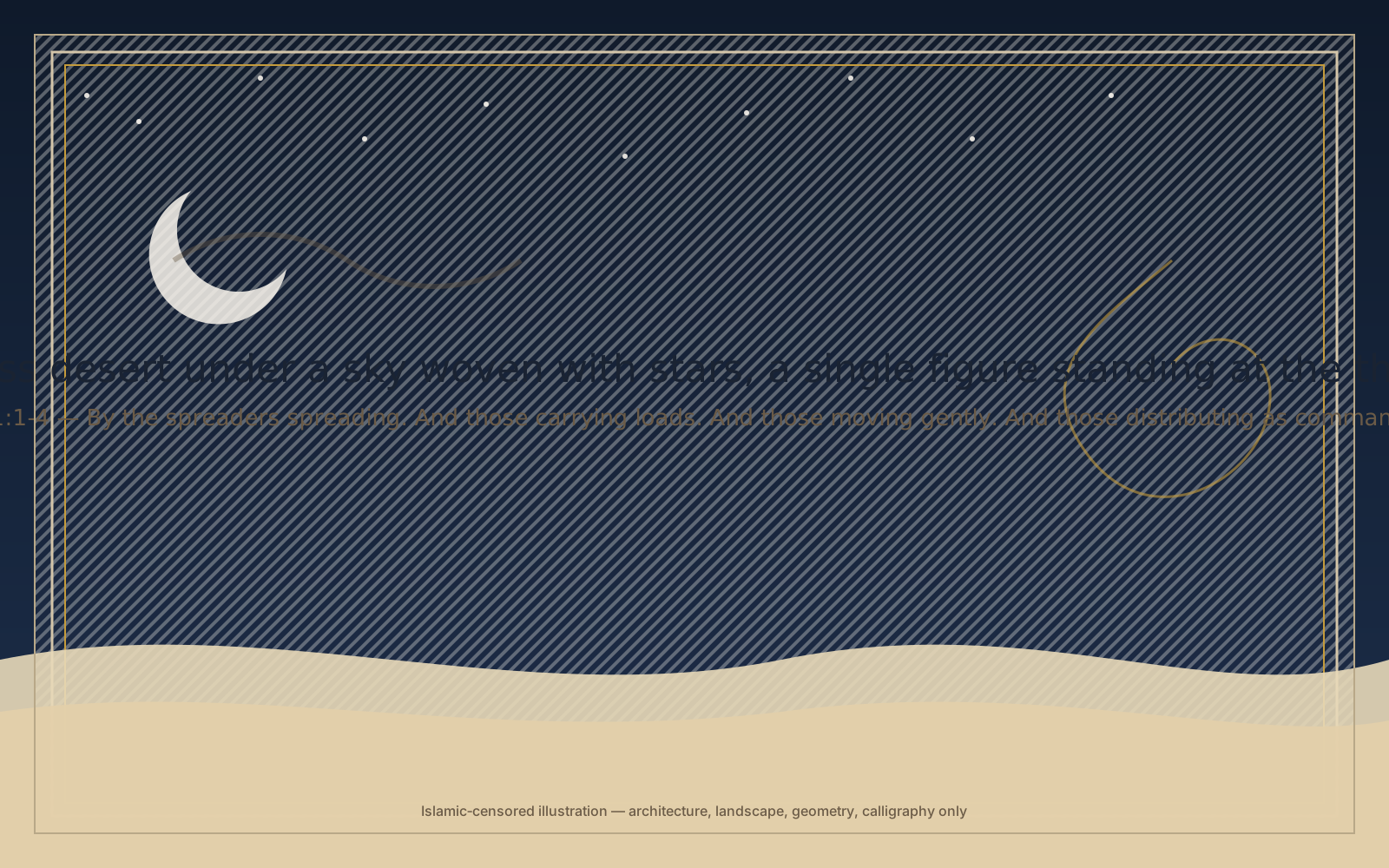
Wind-driven sand sweeping across an endless desert under a sky woven with stars, a single figure standing at the threshold of a tent with light spilling from within
51:1-4 — By the spreaders spreading. And those carrying loads. And those moving gently. And those distributing as commanded.

There are verses in the Quran that scholars debate for centuries. And then there is 51:56 — a verse so direct, so unambiguous, so surgically precise in its declaration that it leaves no room for interpretation at all. Eight words in the Talal Itani translation. Twelve in Arabic. The answer to every existential question a human being has ever asked, compressed into a single breath: 'I did not create the jinn and the humans except to worship Me.' Not to accumulate. Not to reproduce. Not to conquer or discover or innovate or be happy. To worship. That is the thesis statement of Surah Adh-Dhariyat — but the surah does not arrive at it in a straight line. It begins in the sky, with four oaths sworn on phenomena no camera has ever captured: winds that scatter, clouds that carry rain, breezes that move gently, and cosmic forces that distribute as commanded. Then it drops to earth, to the tent of Ibrahim, where a very old man is serving a fatted calf to strangers who turn out to be angels carrying two messages — one joyful, one catastrophic. Then it accelerates through the ruins of five civilisations — Lut's people, Pharaoh's Egypt, Aad, Thamud, the people of Nuh — each destroyed by a different element, each for the same reason: they were told the truth and refused it. And then, after the wind and the dinner and the ruins and a parenthetical observation that the universe is expanding, the Quran delivers the sentence that makes sense of all of it. You were made for one thing. Everything else is either a means to that thing or a distraction from it.

“I did not create the jinn and the humans except to worship Me.”
— Allah 51:56
Spiritual Barometer
Force
moderate
Tone
warning with embedded gentleness
Urgency
timeless

The Daily Revelation Edition 51

Lead Story

THE OATH NOBODY CAN SEE: Why God Begins His Most Important Revelation About Purpose by Swearing on the Wind

The Quran swears oaths on many things — the sun, the moon, the stars, the fig, the olive, the pen. But the opening of Adh-Dhariyat may be its most enigmatic. Four oaths in four verses, and not one of them names its subject directly: "By the spreaders spreading. And those carrying loads. And those moving gently. And those distributing as commanded" 51:1-4. What is spreading? What carries loads? What moves gently? What distributes as commanded? The Arabic is deliberately ambiguous — adh-dhariyat can mean winds that scatter dust, or clouds that bear rain, or ships that glide across the sea, or angels that distribute God's decrees. The classical commentators debated this endlessly. Ali ibn Abi Talib reportedly identified them as winds, clouds, ships, and angels respectively. Others saw all four as descriptions of the same wind at different stages of its work.

But the ambiguity is the point. God is not swearing on something you can photograph and label. He is swearing on processes — invisible, continuous, essential processes that sustain the world every second of every day without any human being noticing or controlling them. The wind that scatters seeds across a continent. The clouds that carry tonnes of water from one ocean to a field a thousand miles away. The gentle currents that make navigation possible. The cosmic forces that distribute sustenance according to a plan no human intelligence designed or manages. The oath is on infrastructure. God's infrastructure. The systems that run the world while you sleep.

And what does God swear to prove? The answer lands in verses five and six with the force of a verdict: "What you are promised is true. Judgment will take place" 51:5-6. Two sentences. No qualification. No 'perhaps.' No 'God willing.' True and will happen. The oath on the invisible systems of the natural world is marshalled as evidence for the invisible reality of the Day of Judgment. The logic is devastating in its simplicity: you accept, every day, that winds you cannot see carry rain that feeds crops that keep you alive. You accept invisible causation in the physical world without complaint. Why, then, do you refuse to accept invisible causation in the moral world? If unseen forces can move clouds, why can't an unseen God hold you accountable?

Verse seven then adds a second oath — this time on something visible: "By the sky that is woven" 51:7. The Arabic al-hubuk — woven, interlaced, textured with paths — is a word that describes the visible structure of the sky: its ribbons of cloud, its layers of atmosphere, the tracery of stars that suggests design so intricate it looks like fabric on a loom. Where the first four oaths targeted invisible processes, this oath targets visible beauty. Together, they form a complete argument: the world works in ways you cannot see and looks like art in ways you can. Both point to the same Architect. Both testify that what He promises — judgment, accountability, consequence — is as real as the wind in your face and the stars above your head.

Then comes the pivot, as sharp as anything in the Quran: "You differ in what you say" 51:8. After six verses of cosmic testimony, the surah suddenly turns its gaze to the audience and observes, with something between sadness and exasperation, that despite all the evidence — the winds, the clouds, the woven sky — people still cannot agree. Some believe. Some deny. Some believe on Tuesdays and deny on Fridays. The Arabic mukhtalifun means to diverge, to pull in opposite directions, to be scattered — the same root from which the chapter takes its name. The humans are as scattered in their opinions as the winds are in their dispersal. But the winds are scattered by divine command. The humans are scattered by their own confusion. The contrast is deliberate and damning: nature obeys; you argue.

51:1 51:2 51:3 51:4 51:5 51:6 51:7 51:8 51:9

The Daily Revelation Edition 51

Special Report

THE DINNER PARTY THAT CHANGED HISTORY: Abraham, the Angels, and the Two Messages That Arrived Over a Fatted Calf

In the middle of a surah about cosmic judgment and civilisational destruction, the Quran slows down to tell a story about hospitality. And it is one of the most psychologically rich domestic scenes in the entire revelation.

It begins with a question: "Has the story of Abraham's honorable guests reached you?" 51:24. The Arabic hal ataka — 'has it reached you?' — is a formula the Quran uses when it wants to signal that what follows is important enough to frame as an event the listener may not have heard. And the guests are described as al-mukrameen — the honoured ones. They are honoured before we know who they are. The Quran establishes their status before revealing their identity, because the story is partly about what it means to honour a stranger before you know what they carry.

Ibrahim's response to these unknown visitors is immediate and instinctive: "When they entered upon him, they said, 'Peace.' He said, 'Peace, strangers'" 51:25. He returns the greeting. He notes their unfamiliarity — qawmun munkarun, literally 'unknown people.' He does not ask them to explain themselves. He does not interrogate. He greets, he observes, and then — without being asked, without any indication that his guests are hungry — he does what comes naturally to him: "Then he slipped away to his family, and brought a fatted calf. He set it before them. He said, 'Will you not eat?'" 51:26-27.

The details are exquisite. He 'slipped away' — faraga — quietly, unobtrusively, without making a production of his generosity. He went to his own family's reserves, not to a servant or a market. He selected a fatted calf — ijlin sameen — the best of what he had, not the leftover, not the adequate. And then he offered it with a question, not a command: 'Will you not eat?' The Arabic is an invitation, not a demand. This is a portrait of a man for whom generosity is not performance but reflex. He does not announce what he is doing. He does not expect gratitude. He provides the best he has and then gently asks if it is acceptable.

But the angels do not eat. And it is at this moment that the scene shifts from domestic warmth to something far more complex: "And he harbored fear of them. They said, 'Do not fear,' and they announced to him the good news of a knowledgeable boy" 51:28. Ibrahim's fear is significant. He has served food and his guests have not touched it. In the hospitality codes of the ancient Near East, a guest who refuses food is either divine or dangerous — someone operating outside the normal human contract of bread and salt. Ibrahim senses that these are not ordinary travellers. His fear is not cowardice. It is recognition. He knows he is in the presence of something beyond the domestic.

The angels' reassurance carries two layers: 'Do not fear' — the standard angelic greeting throughout scripture — and then, without transition, the announcement that Ibrahim and his wife will have a son. A knowledgeable boy. Ghulamin aleem. The word aleem means profoundly knowing, deeply learned — not merely a child but a child destined for wisdom. Sarah's response is one of the most human moments in the Quran: "His wife came forward crying. She clasped her face, and said, 'A barren old woman?'" 51:29. She strikes her own face in astonishment — sakkhat wajhaha — a gesture of disbelief so vivid you can hear it. Her words are not doubt. They are the shock of someone who had made peace with impossibility and is now told the impossible is happening anyway. The angels' reply is calm and absolute: "Thus spoke your Lord. He is the Wise, the Knowing" 51:30. No explanation. No mechanism. Just authority. Your Lord said it. That is sufficient.

And then Ibrahim — still in the role of host, still in the mode of a man who pays attention — asks the question that reveals his instinct: "What is your business, O envoys?" 51:31. He calls them al-mursaloon — envoys, the sent ones. He has already deduced that they are on a mission beyond the delivery of personal good news. And they confirm it: "We are sent to a people guilty of sin. To unleash upon them rocks of clay. Marked by your Lord for the excessive" 51:32-34. The second message arrives over the same dinner table as the first. One message is a child. The other is annihilation. Joy and catastrophe, delivered in the same sitting, by the same messengers, to the same host. This is the Quran's way of saying that God's mercy and God's justice are not separate departments. They travel together. They arrive at the same door. And the man who receives them both with composure — who serves a fatted calf to angels he does not yet recognise and asks the right questions without panic — is the model the surah holds up for all of humanity.

51:24 51:25 51:26 51:27 51:28 51:29 51:30 51:31 51:32 51:33 51:34 51:35 51:36 51:37

The Daily Revelation Edition 51

Investigation

FIVE CIVILISATIONS, FIVE ELEMENTS, ONE VERDICT: The Catalogue of Destruction That Proves God Does Not Bluff

Beginning at verse 32 and accelerating through verse 46, Adh-Dhariyat executes one of the most compressed historical surveys in the Quran — five distinct civilisations, each destroyed by a different means, presented in rapid succession with the efficiency of a prosecutor reading a charge sheet. The effect is cumulative. Each case is brief. Each is devastating. And the pattern that emerges from the five together is the surah's real argument: God warns. People refuse. God acts. And no civilisation, regardless of its power, its technology, its military strength, or its geographic advantage, has ever been an exception.

The first case is the People of Lut. The angels who have just delivered two messages to Ibrahim — a son and a mission — now proceed to their target. "We evacuated all the believers who were in it. But found in it only one household of Muslims" 51:35-36. The mathematics of this detail is chilling. An entire city, and only one family worth saving. One household. The Arabic bayt — house, household, family unit — emphasises the loneliness of righteousness in a corrupt society. And then the conclusion: "We left in it a sign for those who fear the painful punishment" 51:37. The ruins are not just ruins. They are pedagogy. They are a lesson left in the landscape, visible to anyone willing to look.

The second case is Musa and Firawn, compressed into three verses with a brevity that borders on the violent: "And in Moses. We sent him to Pharaoh with a clear authority. But he turned away with his warlords, and said, 'A sorcerer or a madman.' So We seized him and his troops, and threw them into the sea, and He was to blame" 51:38-40. The entire Exodus narrative — the plagues, the miracles, the splitting of the sea, the chase, the drowning — is reduced to three lines. The Quran does not retell the story here. It summarises the verdict. Pharaoh called Musa a sorcerer. God threw Pharaoh into the sea. Case closed. The final phrase — wa huwa muleem, 'and he was to blame' — is a one-word moral judgment. Not tragic. Not unfortunate. Blameworthy. He did it to himself.

The third case is Aad, and the weapon changes: "And in Aad. We unleashed against them the devastating wind. It spared nothing it came upon, but rendered it like decayed ruins" 51:41-42. The wind — ar-reeh al-aqeem, the barren wind, the wind that carries no rain, no life, no mercy — is the same element invoked in the surah's opening oaths. The winds of verses 1-4 were productive — scattering seeds, carrying rain, distributing as commanded. The wind of verse 41 is their inverse: barren, annihilating, leaving nothing but ar-rameem — decayed matter, dust, the residue of everything that once existed. The surah that opens by swearing on the constructive wind now shows what the destructive wind can do. Same element. Opposite purpose. The message: the forces that sustain you are the same forces that can erase you. The wind does not choose. God chooses what the wind does.

The fourth case is Thamud: "And in Thamood. They were told, 'Enjoy yourselves for a while.' But they defied the command of their Lord, so the lightning struck them as they looked on. They could not rise up, nor could they find help" 51:43-45. The detail that haunts this passage is wa hum yanthurun — 'as they looked on.' They saw it coming. They were watching when the lightning hit. Unlike a flood or an earthquake, which can arrive without warning, the destruction of Thamud came while they were conscious, aware, watching the sky. They were told to enjoy themselves for a limited time — a stay of execution, not a pardon — and when the time expired, the strike came in plain sight. The psychological horror is in the helplessness: "They could not rise up, nor could they find help." The most powerful people in their region, reduced to bodies on the ground, unable to stand.

The fifth and final case predates all the others: "And before that, the people of Noah. They were immoral people" 51:46. One verse. The civilisation that required an entire surah of its own — Surah Nuh, twenty-eight verses of anguished prophetic testimony — is here reduced to a single line, a footnote, a parenthetical reminder that the pattern extends all the way back to the beginning of human civilisation. The flood, the ark, the nine hundred and fifty years of preaching — none of it needs retelling. The audience knows the story. The Quran only needs to invoke the name. Nuh's people were immoral. They were destroyed. You know the rest.

Five civilisations. Rocks of clay. The sea. A devastating wind. Lightning in plain sight. A flood. Five different weapons, five different eras, five different geographies — and every single time, the cause was the same. They were warned. They refused. The surah presents this not as tragedy but as evidence. The universe runs on consequences. And anyone who thinks they are exempt is simply the next case study the Quran has not yet written.

51:35 51:36 51:37 51:38 51:39 51:40 51:41 51:42 51:43 51:44 51:45 51:46

The Daily Revelation Edition 51

Science and Theology

THE VERSE THAT PREDICTED THE EXPANDING UNIVERSE: How Fourteen Words in the Seventh Century Anticipated Hubble by Thirteen Hundred Years

Buried between the catalogue of destroyed civilisations and the surah's climactic declaration of human purpose is a verse that, for most of Islamic history, was understood as a statement about God's creative power and nothing more. Then, in 1929, Edwin Hubble pointed a telescope at distant galaxies and discovered that they were moving away from us — that the universe was not static but expanding, stretching in every direction at once. And suddenly, verse 47 of Adh-Dhariyat read differently than it ever had before: "We constructed the universe with power, and We are expanding it" 51:47.

The Arabic is precise. Wa as-sama'a banaynaha bi-aydin wa inna la-musi'un. The word musi'un — from the root waw-sin-ayin, meaning to widen, to extend, to make vast — is a present-tense active participle. It does not say 'We expanded it' — past tense, a completed act. It does not say 'We will expand it' — future tense, a promise. It says 'We are expanding it' — an ongoing, continuous process. The universe, according to this verse, is not in a fixed state. It is being widened, right now, by divine action. This was written in the seventh century, in a desert town, by an illiterate prophet who had never seen a telescope.

The verse that follows extends the argument from the sky to the earth: "And the earth — We spread it out — How well We prepared it!" 51:48. Then comes the principle that unifies all of creation: "We created all things in pairs, so that you may reflect and ponder" 51:49. Pairs. Zawjayn. Not just male and female — though that is the most visible example — but the fundamental duality that runs through everything: matter and antimatter, positive and negative charge, electron and proton, particle and wave. The Quran is not making a biological observation. It is making a cosmological one. The structure of reality is binary at its foundation, and that binary is designed — la'allakum tadhakkarun — so that you may reflect. The purpose of the pairs is not merely functional. It is pedagogical. Creation is built to make you think.

The three verses together — 47, 48, and 49 — form a compact creation theology that moves from the cosmic to the terrestrial to the structural. The universe is expanding. The earth is prepared. Everything is made in pairs. And all of it is deliberate. The Quran does not present the natural world as a backdrop for human drama. It presents it as evidence in an ongoing trial where the only question is: who made this, and what do you owe them? The answer to the first question is in the verses. The answer to the second is in the verse that comes seven lines later: worship. Everything between 51:47 and 51:56 is the evidence. 51:56 is the verdict.

Modern cosmology has confirmed the expanding universe in exhaustive detail. The cosmic microwave background radiation, the redshift of distant galaxies, the mathematical models of general relativity — all point to a universe that began in a singularity and has been expanding ever since. The Quran does not provide the mathematics. It provides the theological frame. The universe is not expanding randomly. It is being expanded — inna la-musi'un — by the same power that constructed it. The same hands that built it are stretching it. And the same God who stretches the cosmos also prepared the earth, created all things in pairs, and will hold you accountable for what you did with the life He placed between those pairs. The science describes the mechanism. The Quran describes the meaning. They are not competitors. They are collaborators, speaking in different languages about the same reality.

51:47 51:48 51:49

The Daily Revelation Edition 51

Theology

TWELVE WORDS THAT ANSWER EVERY QUESTION: 51:56 and the Sentence That Defines the Purpose of Existence

Every religion, every philosophy, every late-night conversation between friends who have run out of small talk eventually arrives at the same question: why are we here? The Quran answers it once, definitively, in twelve Arabic words, in the fifty-sixth verse of its fifty-first chapter: "I did not create the jinn and the humans except to worship Me" 51:56. Wa ma khalaqtu al-jinna wal-insa illa liya'budun. No qualifier. No subordinate clause. No 'among other things.' Except. Illa. The Arabic particle of absolute exclusion. There is one reason. This is it.

The theological weight of this verse cannot be overstated. It is the answer the entire Quran has been building toward from Alhamdulillah in Al-Fatiha. Every law revealed in Al-Baqarah, every story told in Yusuf, every warning issued in Ya-Sin, every destroyed civilisation catalogued in this very surah — all of it is in service of this single principle. You exist to worship. Not as one item on a list of purposes. As the purpose. The sole, exclusive, non-negotiable reason anything with consciousness was ever brought into being.

The word ya'budun — to worship — is broader than the English suggests. Its root, ayn-ba-dal, carries the meanings of service, devotion, obedience, and recognition of sovereignty. Ibadah in Islamic theology is not limited to prayer, fasting, and pilgrimage. It encompasses every action performed with the intention of pleasing God and in accordance with His guidance. Eating can be worship. Working can be worship. Sleeping can be worship — if done with the right intention, in the right measure, with the right awareness. The verse is not saying that humans were created to spend every moment in prostration. It is saying that every moment — prostration and otherwise — should be oriented toward the One who created it.

The two verses that follow extend the declaration into its logical consequence: "I need no livelihood from them, nor do I need them to feed Me. God is the Provider, the One with Power, the Strong" 51:57-58. This is the other half of the equation, and it is as important as the first. God does not need your worship. He is not hungry for it. He is not diminished without it. He is ar-Razzaq — the Provider, the one who feeds all things and is fed by nothing. The worship you offer does not add to Him. It adds to you. The command to worship is not a divine demand for tribute. It is a divine prescription for human completeness. You were built for this the way a lung was built for breathing. You can refuse — you have that freedom — but the refusal does not inconvenience the atmosphere. It suffocates you.

The placement of this verse is architecturally deliberate. It comes after the cosmic oaths. After the signs in the self and on earth. After Ibrahim's hospitality and the angels' mission. After five civilisations destroyed for refusing the truth. After the expanding universe and the creation in pairs. The surah has spent fifty-five verses building a case — evidence from nature, evidence from history, evidence from cosmology, evidence from domestic life — and then delivers its verdict in a single line. Everything before verse 56 is the argument. Verse 56 is the conclusion. And everything after it — the warning to wrongdoers in verse 59, the woe to disbelievers in verse 60 — is the consequence of ignoring the conclusion.

Ibn Abbas, the Prophet's cousin and one of the most authoritative early commentators, interpreted illa liya'budun as illa liya'rifun — 'except to know Me.' The equation between worship and knowledge is not contradictory. In the Quranic framework, true worship requires knowledge, and true knowledge produces worship. You cannot genuinely worship what you do not know. And you cannot genuinely know God without being moved to worship. The verse is not a command issued to ignorant subjects. It is a design specification revealed to conscious beings. You were made for this. The evidence is the universe around you and the restlessness inside you. The prescription is worship. The alternative is what the five destroyed civilisations chose. The surah has shown you both options. Now choose.

51:56 51:57 51:58

The Daily Revelation Edition 51

Psychology

THE PURPOSE DEFICIT: What Happens to a Species Designed for Worship When It Worships Everything Except God

If 51:56 is correct — if human beings were designed with worship as their primary function — then the modern epidemic of meaninglessness is not a mystery. It is a diagnosis. You are using yourself for a purpose other than the one for which you were built. The machine is running, but it is running on the wrong fuel, and the check-engine light has been on for decades.

Viktor Frankl, the Austrian psychiatrist who survived Auschwitz and went on to develop logotherapy — therapy centred on the search for meaning — observed that the primary drive of human beings is not pleasure, as Freud proposed, or power, as Adler proposed, but meaning. People can endure almost any suffering if they believe it serves a purpose. And people can collapse under the weight of almost any prosperity if they believe it serves none. Frankl called this the 'existential vacuum' — the hollowness that appears when a person's material needs are met but their need for purpose is not. He documented it in concentration camps, where some prisoners who had reason to live survived conditions that killed others who had given up. And he documented it in affluent post-war Vienna, where patients with every comfort reported a pervasive, gnawing emptiness that no amount of success could fill.

The Quran's Adh-Dhariyat arrives at the same conclusion through a different method. The five destroyed civilisations of verses 32-46 are not destroyed because they are poor, oppressed, or resource-deprived. They are destroyed because they are purposeless — because they have replaced the worship they were created for with other allegiances (power, pleasure, tribal pride, material accumulation) and those replacements cannot bear the weight. Pharaoh had an empire. Aad had physical strength. Thamud had rock-hewn cities. The people of Lut had a thriving urban culture. All of it collapsed. Not because the structures were weak, but because the foundation — the purpose — was missing. You can build an extraordinary life on the wrong foundation, and it will still fall. The surah's parade of ruins is not a threat. It is a case study in structural failure caused by purpose deficit.

Abraham Maslow — whose hierarchy of needs provides the analytical framework for this newspaper — placed 'self-transcendence' at the very top of his revised pyramid. Beyond physiological needs, beyond safety, beyond belonging and esteem, beyond even self-actualisation, there is the need to connect with something larger than oneself — to serve a purpose that exceeds personal benefit. Maslow's own research, conducted in the latter years of his life and less widely cited than his earlier work, found that self-transcendence was the distinguishing characteristic of the most psychologically whole individuals he studied. They were not merely actualised — fulfilling their potential — they were transcendent: oriented toward something beyond themselves.

Verse 51:56 names that 'something beyond.' It is not ambiguous. It is not a vague gesture toward 'spirituality' or 'higher purpose' or 'the universe.' It is worship. Ibadah. Directed at one specific recipient. The verse does not say 'I created humans to find meaning.' It says 'I created humans to worship Me.' The specificity is the point. A general sense of purpose is not enough. A vague spirituality is not enough. The Quran insists that the human being is a device built for a specific connection — like a phone built for a specific network. You can try to connect to a different network. The phone will still turn on. The screen will still glow. But the calls will not go through. And the longer you operate on the wrong network, the more drained the battery becomes, until you are carrying around a beautiful, expensive, fully charged device that cannot do the one thing it was designed to do.

The pious described in verses 15-19 — those who sleep little, pray at dawn, and share their wealth — are not performing arbitrary rituals. They are operating as designed. Their worship is not a burden imposed from outside. It is the activity their nature was built for, and the result is what you would expect from any system running on its proper fuel: gardens and springs 51:15. The Quran does not describe worship as a sacrifice. It describes it as the only path to the environment your psychology was engineered to thrive in. The gardens are not payment. They are habitat.

51:15 51:16 51:17 51:18 51:19 51:20 51:21 51:56

The Daily Revelation Editorial Edition 51

✸ ✸ ✸

Letter from the Editor: The Surah That Answers the Question You Have Been Asking Your Entire Life

Every human being, at some point between childhood and death, asks the same question. They may ask it in a philosophy seminar or at three in the morning staring at the ceiling. They may ask it after a promotion that felt hollow or a loss that felt total. They may ask it once and move on, or they may ask it every day for forty years. The question is always the same: why am I here?

Surah Adh-Dhariyat has an answer. It is not a gentle answer. It is not a vague answer. It is not an answer that leaves room for negotiation or personal customisation. It is twelve Arabic words that landed in a desert town fourteen centuries ago and have not budged since: "I did not create the jinn and the humans except to worship Me." That is the answer. The entire answer. And the surah spends its other fifty-nine verses ensuring you have no excuse for dismissing it.

The structure of Adh-Dhariyat is the structure of a legal brief. The opening oaths are the credentials of the witness — the winds, the clouds, the woven sky testifying that the cosmos is designed and governed by a power beyond human comprehension. The story of Ibrahim is the character witness — a man who worships by instinct, whose generosity to strangers is worship, whose composure in the face of impossible news is worship, whose every action demonstrates what it looks like when a human being operates according to their design specification. The five destructions are the precedents — case law showing what happens when civilisations reject the verdict. The expanding universe is the physical evidence — the cosmos itself displaying the fingerprints of its Maker. And verse 56 is the ruling.

I have been thinking about the pious of verses 15-19 — the people the surah holds up as the positive case study, the ones who got it right. Notice what defines them. It is not that they pray more or fast longer, though they do both. It is that they integrate worship into every dimension of their lives. They receive gratefully. They were virtuous before being asked to be. They sacrifice sleep voluntarily. They pray at the hour when nobody is watching. And they share their wealth with those who need it. Worship, in this portrait, is not a compartment. It is a posture. A way of holding your entire life — your time, your money, your sleep, your dawn — toward the One who created you.

The surah ends with a warning: "So woe to those who disbelieve because of that Day of theirs which they are promised" 51:60. It is the same promise from verse 5, the one sworn on by the winds: "What you are promised is true." The surah has come full circle. It began with evidence that the promise is real. It ends by reminding you that the promise has consequences. Between the beginning and the end, it has shown you the host who serves the angels, the civilisations that burned, the universe that stretches, and the sentence that explains everything. The question is no longer 'why am I here?' The Quran has answered that. The question is: now that you know, what will you do about it?

For Reflection
The Quran says you were created to worship God. Not as one purpose among many, but as the purpose. Sit with that for sixty seconds — not as theology, but as a personal diagnosis. If worship is the function you were designed for, then every moment of your life is either fulfilling that design or ignoring it. Look at your last twenty-four hours. How much of it was oriented toward the One who created you — and how much was just machinery running on the wrong fuel?
Supplication
O Allah, You told us in twelve words why we exist, and we have spent our lives looking for longer answers. Forgive us for the complexity we invented to avoid the simplicity You revealed. You do not need our worship — You are the Provider, the Powerful, the Strong. But we need to worship You — because without it we are phones disconnected from the only network that works, lungs refusing the only air that fills. Make our sleep little and our dawns full of prayer. Make our wealth contain a share for those who have none. Make our every action — eating, working, resting, speaking — an act of worship directed at You alone. And when the Day that is promised arrives, let us be among those who believed the wind. Ameen.
✸ ✸ ✸

The Daily Revelation Back Page Edition 51

Today's Action
Choose one ordinary act today — drinking water, eating a meal, stepping outside — and pause before doing it. Say 'Bismillah' not as routine but as recognition: this water, this food, this air was provided by the One who created me to worship Him. Let that single pause convert one mundane moment into an act of ibadah. Do it once today. Tomorrow, do it twice.
Weekly Challenge
For seven days, wake up ten minutes before your normal time and spend those ten minutes in istighfar — asking for forgiveness, as the pious of 51:18 did at dawn. Not because you have committed spectacular sins, but because the dawn prayer for pardon is the habit that distinguished the people of the gardens from the people of the ruins. At the end of the week, notice whether those ten minutes changed the texture of your day.
Related Editions
Edition 56 The companion surah to Adh-Dhariyat in Juz 27 — where Dhariyat declares why you were created, Waqi'ah sorts you by how you responded to that purpose
Edition 36 Shares the creation-signs-to-resurrection argument structure — both surahs use evidence from the natural world to prove accountability
Edition 11 Extended narratives of the same civilisations Dhariyat summarises in one verse each — Aad, Thamud, Lut, Nuh — the full case files behind Dhariyat's charge sheet
Edition 71 The People of Nuh get one verse in Dhariyat (51:46) but an entire surah of their own — 950 years of rejection compressed into a single footnote here
Edition 2 Ibrahim's story in extended form — the man who served angels a fatted calf in Dhariyat is the same man who built the Kaaba and was tested with his son in Al-Baqarah
Characters in This Edition
Allah Ibrahim Angels Sarah Musa Firawn Aad Thamud People of Nuh People of Lut Believers Disbelievers
Coming Next
NEXT EDITION: Surah At-Tur (The Mount) — God swears by Mount Sinai, by a Book inscribed, by the sea set ablaze, and by the ceiling raised high. Another Meccan surah of cosmic oaths, but this time directed squarely at the Prophet's tormentors. The accusation that Muhammad is a poet, a soothsayer, a fabricator is met head-on — and the response is devastating.
Page 1 of 9
Ed. 50 Ed. 52