Edition 36 of 114 Mecca Bureau 83 Verses

The Daily Revelation

Revelation. Reported. Truth.
يس

Ya-Sin — Ya-Sin
Force: Strong Tone: Compassionate Urgency: Urgent

THE HEART OF THE QURAN: A Man Runs Toward Death — and Enters Paradise Before the World Ends

Surah Ya-Sin — recited over the dying, read at funerals, studied every Friday — delivers the Quran's most complete case for resurrection in a single, unrelenting arc from oath to cosmic command


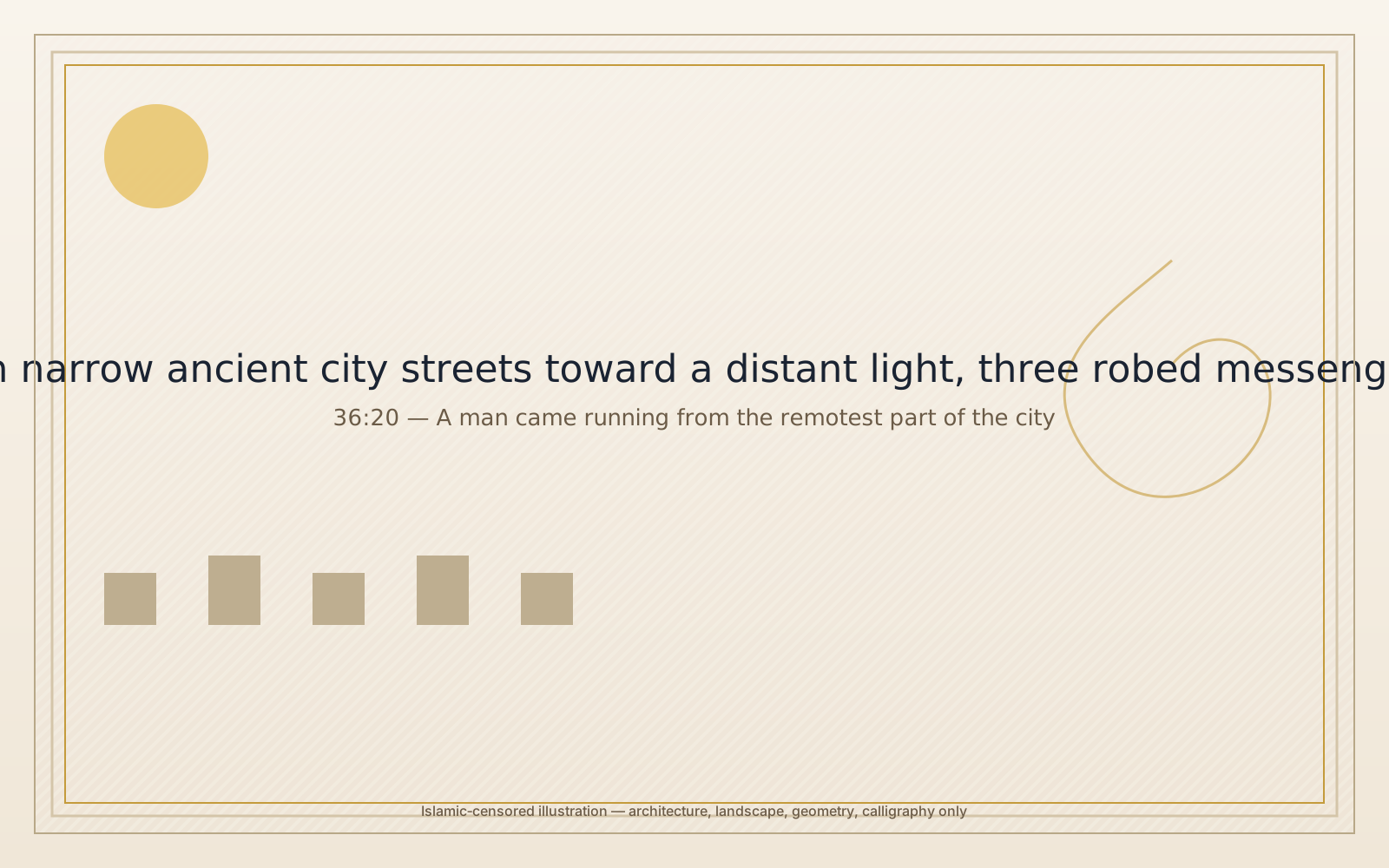
A lone figure running through narrow ancient city streets toward a distant light, three robed messengers standing at the city gates
36:20 — A man came running from the remotest part of the city

There is a surah the Prophet Muhammad, peace be upon him, called the Heart of the Quran. Not the longest, not the most legally detailed, not the most historically sweeping — but the heart. The organ without which the body cannot live. For fourteen centuries, Muslims have recited Ya-Sin over the dying, whispered it at gravesides, returned to it every Friday as though its eighty-three verses contain something the rest of the Quran concentrates but does not replace. They are right. Ya-Sin is the Quran's argument for resurrection compressed into a single sitting — and it makes that argument not through theology alone, but through narrative, through nature, through the testimony of sealed mouths and speaking hands, and through a final declaration so absolute it needs only two syllables: Be.

“His command, when He wills a thing, is to say to it, 'Be,' and it is.”
— God 36:82
Spiritual Barometer
Force
strong
Tone
compassionate
Urgency
urgent

The Daily Revelation Edition 36

Lead Report

THE OATH AND THE CHARGE: Muhammad Confirmed as Messenger in the Surah's Opening Salvo

Ya-Sin.

Two letters. No one knows what they mean. Fourteen centuries of scholarship — lexicographic, mystical, mathematical, phonetic — and the opening of the Quran's heart remains locked. Some classical scholars suggested the letters are an abbreviation for Ya Insan — O Human. Others proposed they are a divine name. The Quran itself offers no commentary. The mystery is, perhaps, the point: the surah that will make the most forceful case for God's knowable power begins by reminding us that some knowledge belongs to God alone.

What follows the mystery, however, is certainty — absolute and uncompromising.

"By the Wise Quran. You are one of the messengers. On a straight path. The revelation of the Almighty, the Merciful" 36:2-5. In four verses, God swears by the Quran itself, confirms Muhammad's prophethood, certifies his guidance, and identifies the source of revelation. There is no preamble, no narrative softening, no gradual approach. This is a legal declaration — sworn testimony with the scripture itself as witness.

The tone is defensive, and for good reason. The Meccan establishment had spent years arguing that Muhammad was a poet, a madman, a fabricator. Ya-Sin does not engage with those accusations. It overrides them. The oath structure — by the Wise Quran — places the argument beyond the reach of human arbitration. God is not asking Quraysh to evaluate Muhammad's claim. He is informing them it is settled.

And then, in a passage of devastating psychological precision, God explains why the message is not reaching them: "We have placed shackles around their necks, up to their chins, so they are stiff-necked. And We have placed a barrier in front of them, and a barrier behind them, and We have covered them, so they cannot see" 36:8-9. This is not a description of punishment. It is a diagnosis of self-inflicted blindness — the spiritual condition of people who have so thoroughly committed to denial that perception itself has been compromised.

The surah's opening twelve verses establish a binary that will govern everything that follows: those who heed the warning, and those who are beyond its reach. "You can only warn him who follows the Reminder, and fears the Most Gracious in secret" 36:11. The message is not indiscriminate. It finds those who are already searching. And the rest — shackled by their own choices — walk through a world saturated with signs and see nothing at all.

Then comes the line that sets the cosmic stakes: "We will revive the dead; and We write down what they have forwarded, and their traces. Everything We have counted in a Clear Record" 36:12. This is the thesis statement of Ya-Sin. Everything that follows — the parable, the signs, the trumpet, the testimony, the command — is an argument for this single claim: the dead will live again, and nothing is lost.

36:1 36:2 36:3 36:4 36:5 36:6 36:7 36:8 36:9 36:10 36:11 36:12

The Daily Revelation Edition 36

World News

THE MAN WHO RAN: An Anonymous Believer Sprints from the Edge of Town — Straight into Paradise

He has no name. No lineage. No title. No army, no wealth, no social standing. He comes from the remotest part of the city — the outskirts, the margins, the place where those who do not matter are expected to stay.

And he runs.

In what may be the most electrifying act of individual courage in the entire Quran, an unnamed man — identified in classical commentary as Habib al-Najjar, the carpenter — hears that his city has rejected and threatened three messengers of God, and he does the one thing no one expected. He does not send a message. He does not convene a meeting. He does not weigh the political consequences. He runs toward the danger.

The parable begins with the city itself. God sends two messengers. The people reject them. God reinforces them with a third. The city's response is contemptuous: "You are nothing but human beings like us, and the Most Gracious has not sent down anything. You are only lying" 36:15. The messengers push back — "Our Lord knows that we are messengers to you. And our only duty is clear communication" 36:16-17 — but the townspeople escalate to threats of stoning and torture 36:18.

This is the moment the unnamed man enters the narrative. Not from the centre of power, not from the religious establishment, not from the educated elite — but from the outskirts. The Quran's word is aqsa — the furthest, the most remote. He is a man from the margins, and he is running.

"O my people, follow the messengers. Follow those who ask you of no wage, and are themselves guided" 36:20-21. His argument is devastating in its simplicity. He does not engage in theology. He does not cite miracles. He points to economics: these men are not charging you anything. And he points to evidence: they are themselves guided. If their message were false, what would they gain from delivering it?

Then he makes it personal. He pivots from advocacy to testimony: "And why should I not worship Him who created me, and to Whom you will be returned?" 36:22. He is no longer arguing on the messengers' behalf. He is confessing his own faith, publicly, in front of a mob that has already promised violence to the messengers he is defending.

He knows exactly what will happen to him. The Quran does not narrate the act of his killing — it cuts directly to the aftermath, which is the real story.

"It was said, 'Enter Paradise.' He said, 'If only my people knew. How my Lord has forgiven me, and made me one of the honoured'" 36:26-27.

Read that again. He has just been killed. He has just entered Paradise. And his first thought — his first utterance in eternity — is not relief, not celebration, not vindication. It is grief for the people who killed him. If only my people knew. He does not say: if only my people had listened. He does not say: if only they could see what they have done. He says: if only they knew what they are missing. His compassion survives his own murder.

This is the Quran's model of moral courage: anonymous, marginal, uncompensated, fatal, and defined by love for the very community that destroyed him. He is not named because the point is not who he was. The point is what he did. And what he did is available to anyone, from any outskirt, in any age.

The city's fate, by contrast, is sealed in a single verse: "It only took one Shout, and they were stilled" 36:29. The civilisation that killed the man from the margins was extinguished by a sound. He entered eternity. They entered silence.

36:13 36:14 36:15 36:16 36:17 36:18 36:19 36:20 36:21 36:22 36:23 36:24 36:25 36:26 36:27 36:28 36:29 36:30

The Daily Revelation Edition 36

Science & Creation

EVIDENCE WRITTEN IN THE EARTH: Dead Ground, Dark Night, and the Ark that Carries Civilisation

If the parable of the three messengers is Ya-Sin's human argument for God's power, the passage that follows is its material one. Beginning at verse 33, God turns from narrative to nature — and constructs a case for resurrection so systematic it reads like a scientific brief filed before the court of human reason.

The first exhibit is the earth itself.

"A sign for them is the dead land: We give it life, and produce from it grains from which they eat" 36:33. The logic is compressed but total. You have watched dead ground come alive every season of your life. You have eaten the proof of resurrection with every meal. The seed is buried in soil — a kind of grave — and from that burial comes life. If God does this to grain, year after year, before your eyes, on what basis do you declare human resurrection impossible?

The Quran then expands the frame. Gardens of palms and vines, springs flowing from the earth, fruits produced in abundance — "so that they may eat of its fruit, though their hands did not make it. Will they not give thanks?" 36:35. The agricultural economy of Mecca and Medina was entirely dependent on these cycles. Every date palm was a standing argument for the claim Ya-Sin was making.

Then the language lifts from terrestrial to cosmic: "Glory be to Him who created all the pairs; of what the earth produces, and of their own selves, and of what they do not know" 36:36. The verse is remarkable for what it claims. Pairing — the duality that modern biology confirms at every level from subatomic particles to sexual reproduction — is presented not as a discovery but as a signature. And the final phrase — and of what they do not know — extends the claim beyond seventh-century knowledge into every future century's discoveries. The Quran is not cataloguing what was known. It is predicting what would be found.

The passage then moves to the sky. "And a sign for them is the night: We strip the day from it, and they are in darkness" 36:37. The verb is naslakhu — to strip, to peel away, as one peels skin from an animal. Daylight is not switched off. It is removed, layer by layer, revealing the darkness that was always underneath. This is not poetry substituting for science. It is a phenomenological description of sunset so precise that the metaphor and the physics converge.

The sun runs to its resting-place — "That is the determination of the Almighty, the All-Knowing" 36:38. The moon follows measured phases — "until it returns like an old palm-stalk" 36:39. The image of the crescent moon as a dried, curved palm branch is one of the Quran's most celebrated natural metaphors — a comparison so visually exact that any Meccan farmer would recognise it instantly. And then the governing principle: "Neither can the sun overtake the moon, nor does the night outpace the day. Each floats in an orbit" 36:40. Cosmic order is not chaos restrained. It is precision designed.

The final sign is the ark — not a specific vessel but the principle of seafaring itself. "A sign for them is that We carried their offspring in the laden Ark. And We created for them the likes of it, in which they ride" 36:41-42. The reference reaches back to Nuh and forward to every ship that has ever sailed. Human civilisation travels on water because God made it possible. And — the warning is unmistakable — "If We will, We can drown them, with no one to hear their screams, and they will not be saved" 36:43. The sea that carries you can consume you. The gift contains the reminder.

Every sign points to the same conclusion: the God who revives dead earth, who cycles night through day, who holds the sun and moon in calibrated orbits, who carries civilisation across oceans — that God is not incapable of reviving the dead. The evidence is not hidden. It is the world you live in.

36:33 36:34 36:35 36:36 36:37 36:38 36:39 36:40 36:41 36:42 36:43 36:44 36:45 36:46 36:47

The Daily Revelation Edition 36

Investigative Report

THE TRUMPET AND THE TESTIMONY: When Bodies Betray Their Owners on Judgment Day

The transition is sudden. One moment the Quran is describing the cosmic order — sun, moon, orbits, oceans. The next, a trumpet sounds, and the order is finished.

"All they can expect is a single blast, which will seize them while they feud. They will not be able to make a will, nor will they return to their families" 36:49-50. The end of the world arrives not at a moment of readiness but at a moment of distraction. They are feuding — arguing over property, status, grievance — when the blast arrives. They cannot make a will. They cannot say goodbye. The mundane and the apocalyptic collide in a single second.

Then the second trumpet: "The Trumpet will be blown, and at once they will rush from the tombs to their Lord" 36:51. The verb is yansilun — to slide rapidly, to pour out. Not a dignified rising but a chaotic emergence. And their first words upon waking are the surah's most psychologically devastating passage:

"They will say, 'Woe to us! Who resurrected us from our resting-place? This is what the Most Gracious had promised; the messengers spoke the truth'" 36:52.

Analyse the psychology of that statement. They call the grave a resting-place — a marqad. Even in death, they had found comfort. And now they are ripped from it, and in the first moment of resurrected consciousness, before they can construct a defence or a denial, the truth escapes their mouths involuntarily: the messengers spoke the truth. The acknowledgment they refused in life is extracted from them by the sheer force of reality in death.

Judgment proceeds with surgical precision. "On that Day, no soul will be wronged in the least, and you will be recompensed only for what you used to do" 36:54. The Quran's eschatological court is not arbitrary. It is forensic. And the evidence is about to become extraordinary.

The believers are described first — briefly, almost casually: "The inhabitants of Paradise, on that Day, will be busy in joyful celebration" 36:55. They are reclining in shade, on couches, with fruit, receiving peace from a Merciful Lord 36:56-58. The description is brief because their case is settled. They submitted. They arrived. Joy requires no cross-examination.

Then God turns to the accused, and what follows is one of the most chilling passages in all of scripture.

"Step aside, you criminals, today" 36:59. The segregation is physical. The guilty are separated. And God addresses them directly: "Did I not covenant with you, O Children of Adam, that you shall not serve the devil — for he is your open enemy? And that you shall serve Me? This is a straight path. He has led astray a great multitude of you. Did you not understand?" 36:60-62.

The covenant is invoked. The warning was given. The enemy was identified by name. And still they followed him.

Then comes the testimony that renders defence impossible: "Today We seal their mouths, and their hands speak to Us, and their feet testify to what they used to earn" 36:65.

The mouths are sealed. The organs of speech — which spent a lifetime denying, deflecting, lying — are shut. And in their place, the body itself takes the stand. Hands speak. Feet testify. The limbs that carried out the deeds become the witnesses against the one who directed them. There is no lawyer who can argue against your own hands. There is no appeal when your feet confirm the prosecution's case.

This is eschatological forensics of the highest order. The Quran is not describing a court that relies on testimony, documentation, or witness recollection. It is describing a court where the evidence is the defendant — where the body, liberated from the soul's control, tells the truth the soul spent a lifetime suppressing.

"If We will, We can blind their eyes as they rush towards the path — but how would they see?" 36:66. The question is rhetorical and terrifying. If God can silence mouths and make hands speak, He can also blind the path itself. The faculties they took for granted are all on loan. Every sense, every limb, every capacity is a trust that can be revoked — and on that Day, will be called to account.

36:48 36:49 36:50 36:51 36:52 36:53 36:54 36:55 36:56 36:57 36:58 36:59 36:60 36:61 36:62 36:63 36:64 36:65 36:66 36:67

The Daily Revelation Edition 36

Philosophy & Theology

KUN FAYAKUN: The Two Syllables That Built the Universe

Every surah has a climax. Ya-Sin saves its for the final passage — and it is, by any measure, the most concentrated statement of divine power in the Quran.

The argument builds through confrontation. The disbelievers had posed what they considered an unanswerable challenge to resurrection: "He makes an example for Us, and he forgets his own creation. He says, 'Who will revive the bones, when they have decayed?'" 36:78. It is a reasonable question, if you assume the universe is governed by chemistry alone. Bones decay. Calcium dissolves. The molecular structure of a human being disperses into soil and water and air. Who reassembles what has been scattered to the atomic level?

God's answer does not engage with chemistry. It overrides it.

"Say, 'He who created them the first time will revive them. He has knowledge of every creation'" 36:79. The logic is elegant and irrefutable on its own terms: if the first creation was possible — if something came from nothing once — then recreation from something is a lesser feat, not a greater one. The objection to resurrection assumes that the initial creation was easy and the repetition is hard. God inverts the assumption. The hard part is already done. You are the proof.

Then the evidence intensifies: "He who made for you fire from the green tree — and you kindle from it" 36:80. The verse is a miracle of compression. A living, green, water-filled tree produces fire — an apparent contradiction that nature resolves through the chemistry of combustion. If the God who engineered fire from wet wood is challenged by the concept of life from dry bones, the challenger has misunderstood the scale of the power they are questioning.

The penultimate argument is cosmological: "Is not He who created the heavens and the earth able to create the likes of them? Yes, and He is the Supreme Creator, the All-Knowing" 36:81. The heavens and the earth — the entirety of the observable universe — were created. A human body is infinitesimally smaller than the cosmos that contains it. If the macro was possible, the micro is trivial.

And then the surah delivers its final verse — the line that generations of Muslims have memorised, chanted, wept over, and carried into battle, into exile, into prayer, into death:

"His command, when He wills a thing, is to say to it, 'Be,' and it is" 36:82.

Kun fayakun.

Two syllables in Arabic. Be. And it is. The entire apparatus of the universe — its physics, its biology, its chemistry, its temporality — collapses into a single act of divine speech. Creation is not labour. It is not process. It is not evolution or engineering or trial and error. It is a word. One word. And the word is sufficient.

The theological implications are staggering. If creation is verbal — if the universe exists because God spoke it into existence — then the laws of nature are not constraints on God's power. They are expressions of it. Gravity is not a limit. It is a sentence in an ongoing utterance. Time is not a cage. It is a clause in a speech act that precedes it. And resurrection — the reassembly of scattered bones, the rekindling of extinguished consciousness, the restoration of a self that has dissolved into the earth — is not a problem to be solved. It is a word to be spoken.

Ya-Sin began with mystery — two unexplained letters. It ends with absolute clarity: two syllables that explain everything. Kun fayakun. Be, and it is. The heart of the Quran beats with the rhythm of divine command, and that rhythm has no beginning and no end.

The surah's final verse is the period at the end of the sentence, and it is the most clarifying statement of faith: "So glory be to Him in whose hand is the dominion of all things, and to whom you will be returned" 36:83. Return. Not arrival — return. You came from God. You will go back to God. Everything between those two points is a brief, brilliant, borrowed life, lived in a universe that exists because its Creator said one word.

36:68 36:69 36:70 36:71 36:72 36:73 36:74 36:75 36:76 36:77 36:78 36:79 36:80 36:81 36:82 36:83

The Daily Revelation Edition 36

Opinion

THE COVENANT BROKEN: Why God Asks Adam's Children to Answer for Their Father's Warning

Buried in the Judgment Day passage of Ya-Sin is a question that reverberates far beyond eschatology and into the foundational theology of human accountability.

"Did I not covenant with you, O Children of Adam, that you shall not serve the devil — for he is your open enemy? And that you shall serve Me? This is a straight path" 36:60-61.

God is addressing humanity collectively — not a specific nation, not a particular generation, not the followers of any single prophet. Children of Adam. All of us. And He invokes a covenant — a pre-existing agreement, a contract that precedes individual lives and individual choices.

The concept is extraordinary. In the Quranic worldview, human beings are not born into a moral vacuum and left to discover truth through reason or culture or accident. They are born into a covenant. The terms were set before history began: do not follow the adversary who was identified as your enemy from the start; follow instead the path of the One who created you. The straight path is not a discovery. It is a reminder. The truth is not found. It is recalled.

This is why the Quran describes its own function as dhikr — remembrance. Not new information but recovered information. Not revelation in the sense of unveiling something previously hidden, but revelation in the sense of restoring what was always known and strategically forgotten.

Iblis appears in Ya-Sin not as a dramatic villain but as a statistical reality: "He has led astray a great multitude of you. Did you not understand?" 36:62. The question is almost exasperated. The enemy was named. The warning was delivered. The covenant was clear. And still — still — a great multitude followed the one they were explicitly told was their adversary.

The passage forces a confrontation with the most uncomfortable dimension of accountability: the impossibility of claiming ignorance. In the Quranic court, the defence of I did not know is inadmissible — not because it is disproven, but because the covenant makes it irrelevant. You were told. You were told before you were born. You were told through every prophet, every scripture, every sign in creation, and through the innate moral faculty the Quran calls fitra. The question on Judgment Day is not whether you knew. It is what you did with what you could not possibly not know.

This is the theological weight behind Ya-Sin's Judgment sequence. The hands testify because the mouth — the organ of denial — has been disqualified. The body speaks because the soul has spent a lifetime lying. And the covenant is invoked because it removes the last refuge of the guilty: the claim that they were never warned.

They were warned. We were warned. Ya-Sin is the warning.

36:59 36:60 36:61 36:62

The Daily Revelation Editorial Edition 36

✸ ✸ ✸

Letter from the Editor: Why This Is the Surah We Read Over the Dying

Of all the traditions surrounding the Quran, few are as universally practised as the recitation of Ya-Sin for the dying. Across continents, across centuries, across every school of Islamic thought, this surah is the one that accompanies the final moments of human life. The tradition is attributed to the Prophet Muhammad himself: "Recite Ya-Sin over your dying."

Why this surah? Why not Al-Fatiha, the opening? Why not Al-Ikhlas, the declaration of God's oneness? Why not any of the surahs that deal more explicitly with death, burial, or the afterlife?

Because Ya-Sin does something none of those surahs do. It makes the complete argument.

It begins with an oath that the Quran is true and Muhammad is a messenger — the foundational creed. It tells the story of a man who died for his faith and entered Paradise immediately — the best possible precedent for someone about to die. It catalogues the signs of God in creation — reminding the departing soul that the world it is leaving was never random, never purposeless, never ungoverned. It describes the trumpet, the resurrection, the judgment — preparing the soul for what comes next. It addresses the Adamic covenant — reconnecting the dying person to the primordial agreement that preceded their earthly life. And it ends with kun fayakun — the assurance that the God who created them from nothing can certainly restore them from something.

Ya-Sin is, in eighty-three verses, the entire arc of existence: creation, warning, rejection, faith, martyrdom, signs, death, resurrection, judgment, paradise, and the power that governs all of it. It is not a chapter of the Quran. It is the Quran in miniature.

The man from the outskirts understood this. He ran toward the messengers not because he was brave — though he was — but because he understood that the truth was worth more than the life it would cost him. And his first words in Paradise were not about himself but about his people. Even in death, even in glory, his heart turned back toward those who were still alive, still ignorant, still capable of choosing differently.

That is why we read Ya-Sin over the dying. Because the dying are about to discover what the man from the outskirts already knew: that God's promise is true, that the messengers spoke the truth, and that the only question that matters — the one the dead will ask with bewildered recognition on the Day of Resurrection — is the one Ya-Sin has been answering all along:

Who will revive the bones, when they have decayed?

He who created them the first time.

Be. And it is.

For Reflection
If Ya-Sin is the surah that accompanies dying, what would it mean to live as though you had already heard it? What would change in your daily choices if you treated the covenant of verse 36:60 as a contract you signed and are currently executing?
Supplication
O Allah, when our time comes, let Ya-Sin be on the lips of those who love us and in the hearts of those we leave behind. Grant us the courage of the man who ran from the outskirts, the faith that survives the grave, and the mercy to think of others even as we enter Your presence. Let our hands testify to good, let our feet witness righteousness, and when You say 'Be' to our resurrection, let us rise among those You have honoured. Ameen.
✸ ✸ ✸

The Daily Revelation Back Page Edition 36

Today's Action
Recite or read Surah Ya-Sin today — all eighty-three verses. If you have never read it, begin now. If you have read it a thousand times, read it as if you are the man from the outskirts, hearing the truth for the first time and deciding whether to run toward it.
Weekly Challenge
Identify one truth you know but have been avoiding acting on — a kindness you have delayed, an injustice you have tolerated, a spiritual obligation you have postponed. The man from the outskirts did not have a committee meeting. He ran. Choose one thing this week and run toward it.
Related Editions
Edition 2 The Adamic covenant and Iblis's refusal — the backstory to the covenant invoked in 36:60-62
Edition 7 The pre-temporal covenant: 'Am I not your Lord?' — the original agreement Ya-Sin holds humanity to
Edition 11 Earlier communities destroyed after rejecting messengers — the pattern Ya-Sin's parable follows
Edition 23 Resurrection and accountability — parallel Judgment Day sequences
Edition 55 God's signs in creation catalogued at length — the cosmic evidence brief expanded
Edition 67 Another Meccan surah on creation, death, and resurrection — companion reading to Ya-Sin
Characters in This Edition
Allah Muhammad The Man from the Outskirts The Three Messengers Disbelievers Believers Iblis Adam Nuh Israfil Mankind Children of Adam
Coming Next
NEXT EDITION: Surah As-Saffat — The angels stand in ranks, the stars become missiles against eavesdropping jinn, and Ibrahim faces the most impossible command a father has ever received: sacrifice your son. The covenant tested at its most extreme.
Page 1 of 9
Ed. 35 Ed. 37