Edition 7 of 114 Mecca Bureau 206 Verses

The Daily Revelation

Revelation. Reported. Truth.
الأعراف

Al-A'raf — The Heights
Force: Strong Tone: Warning Urgency: Important

THE HEIGHTS: Five Civilisations Destroyed, One Devil's Oath, and the Mountain That Turned to Dust

The Quran's most sweeping epic — spanning the creation of Adam, the expulsion from Paradise, Iblis's vow to waylay humanity, the annihilation of five defiant nations, and the longest account of Moses versus Pharaoh — culminates in a single verse that contains the widest promise in all of scripture: 'My mercy encompasses all things'


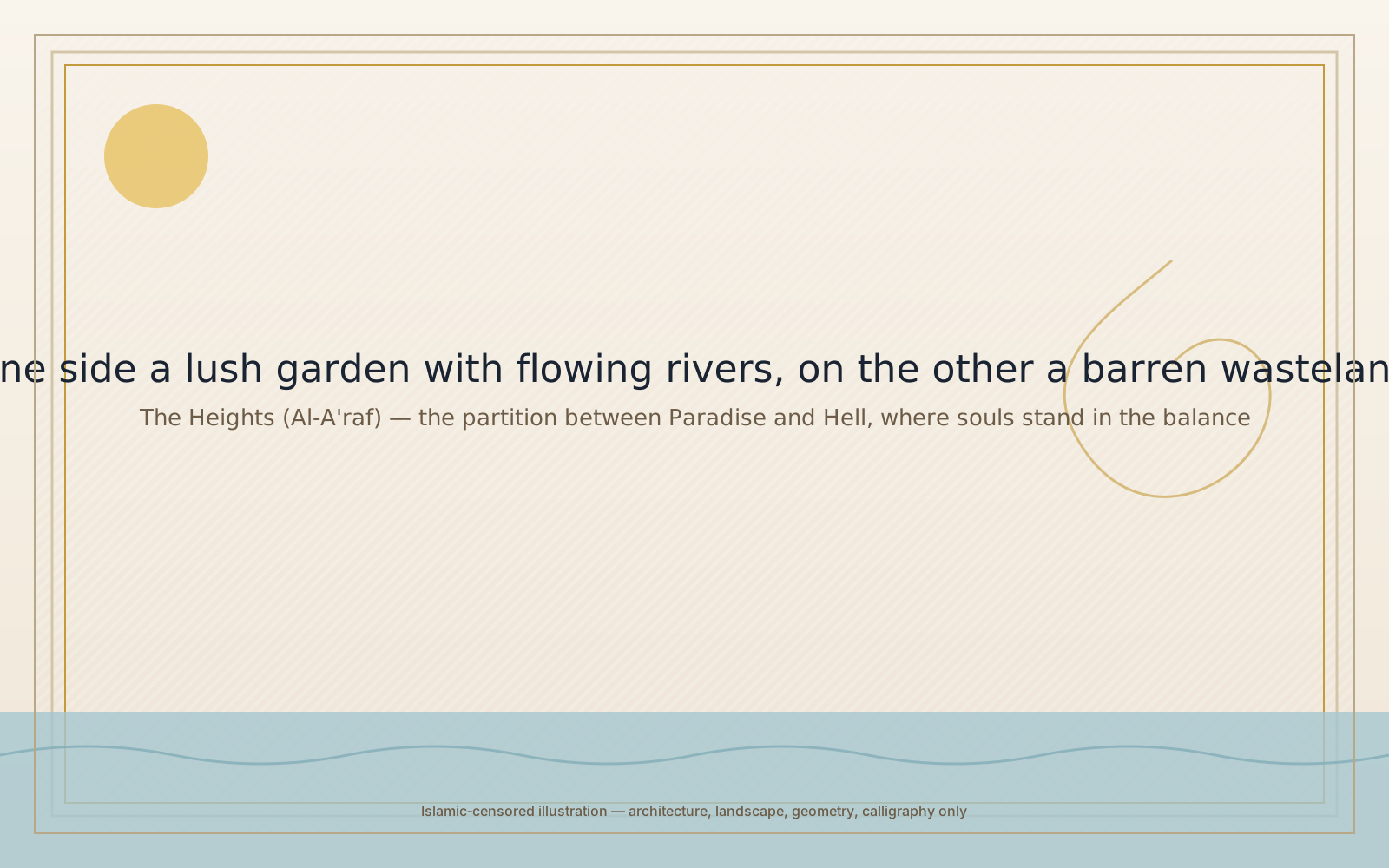
A vast cosmic landscape split in two — on one side a lush garden with flowing rivers, on the other a barren wasteland of ruined cities, with a towering wall between them where shadowed figures stand watching both sides
The Heights (Al-A'raf) — the partition between Paradise and Hell, where souls stand in the balance

It begins before history. Before the first city, the first civilisation, the first human footprint on earth. It begins with God moulding a shape from clay and commanding every angel in existence to bow before it. They all obeyed — except one. 'I am better than he,' the dissenter declared. 'You created me from fire, and You created him from mud' (7:12). That single sentence of cosmic arrogance set the terms for everything that would follow: every temptation, every fallen nation, every prophet sent and rejected, every civilisation reduced to rubble. Surah Al-A'raf — The Heights — is the Quran's grand chronicle of that war. Across 206 verses, it moves from the Garden of Eden to the ruins of five destroyed peoples, from the staff of Moses turning into a serpent to a mountain disintegrating at God's manifestation. It names forty-one characters. It records ninety-eight direct speeches. And at its centre stands the most haunting image in Islamic eschatology: a group of souls on a barrier between Heaven and Hell, recognising the inhabitants of both, belonging to neither, waiting.

“My punishment—I inflict it upon whomever I will, but My mercy encompasses all things.”
— God 7:156
Spiritual Barometer
Force
strong
Tone
warning
Urgency
important

The Daily Revelation Edition 7

Cosmic Affairs

'I AM BETTER THAN HE': The First Act of Defiance in Creation — and the Oath That Launched a War on Humanity

Before there was a single human being on earth, there was a rebellion in heaven.

God created Adam. He shaped him, formed him, breathed life into him. And then He issued a command to every being in the celestial assembly: "Bow down before Adam" 7:11. The angels complied. Every last one of them — beings of pure light, fashioned for obedience — fell into prostration before this creature made of mud. Every one, except Iblis.

God's question was direct: "What prevented you from bowing down when I have commanded you?" 7:12. The answer was not confusion. It was not hesitation. It was ideology: "I am better than he; You created me from fire, and You created him from mud." In a single sentence, Iblis invented racism — the conviction that one's origin material determines one's worth. Fire is superior to clay. I am superior to him. Therefore I am exempt from Your command.

God's response was immediate and absolute: "Get down from it! It is not for you to act arrogantly in it. Get out! You are one of the lowly!" 7:13. The being who claimed superiority was declared lowly. The hierarchy he invented was inverted on the spot.

But Iblis did not leave quietly. He negotiated. "Give me respite, until the Day they are resurrected" 7:14. He asked for time — not to repent, but to wage war. And God granted it: "You are of those given respite" 7:15. What followed was the most consequential oath in the history of creation.

"Because you have lured me, I will waylay them on Your straight path. Then I will come at them from before them, and from behind them, and from their right, and from their left; and you will not find most of them appreciative" 7:16-17. Four directions. Total siege. Not a flanking manoeuvre but an encirclement. Iblis declared that he would attack humanity from every conceivable angle — their future anxieties (before them), their past regrets (behind them), their worldly temptations (right and left). And his prediction was devastating in its confidence: most of them would fall.

God did not dispute the prediction. He accepted the terms: "Get out of it, despised and vanquished. Whoever among them follows you — I will fill up Hell with you all" 7:18. The war was declared. The battlefield would be every human heart from Adam to the last person standing on the Day of Judgement. And both sides knew the stakes from the beginning.

What makes this exchange so psychologically devastating is the motive Iblis declared. He did not claim to hate Adam. He did not accuse God of injustice. He said he was better. Pride — not grievance, not rebellion for a cause, but raw, elemental arrogance — was the original sin. Before Adam touched the forbidden tree, before the first human lie or murder, there was Iblis looking at a creature and declaring himself its superior based on nothing but the material he was made from.

The Quran places this scene at the opening of its longest narrative surah for a reason. Everything that follows — the fall from the Garden, the destroyed nations, the rejection of every prophet — is a variation on this single theme. Pride that refuses to submit. Arrogance that overrides evidence. The creature that looks at another creature and says: I am better.

7:11 7:12 7:13 7:14 7:15 7:16 7:17 7:18

The Daily Revelation Edition 7

Origins

THE FALL: How Adam and Hawwa Lost Paradise — and How Their Prayer Became Humanity's First Lesson in Repentance

The setup was perfect. Paradise. Two inhabitants. One prohibition. And one enemy with an eternity's worth of resentment and a freshly sworn oath to destroy them.

God placed Adam and his wife in the Garden with a single restriction: "Inhabit the Garden, you and your wife, and eat whatever you wish; but do not approach this tree, lest you become sinners" 7:19. The instruction was not complicated. The entire Garden was permitted. One tree was not. The boundary was clear, the consequence stated.

Iblis came not with force but with whispers. The Quran uses the verb waswasa — to whisper repeatedly, to insinuate — suggesting not a single bold temptation but a sustained campaign of suggestion. His strategy was brilliant in its inversion: he told them the forbidden tree was forbidden for their benefit. "Your Lord has only forbidden you this tree, lest you become angels, or become immortals" 7:20. The lie reframed God's prohibition as God's selfishness — as if the Creator was hoarding something from His creation.

And then the detail that elevates this from myth to psychological portrait: "And he swore to them, 'I am a sincere advisor to you'" 7:21. He did not merely suggest. He took an oath. The first lie in creation was delivered under the cover of sincerity. The being who had just vowed to destroy humanity presented himself as humanity's well-wisher.

"So he lured them with deceit" 7:22. The Arabic word is dalla — he brought them down, step by step, through false promises. And the moment they tasted the tree, the illusion shattered: "Their nakedness became evident to them, and they began covering themselves with the leaves of the Garden" 7:22. The exposure was immediate. What had been invisible — their vulnerability, their physical form — was suddenly, shamefully apparent. The first consequence of disobedience was not punishment. It was self-awareness of a kind they had never known: the awareness of being exposed.

God's voice came: "Did I not forbid you from this tree, and say to you that Satan is a sworn enemy to you?" 7:22. Not rage. A question. A reminder that the warning had been given and ignored.

What Adam and Hawwa said next became the template for every act of repentance in human history: "Our Lord, we have done wrong to ourselves. Unless You forgive us, and have mercy on us, we will be among the losers" 7:23. No deflection. No blaming the serpent, no claiming entrapment. They owned the failure completely — we have done wrong to ourselves. The acknowledgement was total and the appeal was direct: forgive us or we are lost.

Compare this to Iblis's response when confronted. He blamed God: "Because you have lured me" 7:16. Adam blamed himself. Iblis demanded respite to wage war. Adam asked for mercy. The entire moral architecture of the Quran rests on this distinction. Both sinned. One repented. One doubled down. The difference between damnation and redemption is not the absence of failure — it is the response to failure.

The descent was ordered: "Fall, some of you enemies to one another. On earth you will have residence and livelihood for a while" 7:24. And then the provision — because even in exile, God clothed them: "O children of Adam! We have provided you with clothing to cover your bodies, and for luxury. But the clothing of piety — that is best" 7:26. The physical garments replace the leaves they had clutched in shame. But the real covering, the Quran insists, is not fabric. It is taqwa — God-consciousness. The garment that cannot be stripped away.

The warning that closes the scene is addressed not to Adam but to all his descendants: "O Children of Adam! Do not let Satan seduce you, as he drove your parents out of the Garden, stripping them of their garments, to show them their nakedness. He sees you, him and his clan, from where you cannot see them" 7:27. The asymmetry is the horror: they can see us, and we cannot see them. The war Iblis declared is being fought on terms where one side is invisible.

7:19 7:20 7:21 7:22 7:23 7:24 7:25 7:26 7:27

The Daily Revelation Edition 7

Special Report

THE PEOPLE ON THE WALL: Inside the Quran's Most Mysterious Afterlife — the Souls Who Belong to Neither Heaven Nor Hell

It is the image that gives this surah its name, and it is the most unsettling scene in all of Quranic eschatology. Between Paradise and the Fire, there is a wall. On top of that wall stand people. They can see both sides. They belong to neither.

"And between them is a partition, and on the Elevations are men who recognize everyone by their features" 7:46. The Arabic word is a'raf — the heights, the elevated places, the ridge between two valleys. These are not angels. They are not prophets. They are human souls, and they are stuck. Their deeds were not heavy enough to tip the scales toward Paradise, nor corrupt enough to plunge them into the Fire. They are the in-between — the souls whose moral ledger balanced to zero.

The scene unfolds in two directions. First, they look toward Paradise: "They will call to the inhabitants of the Garden, 'Peace be upon you.' They have not entered it, but they are hoping" 7:46. Peace upon you — the greeting of the blessed — spoken by those who are not yet blessed themselves. They hope. That word hangs in the verse like a thread over an abyss.

Then they look the other way: "And when their eyes are directed towards the inmates of the Fire, they will say, 'Our Lord, do not place us among the wrongdoing people'" 7:47. The hope that looked toward Paradise turns to terror when it faces the Fire. These are souls who can see their potential fate in both directions — and the vision of Hell is enough to make them pray with a desperation the people of Paradise no longer need.

But the people on the Heights are not merely observers. They are participants in a cosmic drama of recognition and judgement. "And the dwellers of the Elevations will call to men they recognize by their features, saying, 'Your hoardings did not avail you, nor did your arrogance'" 7:48. They see specific people in the Fire — people they knew, perhaps, in life — and they address them directly. Your wealth did not save you. Your pride did not elevate you. The people on the wall have clarity that those below them lacked.

Then comes the verse that scholars have debated for fourteen centuries: "Are these the ones you swore God will not touch with mercy?" The people on the Heights point to the inhabitants of Paradise and address the people of Hell with this question. Then, turning to those same humble souls now in Paradise, they say — or God says through them — "Enter the Garden; you have nothing to fear, and you will not grieve" 7:49. The ones the arrogant dismissed as unworthy are welcomed in. The ones who dismissed them are below, watching.

And then the final exchange — the most visceral in the Quran's afterlife literature: "The inmates of the Fire will call on the inhabitants of the Garden, 'Pour some water over us, or some of what God has provided for you.' They will say, 'God has forbidden them for the disbelievers'" 7:50. A request for water. From Hell. Denied. Not out of cruelty from the people of Paradise but because the provision of God — even water — has been withdrawn from those who rejected it in life.

Who are the people of the Heights? Classical scholars differ. Ibn Abbas said they are men whose good and bad deeds are exactly equal. Al-Hasan al-Basri suggested they are martyrs who went to war without their parents' permission — their sacrifice sufficient to escape Hell, their disobedience preventing full entry to Paradise. Others proposed they are the last group to be admitted to Paradise after a period of waiting. What every interpretation shares is the recognition that this is the Quran's most terrifying middle ground — a place where the soul has not failed completely but has not succeeded either. It is the afterlife's purgatory, and its residents are defined by a single, agonising quality: they can see what they are missing.

7:44 7:45 7:46 7:47 7:48 7:49 7:50 7:51 7:52 7:53

The Daily Revelation Edition 7

Dispatches from the Ruins

FIVE NATIONS, FIVE WARNINGS, FIVE DESTRUCTIONS: The Quran's Deadliest Pattern — and Why Every Civilisation Repeated It

The surah's middle section reads like a war correspondent's dispatches from five consecutive civilisational collapses. Each story follows the same architecture: a prophet arrives, warns his people, is mocked and rejected, and then annihilation comes. The repetition is not redundancy — it is the point. The pattern is the lesson.

I. The People of Nuh — The Flood

Nuh came to his people with the simplest possible message: "O my people! Worship God; you have no god other than Him. I fear for you the punishment of a tremendous Day" 7:59. The response from the elites was contempt: "We see that you are in obvious error" 7:60. Nuh did not retreat. He argued, reasoned, pleaded. He reminded them that he was "a messenger from the Lord of the Worlds" 7:61, that he knew from God "what you do not know" 7:62. They called him a liar. "So We saved him and those with him in the Ark, and We drowned those who rejected Our revelations. They were blind people" 7:64. The flood came. An entire civilisation vanished. The Quran's verdict is five words: they were blind people.

II. The People of Ad — The Wind

Their brother Hud came next. Same message: "Worship God; you have no god other than Him" 7:65. Same elite response: "We see foolishness in you, and we think that you are a liar" 7:66. Hud reminded them of their privilege — God had made them successors after Nuh's people, had "increased you greatly in stature" 7:69. The Ad were giants, builders of monuments, a civilisation of physical power. Their arrogance was proportional to their strength. They challenged Hud: "Then bring us what you threaten us with, if you are truthful" 7:70. The threat arrived. "So We saved him and those with him, by mercy from Us, and We cut off the roots of those who rejected Our revelations" 7:72. Cut off the roots. Total elimination. The giants who thought their stature made them invincible were erased from the earth.

III. The People of Thamud — The Earthquake

Salih came to Thamud — a civilisation of architects who carved mansions from mountains 7:74. Their sign was extraordinary: a she-camel, sent by God as a living miracle, to be left to graze freely on God's earth 7:73. The elites divided immediately. The arrogant faction told the believers: "Do you know that Saleh is sent from his Lord?" The believers answered: "We are believers in what he was sent with" 7:75. The arrogant replied: "We reject what you believe in" 7:76. Then they hamstrung the she-camel — they destroyed the miracle with their own hands — and taunted Salih: "Bring upon us what you threaten us with, if you are one of the messengers" 7:77. "Whereupon the quake overtook them, and they became lifeless bodies in their homes" 7:78. The mountain-carvers were buried by the mountains.

IV. The People of Lut — The Rain

Lut's people were the most explicitly condemned. "Do you commit lewdness no people anywhere have ever committed before you?" 7:80. Their response to moral rebuke was to threaten expulsion: "Expel them from your town; they are purist people" 7:82. Purity was mocked as a defect. The righteous were the ones who needed to leave. God saved Lut and his family — "except for his wife; she was of those who lagged behind" 7:83 — and then: "We rained down on them a rain; note the consequences for the sinners" 7:84. The rain was not water. It was destruction from the sky.

V. The People of Madyan — The Quake

Shuayb brought a different message — not only spiritual but economic. "Give full measure and weight, and do not cheat people out of their rights, and do not corrupt the land once it has been set right" 7:85. He warned against those who "lurk on every path, making threats and turning away from the path of God those who believe" 7:86. The pattern repeated: the arrogant elite threatened eviction 7:88. Shuayb's reply was defiant: "We would be fabricating falsehood against God, if we were to return to your religion, after God has saved us from it" 7:89. Then: "The quake struck them; and they became lifeless bodies in their homes" 7:91. And the Quran's epitaph for Madyan is haunting: "Those who rejected Shuaib — as if they never prospered therein" 7:92. As if they had never existed.

Five nations. Five prophets with essentially the same message. Five ruling classes that responded with mockery, threats, and violence. Five destructions by five different means — flood, wind, earthquake, celestial rain, earthquake again — as if God varied the instrument to prove that no force of nature was beyond His command, and no form of arrogance beyond His reach.

The surah then pauses and addresses the listener directly: "Had the people of the towns believed and turned righteous, We would have opened for them the blessings of the heaven and the earth; but they rejected the truth, so We seized them by what they were doing" 7:96. The destruction was not inevitable. It was chosen — chosen by the people who rejected every warning, every sign, every messenger sent to save them.

7:59 7:60 7:61 7:62 7:63 7:64 7:65 7:66 7:67 7:68 7:69 7:70 7:71 7:72 7:73 7:74 7:75 7:76 7:77 7:78 7:79 7:80 7:81 7:82 7:83 7:84 7:85 7:86 7:87 7:88 7:89 7:90 7:91 7:92 7:93 7:96 7:97 7:98 7:99 7:100 7:101 7:102

The Daily Revelation Edition 7

Power & Confrontation

SERPENT IN THE COURT: Moses Throws Down His Staff and Pharaoh's World Begins to Crack

The surah's longest and most dramatic sequence opens with a summary that reads like a war dispatch: "Then, after them, We sent Moses with Our miracles to Pharaoh and his establishment, but they denounced them. So consider the end of the evildoers" 7:103. Consider the end. The verdict is announced before the trial begins.

Moses entered Pharaoh's court not as a supplicant but as an emissary: "O Pharaoh, I am a messenger from the Lord of the Worlds" 7:104. The claim was audacious — a former fugitive from this very court, now standing before the most powerful ruler in the ancient world, declaring that his authority came from a Lord higher than Pharaoh. His demand was specific: "Let the Children of Israel go with me" 7:105.

Pharaoh demanded proof. "If you brought a miracle, then present it, if you are truthful" 7:106. What followed was one of the most iconic moments in prophetic history: "So he threw his staff, and it was an apparent serpent" 7:107. Not an illusion. Not a trick of light. An apparent serpent — visible, undeniable, terrifying. And then the second sign: "He pulled out his hand, and it was white to the onlookers" 7:108. Radiant, luminous, unmistakably supernatural.

Pharaoh's court responded not with wonder but with political calculus. The notables conferred: "This is really a skilled magician. He wants to evict you from your land" 7:109-110. The miracle was reframed as a power grab. The sign from God was rebranded as a political threat. Their solution: fight magic with magic. "Send heralds to the cities. And let them bring you every skillful magician" 7:111-112.

The magicians came. They were professionals — mercenaries of spectacle, loyal to whoever paid them. "Surely there is a reward for us, if we are the victors" 7:113. Pharaoh confirmed: "Yes, and you will be among my favorites" 7:114. The contest was set. The magicians threw first: "They beguiled the eyes of the people, and intimidated them, and produced a mighty magic" 7:116. The spectacle was real enough to terrify the crowd.

Then God spoke to Moses: "Throw your staff" 7:117. And Moses threw. "And at once, it swallowed what they were faking" 7:117. The serpent consumed every illusion. The truth devoured the spectacle. "So the truth came to pass, and what they were producing came to nothing. There they were defeated, and utterly reduced" 7:118-119.

What happened next was the most dramatic conversion scene in the Quran. The magicians — the professionals, the men who had come for a reward from Pharaoh — fell to their knees: "We have believed in the Lord of the Worlds. The Lord of Moses and Aaron" 7:121-122. They recognised the difference between their tricks and Moses's miracle instantly. Because they were experts. They knew what magic could do, and what had just happened was not magic.

Pharaoh's response was fury: "Did you believe in Him before I have given you permission? This is surely a conspiracy you schemed in the city" 7:123. He could not conceive of a conversion that was not political. If they switched sides, it must have been pre-arranged. And his threat was savage: "I will cut off your hands and your feet on opposite sides; then I will crucify you all" 7:124.

The magicians' reply is among the most courageous lines in all of scripture. Moments ago they were mercenaries. Now they were martyrs: "It is to our Lord that we will return. You are taking vengeance on us only because we have believed in the signs of our Lord when they have come to us" 7:125-126. And their prayer: "Our Lord! Pour out patience upon us, and receive our souls in submission." They asked not to be saved from death but to die well. The men who had entered the court seeking gold left it seeking God.

7:103 7:104 7:105 7:106 7:107 7:108 7:109 7:110 7:111 7:112 7:113 7:114 7:115 7:116 7:117 7:118 7:119 7:120 7:121 7:122 7:123 7:124 7:125 7:126

The Daily Revelation Edition 7

Crisis & Catastrophe

PLAGUES, PROMISES, AND BETRAYALS: The Nine Signs That Broke Egypt — and the Exodus That Followed

After the magicians' conversion, Pharaoh doubled down. His advisors whispered: "Will you let Moses and his people cause trouble in the land, and forsake you and your gods?" 7:127. His response was mass murder: "We will kill their sons, and spare their women. We have absolute power over them" 7:127. The same decree that had been in force when Moses was an infant — the systematic slaughter of Israelite boys — was reinstated.

Moses responded not with counter-violence but with theology. His counsel to the Children of Israel in their darkest hour is one of the surah's defining statements: "Seek help in God, and be patient. The earth belongs to God. He gives it in inheritance to whomever He wills of His servants, and the future belongs to the righteous" 7:128. The earth belongs to God — not to Pharaoh. The future belongs to the righteous — not to the powerful. It was a direct challenge to every assumption that held the Egyptian empire together.

The Israelites were not persuaded. "We were persecuted before you came to us, and after you came to us," they complained 7:129. Moses had not made things better — he had made them worse. His answer was a promise: "Perhaps your Lord will destroy your enemy, and make you successors in the land; then He will see how you behave." The promise came with a condition: succession was not guaranteed forever. It would depend on what they did with it.

Then came the plagues. Five catastrophes, each explicitly named: "So We let loose upon them the flood, and the locusts, and the lice, and the frogs, and blood — all explicit signs — but they were too arrogant. They were a sinful people" 7:133. The Quran does not dramatise each plague individually here — it lists them in a single devastating verse, as if the sheer accumulation of calamity was the point. Flood, locusts, lice, frogs, blood. Five ecological catastrophes, each one sufficient to humble a nation, all five insufficient to humble Pharaoh.

Instead, a cycle of bad faith emerged: "Whenever a plague befell them, they would say, 'O Moses, pray to your Lord for us, according to the covenant He made with you. If you lift the plague from us, we will believe in you, and let the Children of Israel go with you'" 7:134. And every time: "But when We lifted the plague from them, for a term they were to fulfill, they broke their promise" 7:135. The pattern — suffering, begging, promise, relief, betrayal — repeated with each plague. Egypt's Pharaoh was not merely stubborn. He was pathological. He made the same promise and broke it five times.

The end came in the sea: "So We took vengeance on them, and drowned them in the sea — because they rejected Our signs, and paid no heed to them" 7:136. And the inheritance Moses had promised was fulfilled: "We made the oppressed people inherit the eastern and western parts of the land, which We had blessed" 7:137. The slaves became the inheritors. The oppressed took the land of the oppressors. And the Quran adds a final epitaph for Pharaoh's civilisation: "We destroyed what Pharaoh and his people had built, and what they had harvested." Everything — the monuments, the granaries, the infrastructure of empire — erased. As if Pharaoh had never built anything at all.

7:127 7:128 7:129 7:130 7:131 7:132 7:133 7:134 7:135 7:136 7:137

The Daily Revelation Edition 7

Faith & Crisis

THE GOLDEN CALF AND THE SHATTERED TABLETS: How the Children of Israel Betrayed Moses Before the Ink Was Dry

The liberation was barely complete when the betrayal began. The Children of Israel had watched the sea part, had walked on dry ground between walls of water, had seen Pharaoh's army swallowed behind them. And within weeks, they were worshipping a statue made from their own jewellery.

The trouble started almost immediately after the crossing. "When they came upon a people who were devoted to some statues of theirs, they said, 'O Moses, make for us a god, as they have gods'" 7:138. They had just been delivered from the greatest idolater in history — and their first request upon freedom was for an idol of their own. Moses was incredulous: "You are truly an ignorant people" 7:138. Then, with devastating clarity: "Shall I seek for you a god other than God, when He has favored you over all other people?" 7:140.

God then summoned Moses to the mountain for forty nights — thirty originally, completed with ten more 7:142. Moses left his brother Harun in charge with clear instructions: "Take my place among my people, and be upright, and do not follow the way of the mischief-makers" 7:142. He climbed the mountain for the most intimate encounter between God and a human being in the entire Quran.

What happened on that mountain defies description — and the Quran barely attempts it. "And when Moses came to Our appointment, and his Lord spoke to him, he said, 'My Lord, allow me to look and see You'" 7:143. Moses, having heard the voice of God, wanted to see the face. The answer was compassionate in its impossibility: "You will not see Me, but look at the mountain; if it stays in its place, you will see Me."

"But when his Lord manifested Himself to the mountain, He turned it into dust, and Moses fell down unconscious" 7:143. A mountain — solid rock, millions of tonnes of stone — was reduced to powder by a fraction of divine manifestation. And the prophet who had faced Pharaoh without flinching collapsed. When he recovered, his words were pure theology: "Glory be to you, I repent to you, and I am the first of the believers" 7:143.

God gave Moses the Tablets — "all kinds of enlightenments, and decisive explanation of all things" 7:145 — and told him to hold fast to them and teach his people. But while Moses was on the mountain receiving divine law, his people were below him destroying it.

"In his absence, the people of Moses adopted a calf made from their ornaments — a body which lowed" 7:148. They had melted down their gold jewellery and fashioned a calf that made sounds. The Quran's contempt is precise: "Did they not see that it could not speak to them, nor guide them in any way?" 7:148. It could low — like an animal — but it could not speak. It could attract worship but it could not guide.

When Moses returned, his fury was volcanic: "What an awful thing you did in my absence. Did you forsake the commandments of your Lord so hastily?" 7:150. He threw down the Tablets — the divine law itself, inscribed by God, shattered on the ground in a prophet's rage. He seized his brother by the head and dragged him toward himself. Harun's defence was desperate: "The people have overpowered me, and were about to kill me" 7:150.

Moses's prayer in the aftermath revealed the depth of his anguish: "My Lord, forgive me and my brother, and admit us into Your mercy; for you are the Most Merciful of the merciful" 7:151. He asked for forgiveness — for himself, for snapping in rage, and for Harun, for failing to prevent the catastrophe. When the anger subsided, he picked up the Tablets again: "In their transcript is guidance and mercy for those in awe of their Lord" 7:154. The law survived Moses's fury. The guidance endured beyond the crisis.

7:138 7:139 7:140 7:141 7:142 7:143 7:144 7:145 7:146 7:147 7:148 7:149 7:150 7:151 7:152 7:153 7:154 7:155

The Daily Revelation Edition 7

Theology

'MY MERCY ENCOMPASSES ALL THINGS': The Verse That Contains the Widest Promise in the Quran

It arrives in the middle of catastrophe. Moses has just confronted the golden calf. He has chosen seventy men from among his people for an appointment with God. An earthquake shakes them. Moses cries out: "My Lord, had You willed, You could have destroyed them before, and me too. Will you destroy us for what the fools among us have done? This is but Your test" 7:155. He is bargaining with God on behalf of a people who have just committed the worst possible sin — worshipping a statue while their prophet was on a mountain receiving divine law.

And then he makes the request: "And inscribe for us goodness in this world, and in the Hereafter. We have turned to You" 7:156. After everything — the rebellion, the calf, the shattered tablets — Moses still asks for goodness. He still believes it is available.

God's answer is the theological centre of this entire 206-verse surah. First, the warning: "My punishment — I inflict it upon whomever I will." God's justice is real. Consequences are real. Destruction is not theoretical — five nations in this very surah have already proved that. But then: "But My mercy encompasses all things" 7:156.

All things. Not most things. Not the things that deserve it. All things. The Arabic is wasi'at kulla shay' — My mercy has encompassed everything that exists. The scope is total. It includes the believers and the sinners, the faithful and the fallen, the people on the Heights who are still hoping, the descendants of the five destroyed nations who might yet repent. It includes the Children of Israel who built the golden calf. It includes the magicians who started the day as Pharaoh's mercenaries and ended it as martyrs. It includes Adam and Hawwa, naked and ashamed, clutching leaves in a Garden they were about to lose.

Scholars have noted that this verse accomplishes something extraordinary. It places mercy and punishment in the same sentence but gives them different grammatical structures. Punishment is specific: I inflict it upon whomever I will — selective, targeted, conditional. Mercy is universal: it encompasses all things — unbounded, preceding everything, the default state of the divine relationship with creation. The implication is not that punishment does not exist — the surah has just detailed five civilisational annihilations. The implication is that punishment is the exception and mercy is the rule.

God then specifies who will receive that mercy in its fullest form: "I will specify it for those who act righteously and practice regular charity, and those who believe in Our signs" 7:156. The mercy encompasses all things; its highest expression is reserved for those who respond to it. The door is open to everyone — but you must walk through it.

The verse that follows extends this mercy across time to its ultimate recipient: "Those who follow the Messenger, the Unlettered Prophet, whom they find mentioned in the Torah and the Gospel" 7:157. In the middle of the Moses narrative, the Quran pivots to Muhammad — the unlettered prophet who would come centuries later, connecting the Mosaic covenant to the final message. The mercy that encompasses all things finds its ultimate channel in the prophet who would be sent "to you all" 7:158 — not to one tribe, not to one nation, but to humanity entire.

This is why scholars call 7:156 the most hopeful verse in the Quran. Not because it denies consequences — the surah is built on consequences. But because it establishes that God's mercy is wider than God's wrath, that the default setting of the universe is compassion, and that no matter how far one has fallen — whether to the bottom of a golden-calf scandal or to the edge of the fire itself — the door of mercy remains open. My mercy encompasses all things. The question has never been whether mercy is available. The question is whether we will accept it.

7:155 7:156 7:157 7:158

The Daily Revelation Edition 7

Primordial Covenant

THE TESTIMONY BEFORE TIME: When Every Soul Testified to God — and Then Forgot

Near the end of the surah, after the cascade of prophetic narratives and destroyed civilisations, the Quran reveals something that happened before any of it — before Adam, before Iblis, before the Garden or the Fall. Something that happened before time itself.

"And when Your Lord summoned the descendants of Adam, and made them testify about themselves. 'Am I not your Lord?' They said, 'Yes, we testify'" 7:172.

The scene is staggering in its implications. Every human soul that would ever exist was gathered — drawn from Adam's loins, according to classical commentators — and asked a single question: Am I not your Lord? And every soul answered: Yes. The Arabic is bala shahidna — yes, we bear witness. Not mere agreement. Testimony. A legal and spiritual declaration, binding across all of time.

The Quran immediately explains why this happened: "Thus you cannot say on the Day of Resurrection, 'We were unaware of this'" 7:172. The pre-eternal testimony eliminates the defence of ignorance. No soul can stand before God on the last day and claim it never knew. The knowledge of God — the recognition of His lordship — was implanted before birth, before history, before the first breath.

The second excuse is also pre-emptively struck down: "Nor can you say, 'Our ancestors practiced idolatry before; and we are their descendants who came after them; will you destroy us for what the falsifiers did?'" 7:173. You cannot blame your upbringing. You cannot blame your culture. You cannot blame your parents. Because before any of those influences existed, you testified. The covenant is personal, individual, and primordial.

This concept — known in Islamic theology as the mithaq, the primordial covenant — is one of the most profound ideas in the Quran. It suggests that faith is not something learned but something remembered. That the pull toward God that believers feel is not an acquisition but a return. That every act of worship is an echo of that first bala — that first yes, spoken before the world began.

It also reframes the entire surah. The five destroyed nations were not merely rejecting messengers. They were violating their own testimony. Iblis's refusal was not merely arrogance — it was a betrayal of a recognition he himself had once affirmed. The people on the Heights are not merely waiting — they are souls whose testimony was genuine but whose earthly lives did not fully honour it. Every drama in this surah is, at root, a drama about whether human beings will remember or forget the promise they made before they were born.

The verse that follows captures the tragedy: "We thus elaborate the revelations, so that they may return" 7:174. Return — not arrive. Not discover. Return. The entire purpose of revelation, in this framing, is to bring humanity back to something it already knows. The Quran is not introducing God to humanity. It is reminding humanity of the God they already testified to, in a moment they have since forgotten.

7:172 7:173 7:174

The Daily Revelation Edition 7

Spiritual Practice

THE CLOSING COUNSEL: Be Tolerant, Command Decency, Avoid the Ignorant — and When Satan Strikes, Take Refuge

After 198 verses of cosmic drama — creation, rebellion, exile, five civilisational destructions, Moses and Pharaoh, the mountain turned to dust, the golden calf, the primordial covenant — the surah does something unexpected. It becomes quiet. The final verses are not thunder. They are counsel. Intimate, practical, and astonishingly concise.

"Be tolerant, and command decency, and avoid the ignorant" 7:199. Nine words in English. Seven in Arabic. Scholars have said this single verse contains the entirety of Islamic ethics. Ibn Uyaynah reportedly said: 'God commanded the Prophet with three things: al-afw (tolerance/forgiveness), al-amr bil-urf (commanding what is decent and recognised as good), and al-i'rad an al-jahilin (turning away from the ignorant).' It is a complete moral programme: be gentle with people, promote what is good, and refuse to be dragged into pointless conflict.

But the Quran knows that this counsel alone is insufficient. Living tolerantly, commanding decency, and avoiding the ignorant requires dealing with an adversary who attacks from four directions. The next verse addresses that reality: "And when a suggestion from Satan assails you, take refuge with God. He is Hearing and Knowing" 7:200. The verb is nazagha — a sudden jab, a sting, an impulse that arrives without warning. The response is not willpower. It is not self-discipline. It is refuge — isti'adha — turning to God in the moment of attack.

The verse that follows describes what this looks like in practice: "Those who are righteous — when an impulse from Satan strikes them, they remind themselves, and immediately see clearly" 7:201. The mechanism is remembrance. The righteous are not immune to Satanic suggestion — the verse explicitly states that impulses strike them. What distinguishes them is not the absence of temptation but the speed of their response. They remember. They see clearly. The fog lifts. The impulse loses its power.

And then the warning for those who lack this mechanism: "But their brethren lead them relentlessly into error, and they never stop short" 7:202. Those allied with the devils are pulled deeper and deeper, with no brake, no moment of clarity, no remembrance to interrupt the descent.

The surah's final instruction is the most beautiful: "And remember your Lord within yourself, humbly and fearfully, and quietly, in the morning and the evening, and do not be of the neglectful" 7:205. Within yourself. Not loudly, not performatively, not for an audience. Quietly, in the private space where only you and God exist. Morning and evening — the bookends of each day, framing every waking hour with awareness. The surah that opened with cosmic rebellion closes with quiet remembrance. The war Iblis declared in verse 16 is won, verse by verse, in the silent mornings and evenings of a life lived in awareness.

The final verse seals it: "Those who are in the presence of your Lord are not too proud to worship Him. They recite His praises, and to Him they bow down" 7:206. Not too proud. In a surah that began with Iblis's pride, the closing image is of beings — angels, the righteous, those who remember — who have no pride before God. They worship. They praise. They bow. This is the answer to every destroyed civilisation, every arrogant ruler, every soul on the Heights still waiting. Humility before God. It was always the answer.

7:199 7:200 7:201 7:202 7:203 7:204 7:205 7:206

The Daily Revelation Editorial Edition 7

✸ ✸ ✸

Letter from the Editor: The War That Began Before We Were Born

Today's edition of The Daily Revelation covers a single surah — and it may be the Quran's most ambitious one. Two hundred and six verses. Forty-one characters. Ninety-eight direct speeches. A timeline that begins before Adam drew breath and ends with a whispered prayer at dawn. Surah Al-A'raf does not tell one story. It tells the story — the only story there is — which is the war between pride and submission, between the creature who said 'I am better' and the Creator who said 'bow down.'

Every narrative in this surah is a variation on that war. Iblis refused to prostrate — and declared a four-directional assault on every human soul. Adam and Hawwa were deceived — and their prayer of repentance became the template for every return to God. Nuh, Hud, Salih, Lut, and Shuayb each came to their people with the same warning and each was dismissed by the same arrogance — the arrogance of elites who could not conceive that truth might come from someone without power. Moses stood before Pharaoh and the earth's most powerful empire learned that staffs can become serpents and seas can part. And on a mountain in Sinai, a prophet who had faced down armies asked to see God's face — and a mountain turned to dust.

But the surah's most haunting image is neither the serpent nor the mountain. It is the people on the Heights — the souls on the wall between Paradise and Hell, recognising the inhabitants of both, belonging to neither. They greet the people of Paradise with 'Peace be upon you' and beg God not to place them with the people of Hell. They are hoping. That is all they have. Hope — and the terrifying clarity of seeing both possible futures.

I believe the people of the Heights are the surah's intended audience. Not the saved, who already know their destination. Not the damned, who refused every sign. But those of us in the middle — who believe but stumble, who pray but forget, who hear the Quran and are moved but do not always act on what moves us. We are the ones on the wall. We can see both sides. And the surah is asking us: which way will you step?

The answer, if we want one, is in the surah's widest verse: "My mercy encompasses all things" 7:156. Not our mercy. God's. Wider than every civilisation that was destroyed, wider than every sin that was committed, wider than Iblis's four-directional assault and the golden calf and the broken tablets and every act of arrogance that runs through these 206 verses like a thread of fire. The mercy is wider than all of it.

The surah's closing instruction is where that mercy becomes practical: "Remember your Lord within yourself, humbly and fearfully, and quietly, in the morning and the evening" 7:205. The cosmic war — the one that began before Adam, the one that levelled five civilisations, the one that Iblis swore to wage until the end of time — is won in quiet mornings. In private prayers. In the moment when a Satanic impulse strikes and you remember, and you see clearly, and you take refuge. That is the battle. That is the Heights. And today, as every day, we stand on them.

For Reflection
The people on the Heights can see both Paradise and Hell. In your own life, can you see both destinations clearly — the person you could become if you follow through on your best intentions, and the person you could become if you follow through on your worst impulses? Which side are you leaning toward today?
Supplication
O Allah, You told us Your mercy encompasses all things — we ask You for that mercy today. Protect us from the pride of Iblis, who saw another creature and said 'I am better.' Protect us from the cycle of the five nations, who heard the truth and chose arrogance. Grant us the courage of the magicians who fell to their knees when they recognised Your signs. Grant us the patience Moses counselled: 'The earth belongs to God, and the future belongs to the righteous.' And when we stand on the Heights — between our best and our worst — tip the scales toward Your Garden. You are the Most Merciful of the merciful. Ameen.
✸ ✸ ✸

The Daily Revelation Tadabbur Edition 7

Preparing contemplation…

The Daily Revelation Back Page Edition 7

“My punishment—I inflict it upon whomever I will, but My mercy encompasses all things.”
7:156
Today's Action
Read verses 7:199-206 — the surah's closing counsel — and commit verse 7:199 to memory: 'Be tolerant, and command decency, and avoid the ignorant.' Practice all three today: forgive one person, encourage one good act, and walk away from one pointless argument.
Weekly Challenge
This surah presents five destroyed civilisations, each of which repeated the same pattern: a warning came, the elite dismissed it, and the people followed the elite instead of the truth. Identify one area in your own life where you are following the crowd against your better judgement — in spending, in speech, in habit, in belief. This week, break the pattern. Be the one person who listens to the warning before the earthquake comes.
Related Editions
Edition 2 The golden calf incident is told in both surahs — Al-Baqarah gives the Israelite perspective (2:51-54), Al-A'raf gives the Moses perspective (7:148-154)
Edition 11 Parallel accounts of Nuh, Hud, Salih, Lut, and Shuayb — Hud provides additional detail and dialogue for each prophet's confrontation
Edition 15 Iblis's dialogue with God is retold with additional detail about the respite and the assault plan (15:28-42)
Edition 20 The most detailed account of Moses's early life, the burning bush, and the confrontation with Pharaoh — complements Al-A'raf's courtroom showdown
Edition 26 The five destroyed nations retold with extended dialogue — the longest parallel to Al-A'raf's prophetic dispatches
Edition 38 Iblis's refusal to prostrate to Adam retold with the additional detail: 'I will lead them all astray, except Your chosen servants' (38:71-85)
Characters in This Edition
Allah Iblis Adam Hawwa Musa Firawn Harun Nuh Hud Salih Lut Shuayb Magicians Children of Israel People of Ad People of Thamud People of Madyan People of Pharaoh Believers Disbelievers Muhammad Mankind
Coming Next
NEXT EDITION: Surah Al-Anfal (The Spoils) — The Battle of Badr erupts, angels descend to fight alongside three hundred believers, and the Quran delivers its doctrine of warfare, loyalty, and the question of who truly wins a war.
Page 1 of 14
Ed. 6 Ed. 8