Edition 15 of 114 Mecca Bureau 99 Verses

The Daily Revelation

Revelation. Reported. Truth.
الحجر

Al-Hijr — The Rocky Tract
Force: Moderate Tone: Gentle Urgency: Important

THE OATH OF THE ENEMY: How Satan Declared War on Humanity — and God Let Him

Surah Al-Hijr opens with a divine promise to guard the Quran, passes through the creation of Adam and the expulsion of Iblis, visits the rubble of four destroyed civilizations, and closes with a command to worship until certainty arrives — 99 verses that frame the entire human drama as a contest between guidance and glamour


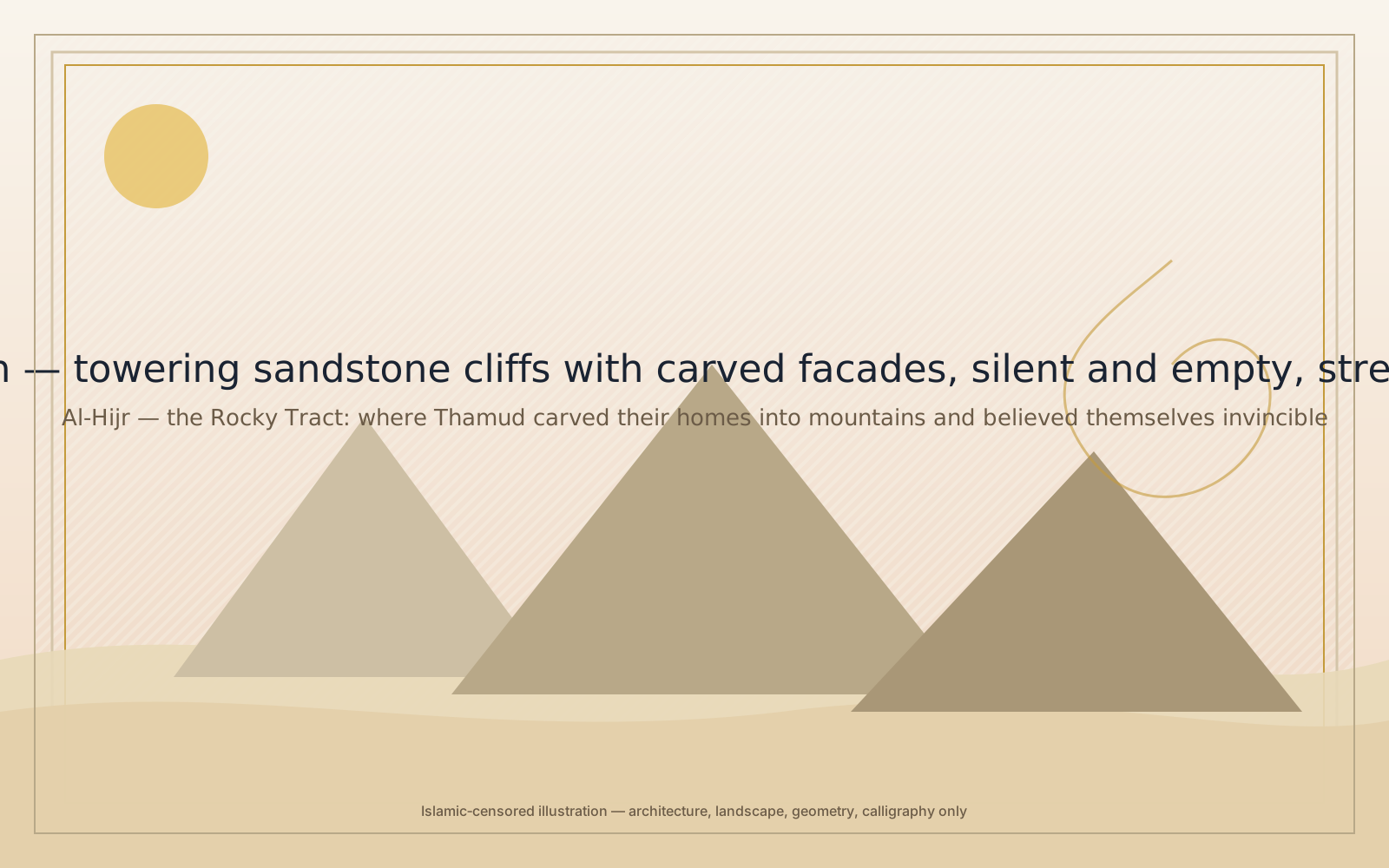
A desolate rocky landscape at dawn — towering sandstone cliffs with carved facades, silent and empty, stretching toward a vast desert horizon
Al-Hijr — the Rocky Tract: where Thamud carved their homes into mountains and believed themselves invincible

It begins with a guarantee and ends with a command. The guarantee: 'Surely We revealed the Message, and We will surely preserve it' (15:9). The command: 'And worship your Lord in order to attain certainty' (15:99). Between those two poles — divine protection and human devotion — Surah Al-Hijr unfolds the origin story of every temptation, every moral failure, and every act of defiance that has ever plagued human civilization. The centrepiece is a scene no other scripture renders with such dramatic immediacy: Satan, standing before God after refusing to bow to Adam, negotiating the terms of his rebellion. He does not slink away in shame. He bargains. He secures a reprieve until the Day of Judgment. He announces his strategy openly — 'I will glamorize for them on earth, and I will lure them all away' (15:39) — and God, with terrifying calm, permits it. Then the surah turns its lens on what that permission has produced: the sexual depravity that consumed Sodom, the arrogance that doomed Thamud, the wickedness that destroyed the People of the Forest. Each civilization thought itself secure. Each was annihilated by morning. And threading through the wreckage, a single consolation to the Prophet Muhammad, mocked by his own people and straining under the weight of revelation: 'We are enough for you against the mockers' (15:95).

“Surely We revealed the Message, and We will surely preserve it.”
— God 15:9
Spiritual Barometer
Force
moderate
Tone
gentle
Urgency
important

The Daily Revelation Edition 15

Theology & Doctrine

THE UNBREAKABLE BOOK: God's Personal Guarantee to Guard the Quran

Of all the claims made in the Quran, none is more audacious — or more verifiable across fourteen centuries — than the nine words of verse 15:9. "Surely We revealed the Message, and We will surely preserve it." Not a promise to preserve the faithful. Not a promise to preserve the community. A promise to preserve the text itself. The Book takes personal responsibility for its own survival.

The context makes this claim extraordinary. The surah opens in the thick of Meccan hostility. The disbelievers have already dismissed Muhammad as insane: "O you who received the message, you are insane" 15:6. They demand angels as proof: "Why do you not bring us the angels, if you are truthful?" 15:7. The response is not to produce miracles on demand. The response is a counter-claim that dwarfs any single miracle: the Quran will outlast every attempt to destroy it. Every empire that has tried to erase it. Every regime that has banned it. Every century that might have corrupted it. The Message will endure.

What makes this verse the theological backbone of Surah Al-Hijr is its placement. It arrives before the creation narrative, before the Iblis rebellion, before the civilizational destructions. It is the frame within which everything else must be read. The civilizations that follow — Sodom, Thamud, the People of the Forest — all perished because they rejected divine messages. But the Message itself? Indestructible. The messengers can be mocked, exiled, and killed. The communities can be obliterated. The text persists.

The surah then pivots immediately to cosmic evidence. The constellations are set as signs and guarded from devils 15:16-18. The earth is spread with provision in precise measure 15:19-21. The winds carry fertility, the rain is stored beyond human control 15:22. Everything in creation operates within a system of divine guardianship — and the Quran is simply the most explicit instance of that guardianship applied to language.

For the Prophet Muhammad, enduring daily ridicule in Mecca, this was not an abstract theological point. It was a survival mechanism. You are mocked. Your message is dismissed. Your sanity is questioned. But the words you carry are under a protection that transcends you. They do not depend on your success. They do not require human armies to defend them. "We will surely preserve it" — the first person plural of divine sovereignty, deployed not in the context of creation or judgment, but in the context of textual integrity.

Fourteen hundred years later, the manuscript evidence is the verse's own commentary. The Sana'a manuscripts, the Birmingham fragments, the Topkapi codex — they confirm what 15:9 promised before any of them were written. The Book that claimed it would survive, survived.

15:1 15:2 15:3 15:4 15:5 15:6 15:7 15:8 15:9 15:10 15:11 15:12 15:13 15:14 15:15 15:16 15:17 15:18 15:19 15:20 15:21 15:22 15:23 15:24 15:25

The Daily Revelation Edition 15

Special Investigation

FACE TO FACE WITH GOD: The Confrontation That Launched Every Temptation in Human History

No scene in the Quran is more unsettling than the one staged in verses 15:28-43. It is not a battle. It is a negotiation. And both parties walk away with exactly what they asked for.

The setting is the moment of human creation. God announces to the angels His intention: "I am creating a human being from clay, from molded mud" 15:28. The material is deliberately humble — mud, clay, the earth itself. Then the divine breath: "When I have formed him, and breathed into him of My spirit, fall down prostrating before him" 15:29. The command is absolute. The angels obey. "So the angels prostrated themselves, all together" 15:30. All together — the Quran emphasises the unanimity to heighten the shock of what follows. "Except for Satan. He refused to be among those who prostrated themselves" 15:31.

God does not strike him down. God asks a question: "O Satan, what kept you from being among those who prostrated themselves?" 15:32. It is the question of a judge who already knows the answer, offered so that the defendant will articulate his own condemnation. And Iblis obliges: "I am not about to prostrate myself before a human being, whom You created from clay, from molded mud" 15:33. The argument is racial supremacy in its purest form. Fire is superior to clay. I am superior to him. Therefore I will not bow. It is the oldest prejudice — the conviction that origin determines worth.

God's sentence is immediate: "Then get out of here, for you are an outcast. And the curse will be upon you until the Day of Judgment" 15:34-35. Expelled. Cursed. Final.

But then Iblis does something extraordinary. He does not beg for mercy. He does not repent. He bargains. "My Lord, reprieve me until the Day they are resurrected" 15:36. He asks for time — not to reform, but to retaliate. And God grants it: "You are of those reprieved. Until the Day of the time appointed" 15:37-38.

With his reprieve secured, Iblis makes his declaration of war. It is the most chilling oath in the Quran: "My Lord, since You have lured me away, I will glamorize for them on earth, and I will lure them all away" 15:39. Note the verb: glamorize. Not terrorize. Not overpower. Glamorize. Iblis does not promise to force humanity into sin. He promises to make sin beautiful. To adorn it. To present it as desirable, sophisticated, liberating. The strategy is not coercion — it is seduction.

But even in his defiance, Iblis acknowledges a limit: "Except for Your sincere servants among them" 15:40. He knows he cannot reach everyone. Sincerity — ikhlas — is the one armour he cannot penetrate. And God confirms the boundary: "Over My servants you have no authority, except for the sinners who follow you" 15:42. The war is permitted, but it is not unlimited. The battlefield is the human heart, and the weapon is glamour, and the defence is sincerity. And the consequence for those who choose the wrong side is laid out with architectural precision: "And Hell is the meeting-place for them all. It has seven doors; for each door is an assigned class" 15:43-44.

This is the origin story the Quran places at the centre of Surah Al-Hijr. Before the destroyed cities. Before the angels visiting Ibrahim. Before the comfort offered to Muhammad. This confrontation — God and Satan, face to face, negotiating the terms of human moral freedom — is the engine that drives everything that follows.

15:26 15:27 15:28 15:29 15:30 15:31 15:32 15:33 15:34 15:35 15:36 15:37 15:38 15:39 15:40 15:41 15:42 15:43 15:44

The Daily Revelation Edition 15

Paradise & Punishment

SEVEN DOORS AND FACING COUCHES: The Quran's Most Intimate Portraits of Hell and Heaven in a Single Breath

Immediately after the cosmic confrontation between God and Iblis, Surah Al-Hijr does something structurally remarkable: it places the two destinations side by side, separated by a single verse. Hell in 15:43-44. Paradise in 15:45-48. The juxtaposition is deliberate — the surah wants you to see both outcomes in one glance, as if holding two photographs next to each other and saying: choose.

The description of Hell is architectural. "And Hell is the meeting-place for them all. It has seven doors; for each door is an assigned class" 15:43-44. Seven doors. Assigned classes. This is not a chaotic inferno — it is a structured institution, an anti-paradise designed with the same precision God applies to everything. The sinners who follow Iblis do not tumble into random fire. They are sorted. Classified. Assigned. The bureaucracy of damnation mirrors the bureaucracy of creation: everything in its place, everything measured.

Then the pivot. "But the righteous will be in gardens with springs" 15:45. The contrast is physical: doors versus gardens, assigned classes versus springs of flowing water. And then the greeting — the single most comforting sentence in the surah: "Enter it in peace and security" 15:46. Peace. Security. The two things most absent from the lives described in the rest of the chapter — the mocked Prophet, the destroyed cities, the hunted Lut. Paradise begins where anxiety ends.

But the verse that stops a reader in their tracks is 15:47: "And We will remove all ill-feelings from their hearts — brothers and sisters, on couches facing one another." This is not about rivers of honey or palaces of gold. This is about psychology. The deepest wound the human heart carries — resentment, grudge, the memory of betrayal — will be surgically removed. The people sitting across from you in Paradise will include those who wronged you in this life, and you will feel nothing but affection. The heart will be healed not by forgetting but by divine intervention into its architecture. Every grievance dissolved. Every bitterness evaporated. Facing each other on couches, with nothing between them.

"No fatigue will ever touch them therein, nor will they be asked to leave it" 15:48. Two negations that describe the two deepest human anxieties: exhaustion and expulsion. You will never be tired. You will never be asked to go. The rest is permanent. The welcome is irrevocable.

And then, as if to ensure both portraits are received with the right emotional weight, God instructs Muhammad to deliver the dual message: "Inform My servants that I am the Forgiver, the Merciful. And that My punishment is the painful punishment" 15:49-50. Both are true. Both are real. Mercy is primary — it is named first. But punishment is not theoretical. The surah has just shown you the seven doors. It is about to show you the cities that walked through them.

15:43 15:44 15:45 15:46 15:47 15:48 15:49 15:50

The Daily Revelation Edition 15

Prophetic History

THE GUESTS WHO TERRIFIED A PROPHET: Angels at Ibrahim's Table, and the News That Changed Everything

The angels arrived looking like men. They said the word travellers always say: "Peace" 15:52. And Ibrahim — the patriarch, the friend of God, the man who had walked through fire — was afraid. "We are wary of you," he told them 15:52. This detail is crucial. Ibrahim was not naive. He lived in an age when strangers could be raiders, and hospitality was both a sacred duty and a calculated risk. His wariness was not cowardice — it was the vigilance of a man who had survived much.

The angels moved to reassure him immediately: "Do not fear; we bring you good news of a boy endowed with knowledge" 15:53. But Ibrahim's reaction was not joy. It was disbelief — the same human incredulity that Zakariya would later show in Surah Maryam when told he would have a son in old age. "Do you bring me good news, when old age has overtaken me? What good news do you bring?" 15:54. The question is layered. He is not merely asking about biology. He is asking whether the promise is real or whether these strangers are mocking him.

Their answer is definitive: "We bring you good news in truth, so do not despair" 15:55. And Ibrahim's response is one of the surah's most psychologically rich moments: "And who despairs of his Lord's mercy but the lost?" 15:56. He corrects himself before anyone else can correct him. His initial surprise was human; his recovery was prophetic. The sentence functions as both personal recalibration and universal principle — despair of divine mercy is itself a form of being lost.

Then the conversation pivots. Ibrahim senses these are not ordinary guests bearing ordinary news. "So what is your business, O envoys?" 15:57. The Arabic word — mursaleen — reveals that he has deduced their true nature. They are messengers. They have a mission beyond delivering birth announcements. And the mission is grim: "We were sent to a sinful people" 15:58. The people of Lut. The city of Sodom. The angels are not merely passing through Ibrahim's home on the way to deliver glad tidings — they are passing through on the way to execute divine judgment.

One visit. Two messages. A son will be born. A city will die. The angels carry both in the same journey, as if the Quran is insisting that creation and destruction are not opposite forces — they are parallel operations of the same divine will. Ibrahim receives the promise of life for his lineage in the same breath that he learns of the annihilation of his nephew's community.

"Except for the family of Lot; we will save them all. Except for his wife" 15:59-60. The exemption within the exemption. Lut's family will be spared — but not all of it. His wife has already been determined to be among those who lag behind. The angels know the verdict before they arrive at the city. The judgment is not reactive. It was rendered before the knock on the door.

15:51 15:52 15:53 15:54 15:55 15:56 15:57 15:58 15:59 15:60

The Daily Revelation Edition 15

Crime & Judgment

TURNED UPSIDE DOWN: The Last Night of Sodom and the Civilizations That Followed It into the Ground

The angels arrived at Lut's home and he did not recognise them. "You are a people unknown to me," he said 15:62. They were strangers, and in Sodom, strangers were prey. The angels knew this. They told him what they carried: "We bring you what they have doubts about" 15:63. The people of Lut had doubted the warnings. The angels were the proof — and the instrument.

Their instructions were precise and urgent: "Travel with your family at the dead of the night, and follow up behind them, and let none of you look back, and proceed as commanded" 15:65. Every clause matters. Travel at night — secrecy. Follow behind them — a rear guard, ensuring no one stops or turns. Let none of you look back — the psychological command, the severance from the past. Proceed as commanded — obedience without improvisation. These are not suggestions. They are evacuation protocols delivered by angels who know what dawn will bring.

And then the city came. "And the people of the town came joyfully" 15:67. Joyfully. The Arabic word — yastabshiroon — means they came celebrating, elated at the news of young male visitors. The Quran does not flinch from the depravity. It names the emotion: joy. They were not driven by desperation or confusion. They were jubilant.

Lut's plea is among the most anguished in the Quran: "These are my guests, so do not embarrass me. And fear God, and do not disgrace me" 15:68-69. He asks for two things — hospitality and decency — and receives neither. The mob's response is contemptuous: "Did we not forbid you from strangers?" 15:70. They had previously warned him not to host outsiders. They had formalised their depravity into policy. Lut, desperate, offers an alternative that reveals the depth of his helplessness: "These are my daughters, if you must" 15:71.

The Quran then interrupts the scene with a divine aside, addressed to Muhammad: "By your life, they were blundering in their drunkenness" 15:72. It is one of only two places in the entire Quran where God swears by the life of the Prophet — an oath of extraordinary intimacy. The word for their state — sakratihim — means intoxication, but not necessarily from alcohol. They were drunk on desire. Drunk on impunity. Blundering through the last hours of their existence without knowing it.

"So the Blast struck them at sunrise" 15:73. Sunrise. The same hour they had come joyfully, they were annihilated. "And We turned it upside down, and rained down upon them stones of baked clay" 15:74. The city was physically inverted — a literalisation of its moral inversion. What was above went below. What was built was buried.

The surah does not stop at Sodom. It runs through the others in rapid succession. "The people of the Woods were also wrongdoers. So We took revenge upon them" 15:78-79. Then: "The people of the Rock also rejected the messengers" 15:80. The People of the Rock — Al-Hijr — from whom the surah takes its name. The Thamud. The civilization that carved homes into mountains, "feeling secure" 15:82. Security carved from stone. It did not save them: "But the Blast struck them in the morning. All they had acquired was of no avail to them" 15:83-84.

Four civilizations. Four mornings after. The pattern is the surah's thesis: no amount of architectural grandeur, no depth of carved stone, no height of civilizational achievement can withstand the morning after divine patience expires. "Surely in that are lessons for those who read signs" 15:75. And then the devastating geographical detail: "And it is on an existing road" 15:76. The ruins are not mythological. They are on a trade route the Meccans used. Every caravan that passed those ruins was walking through a newspaper headline they refused to read.

15:61 15:62 15:63 15:64 15:65 15:66 15:67 15:68 15:69 15:70 15:71 15:72 15:73 15:74 15:75 15:76 15:77 15:78 15:79 15:80 15:81 15:82 15:83 15:84

The Daily Revelation Edition 15

Psychology & Faith

'WE KNOW YOUR HEART IS STRAINED': The Quran's Most Direct Act of Pastoral Care for Its Own Prophet

The closing passage of Surah Al-Hijr is unlike anything else in the Quran. It is not a command. It is not a warning. It is not a doctrinal declaration. It is a consolation — God speaking to Muhammad not as Legislator to servant, but as Protector to the one who is breaking under the weight of the mission.

The transition begins at 15:85: "We did not create the heavens and the earth, and what lies between them, except with truth. The Hour is coming, so forgive with gracious forgiveness." After five pages of destroyed civilizations and satanic warfare, the surah pauses to state first principles. Creation has purpose. The Hour is real. And the appropriate response — after all the judgment, all the fire, all the inverted cities — is forgiveness. Gracious forgiveness. Not grudging pardon. Not strategic clemency. Forgiveness as an aesthetic act — safh al-jameel, the beautiful release.

Then the gift: "We have given you seven of the pairs, and the Grand Quran" 15:87. The "seven of the pairs" — traditionally understood as Surah Al-Fatiha, the seven verses recited in every unit of every prayer. God reminds Muhammad of what he has already been given. Before telling him what to endure, He tells him what he possesses. The Fatiha and the Quran. The prayer and the text. These are your weapons. These are your consolations.

Then the instruction: "Do not extend your eyes towards what We have bestowed on some couples of them to enjoy, and do not grieve over them, and lower your wing to the believers" 15:88. Three directives in one verse. First: do not envy the material wealth of those who mock you. Second: do not grieve over their rejection. Third: turn your tenderness — lower your wing, a metaphor of exquisite gentleness — toward those who do believe. Stop looking at what the disbelievers have. Stop mourning what the disbelievers refuse. Start sheltering those who said yes.

The psychological precision here is remarkable. The Quran diagnoses the three emotional traps that threatened the Prophet's wellbeing: envy of his persecutors' comfort, grief over their rejection, and the temptation to harden against everyone. The remedy is specific to each trap. For envy: perspective — what they have is temporary. For grief: acceptance — their choices are not your failure. For hardening: gentleness — become softer toward those who need you.

Then the reassurance: "We are enough for you against the mockers" 15:95. Five words. God assumes personal responsibility for dealing with those who ridicule the Prophet. Muhammad does not need to defend himself. He does not need to retaliate. He does not need to win the argument. God will handle the mockers. The Prophet's only job is to keep going.

And the surah's final three verses bring it all home: "We are aware that your heart is strained by what they say" 15:97. The Creator of the universe acknowledges, explicitly, that His Prophet is in emotional pain. That the mockery hurts. That the rejection lands. And the prescription: "So glorify the praise of your Lord, and be among those who bow down. And worship your Lord in order to attain certainty" 15:98-99. Worship is not presented here as obligation. It is presented as therapy. The cure for a strained heart is not argument, not revenge, not withdrawal — it is prostration. Keep bowing until certainty comes. Keep worshipping until death arrives. That is the entire programme. That is the last word.

15:85 15:86 15:87 15:88 15:89 15:90 15:91 15:92 15:93 15:94 15:95 15:96 15:97 15:98 15:99

The Daily Revelation Editorial Edition 15

✸ ✸ ✸

Letter from the Editor: The War You Are Already Fighting

Surah Al-Hijr tells you something most people would rather not hear: you are already a combatant in a war you did not start, cannot opt out of, and will fight every day until you die.

The war was declared in verse 15:39, when Iblis stood before God and announced his strategy: "I will glamorize for them on earth, and I will lure them all away." Not some of them. All. The only exception he himself acknowledged was the sincere — those whose devotion is pure enough to be impervious to glamour. Everyone else is a target. You are a target. You have been since the moment the reprieve was granted.

This is the theological framework Surah Al-Hijr installs before it shows you anything else. Before the destroyed cities, before the angelic visits, before the consolation to Muhammad — first, the origin of the war. Because without understanding the war, the destructions make no sense. Sodom was not destroyed because God is arbitrary. It was destroyed because a civilization chose glamour over guidance, chose desire over decency, chose to celebrate what the angels came to punish. Thamud was not destroyed because stone homes offended heaven. It was destroyed because security carved from rock became a substitute for security sought from God.

And the consolation to Muhammad in the closing verses is not incidental — it is the surah's entire point. If you understand that the war is real, that the enemy's strategy is glamour, that civilizations have fallen to it, and that the ruins are on a road you travel daily, then the question becomes: how do you survive? The answer is 15:99: "Worship your Lord in order to attain certainty."

Not certainty first, then worship. Worship first, then certainty. The act produces the conviction. The prostration generates the faith. The bowing creates the knowing. This is not the Western model of belief, where you must first be convinced before you act. This is the Quranic model: act, and conviction will follow. Keep praying even when your heart is strained. Keep glorifying even when the mockers are loud. Keep serving even when the road passes through ruins.

Because the Message is preserved. That was the first promise. And the certainty will come. That was the last. Everything between those two verses — the war, the destruction, the grief — is the terrain through which you must walk to get from one to the other.

For Reflection
Iblis promised to 'glamorize' sin for humanity. What in your life right now looks beautiful but pulls you away from God? What appears dull or difficult but is actually the path of sincerity that Iblis admitted he could not penetrate?
Supplication
O Allah, You promised to preserve Your Message — preserve it in our hearts as You preserved it in the text. You warned us of an enemy who makes wrong look beautiful — grant us the sincerity that renders his glamour transparent. You told Your Prophet that You are aware of his strained heart — be aware of ours, and grant us the worship that leads to certainty. We ask for the mercy of gardens with springs, for hearts emptied of grudge, for the company of brothers and sisters on facing couches. And we seek refuge from the seven doors and the classes assigned to them. You are the Forgiver, the Merciful — and Your punishment is the painful punishment. Let us never forget either truth. Ameen.
✸ ✸ ✸

The Daily Revelation Back Page Edition 15

Today's Action
Read verses 15:45-50 slowly before bed tonight. Let the image of Paradise settle into your mind — the gardens, the springs, the greeting of peace, the removal of all ill-feeling, the couches facing one another. Then read 15:49-50 and hold both realities: God is the Forgiver and His punishment is real. Fall asleep with that dual awareness as your compass.
Weekly Challenge
Iblis said his weapon is glamour — making wrong look beautiful. This week, identify one thing in your life that is glamorous but harmful, and one thing that is unglamorous but spiritually essential. Consciously reduce time spent on the first and increase time spent on the second. On Friday, recite 15:99 — 'Worship your Lord in order to attain certainty' — and assess whether the shift brought you closer to the certainty the verse promises.
Related Editions
Edition 2 The original Adam-Iblis prostration narrative (2:30-39) — Surah Al-Hijr's version adds Iblis's glamour strategy and God's explicit permission
Edition 7 The most extended Iblis-Adam narrative in the Quran (7:11-25) — complements Al-Hijr's focus on the war's terms with the Garden temptation scene
Edition 11 Parallel accounts of Lut, Thamud, and Madyan with additional narrative detail and emotional texture
Edition 12 Ibrahim's grandson Yusuf — the preceding surah's story of a prophet tested by glamour (Zulaykha's seduction) connects directly to Iblis's declared strategy in 15:39
Edition 19 Ibrahim's encounter with his father about idolatry — a different facet of the patriarch who hosts angels in Al-Hijr
Characters in This Edition
Allah Iblis Adam Angels Muhammad Ibrahim Lut People of Lut People of Thamud People of Madyan Disbelievers Believers Mankind
Coming Next
NEXT EDITION: Surah An-Nahl (The Bee) — 128 verses of evidence built from rain, milk, honey, and the flight of bees, as God constructs an argument for gratitude so overwhelming that ingratitude becomes absurd.
Page 1 of 9
Ed. 14 Ed. 16