Edition 16 of 114 Mecca Bureau 128 Verses

The Daily Revelation

Revelation. Reported. Truth.
النحل

An-Nahl — The Bee
Force: Moderate Tone: Gentle Urgency: Important

THE SURAH OF BLESSINGS: 128 Verses Cataloguing Every Gift You Never Thanked God For

In the longest sustained argument for gratitude anywhere in scripture, God inventories creation itself — livestock, rivers, stars, silk, honey, milk extracted from between blood and waste — and names the surah not after any of them, but after a bee. The message: even the smallest creature carries divine instruction.


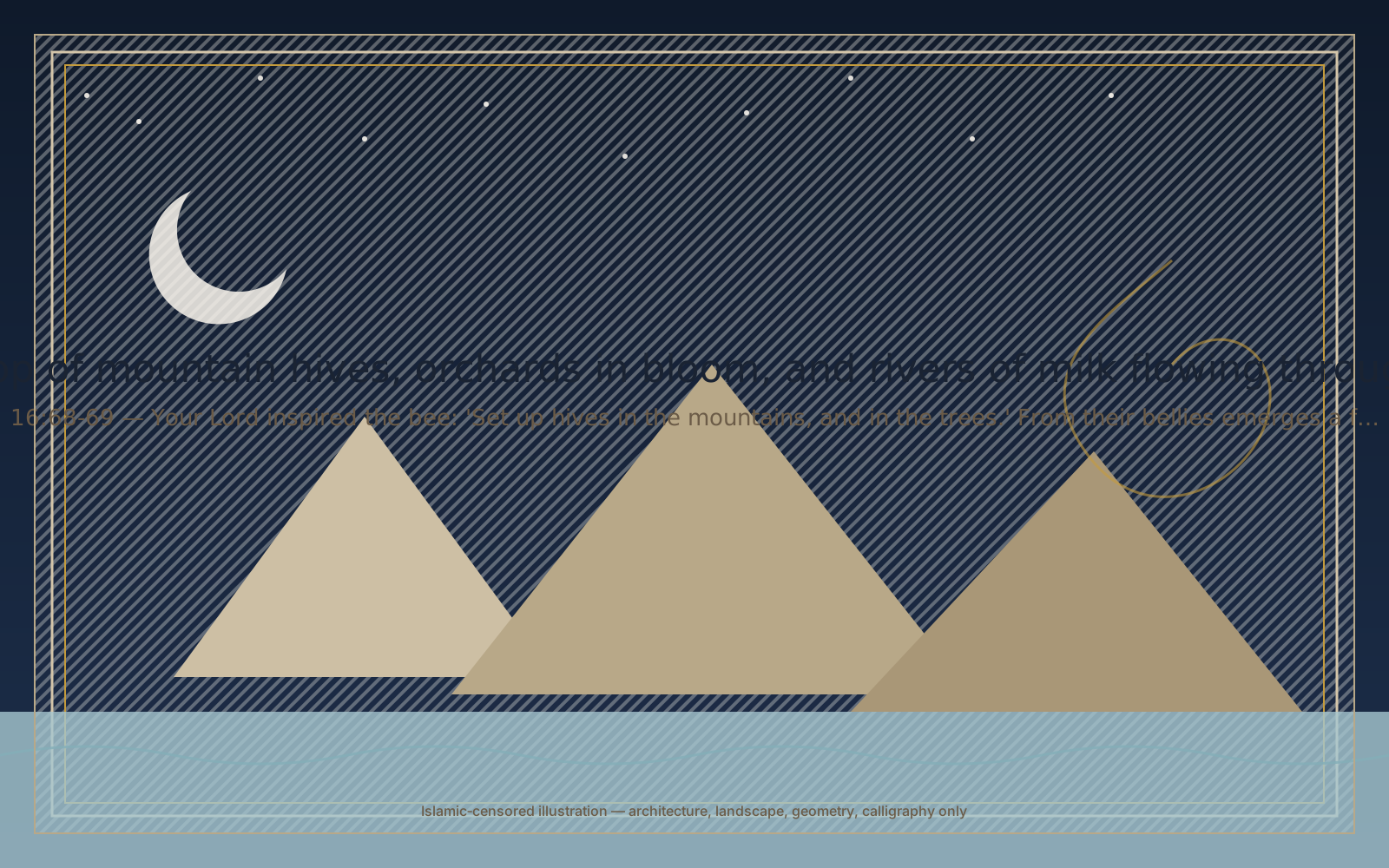
A golden honeybee in flight against a backdrop of mountain hives, orchards in bloom, and rivers of milk flowing through green valleys under an ordered sky of sun, moon, and stars
16:68-69 — Your Lord inspired the bee: 'Set up hives in the mountains, and in the trees.' From their bellies emerges a fluid of diverse colors, containing healing for the people.

There are surahs in the Quran that tell stories. There are surahs that legislate. There are surahs that warn, that promise, that terrify, that console. And then there is An-Nahl — The Bee — which does something no other surah attempts at this scale: it counts. It counts everything God has given you. The rain that waters your crops. The livestock that carry your loads. The horses you ride for pleasure. The seas you fish for food and dive for pearls. The mountains that anchor the earth beneath your feet. The stars that guide you through the night. The silk, the wool, the fur. The milk — extracted, impossibly, from between blood and waste, emerging pure and refreshing. The grapes. The olives. The date-palms. The honey — produced by an insect operating on divine programming so precise that the Quran calls it 'inspiration.' One hundred and twenty-eight verses. And when God finishes counting, He delivers the verdict that echoes across the entire chapter: 'If you tried to enumerate the favours of God, you will not be able to count them.' He knows. He just spent an entire surah proving it.

“And if you tried to enumerate the favours of God, you will not be able to count them. God is Forgiving and Merciful.”
— God 16:18
Spiritual Barometer
Force
moderate
Tone
gentle
Urgency
important

The Daily Revelation Edition 16

Lead Report

THE GRAND INVENTORY: How God Builds a Case for Gratitude Out of Livestock, Rain, and Stars

The surah opens with a warning dressed as a promise: "The command of God has come, so do not rush it" 16:1. The Meccan pagans had been demanding signs, demanding punishment, demanding proof. God's response is not defensive. It is architectural. Rather than answering their challenge with thunder, He answers it with evidence — and the evidence is everything they already have.

What follows, across the first eighteen verses, is the most systematic catalogue of divine provision in the Quran. It is not poetry for its own sake. It is prosecution. God is building a case, and the exhibits are arranged with the precision of a forensic accountant.

First, the angels and the spirit: "He sends down the angels with the Spirit by His command" 16:2. The chain of communication between heaven and earth is established. Then the heavens and the earth themselves: created with justice 16:3 — not arbitrarily, not accidentally, but with a moral architecture embedded in the physics.

Then the human being — created from a drop of fluid, who immediately becomes "an open adversary" 16:4. This is not a neutral observation. It is the prosecution's first charge: ingratitude is not a late development. It is the human default. You were made from almost nothing. You responded with defiance.

And then the gifts begin. Livestock for warmth, food, and beauty 16:5-6. Transport animals — horses, mules, donkeys — for travel and luxury 16:7-8. Rain from the sky, producing vegetation, grains, olives, date-palms, grapes, and "all kinds of fruits" 16:10-11. The night and the day, the sun and the moon and the stars, all "disposed by His command" 16:12. The diversity of colours on earth 16:13. The sea — for tender meat, ornaments, and commerce 16:14. Mountains as anchors, rivers as roads, stars as guides 16:15-16.

Sixteen verses. Sixteen exhibits. And then the question that detonates the entire sequence: "Is He who creates like him who does not create? Will you not take a lesson?" 16:17. The logic is devastating in its simplicity. You worship idols who have never created anything. The Being who created everything you just heard listed — the livestock, the rain, the stars, the sea, the mountains — stands on one side of the ledger. Your stone statues stand on the other. Choose.

And then the confession that even God acknowledges the impossibility of His own catalogue: "And if you tried to enumerate the favours of God, you will not be able to count them" 16:18. The surah has listed perhaps two dozen blessings. It concedes — with something approaching divine humour — that this list barely scratches the surface. The inventory is infinite. The accountant is merely offering samples.

16:1 16:2 16:3 16:4 16:5 16:6 16:7 16:8 16:10 16:11 16:12 16:13 16:14 16:15 16:16 16:17 16:18

The Daily Revelation Edition 16

Science & Natural World

THE BEE'S DIVINE PROGRAMME: How a Two-Verse Passage Became the Surah's Name

Of the one hundred and twenty-eight verses in this surah — verses that catalogue the sun, the moon, the oceans, the mountains, the livestock, and the entire apparatus of creation — God chose to name it after a bee. Not the horse. Not the sea. Not the star. A bee. And the reason is contained in two verses that are among the most scientifically extraordinary in the entire Quran.

"And your Lord inspired the bee: 'Set up hives in the mountains, and in the trees, and in what they construct'" 16:68. The Arabic word is awha — the same root used for divine revelation to prophets. God inspired the bee. Not taught. Not programmed. Inspired. The Quran is making a theological claim of staggering implications: the instinct that drives a honeybee to build hexagonal cells of mathematically perfect geometry, to perform waggle dances that communicate distance and direction to food sources, to regulate hive temperature to within half a degree — this is not random evolution. It is wahy. It is revelation. The bee receives its instructions from the same source that sent scripture to Muhammad.

"Then eat of all the fruits, and go along the pathways of your Lord, with precision" 16:69. The bee's foraging routes are described as subul Rabbiki — the pathways of your Lord. And the word dhululan — translated as 'with precision' or 'made smooth for you' — suggests that these pathways are pre-ordained, pre-calculated, facilitated. Modern entomology has confirmed that honeybees navigate using the sun's position, the earth's magnetic field, and an internal map of landmarks — a navigational system of such sophistication that robotics engineers still struggle to replicate it. The Quran attributes this not to adaptation, but to design.

And then the product: "From their bellies emerges a fluid of diverse colors, containing healing for the people" 16:69. The Arabic shifa'un lin-nas — healing for the people — is one of only two substances in the entire Quran explicitly described as medicinal (the other being the Quran itself). Honey's antibacterial, anti-inflammatory, and wound-healing properties have been documented by modern medicine. Manuka honey is now used in clinical wound care in hospitals across the world. The Quran's claim, made in seventh-century Arabia, has been vindicated by twenty-first-century pharmacology.

But the deeper point is not the honey. It is the system. A bee weighs approximately one-tenth of a gram. Its brain contains fewer than one million neurons — compared to the human brain's eighty-six billion. And yet this creature, operating on divine inspiration, constructs architecture that maximises storage while minimising material, produces a substance that heals wounds, pollinates the crops that feed civilisations, and navigates with a precision that satellite technology has only recently matched. The surah is named after the bee because the bee is the argument in miniature. If God's design is this precise in a creature you can crush between your fingers, what does that tell you about the design embedded in the rest of creation?

"Surely in this is a sign for people who reflect" 16:69. Not 'for people who believe.' Not 'for people who pray.' For people who reflect. The bee is evidence. The honey is evidence. The hexagonal cells are evidence. The waggle dance is evidence. And the surah named after this creature is, in its entirety, a sustained demand that human beings look at the evidence and draw the obvious conclusion.

16:68 16:69

The Daily Revelation Edition 16

Investigative Report

MILK FROM BLOOD: The Verse That Describes Lactation Fourteen Centuries Before Biology Explained It

Buried in the middle of the surah's relentless catalogue of blessings is a single verse that has fascinated scientists, theologians, and literary critics for over a millennium. It describes a biological process so precisely that modern physiology textbooks could hardly improve upon it.

"And there is a lesson for you in cattle: We give you a drink from their bellies, from between waste and blood, pure milk, refreshing to the drinkers" 16:66.

The phrase that arrests the reader is min bayni farthin wa damin — from between waste and blood. This is, in seventh-century Arabic, a functional description of mammalian lactation. Milk is produced in the mammary glands from nutrients absorbed through the intestinal wall (adjacent to digestive waste) and carried by the bloodstream (blood). The mammary gland sits, physiologically, between the digestive tract and the circulatory system — extracting nutrients from blood plasma, which itself derived those nutrients from digested food in the gut. From between waste and blood: pure milk.

The Quran does not present this as a science lesson. It presents it as a sign — the Arabic word is ibrah, meaning a lesson, something that causes you to cross over from ignorance to understanding. The biological process is the evidence. The theological conclusion is the point: a God who can extract purity from between waste and blood — who can produce something white, nourishing, and refreshing from the intersection of two substances humans find repulsive — that God's creative power operates at a level of precision that should make denial absurd.

The rhetorical structure is deliberate. The surah has already catalogued macro-blessings: the sun, the moon, the mountains, the seas. Now it zooms in to the microscopic — to the interior of a cow's body, to the biochemistry of lactation. The argument scales from the cosmic to the cellular. God's design is not only in the arrangement of the stars. It is in the plumbing of a mammal's udder. And the fact that you drank milk this morning without thinking about any of this is precisely the kind of ingratitude the surah is designed to dismantle.

The companion verse follows immediately: "And from the fruits of date-palms and grapevines, you derive sugar and wholesome food. In this is a sign for people who understand" 16:67. From the animal kingdom to the plant kingdom, from biochemistry to agriculture, from milk to wine and vinegar and raisins and date syrup — the catalogue presses forward. Each verse is a different exhibit in the same trial. Each gift is a different piece of evidence in the same prosecution. And the charge is always the same: you received all of this, and you did not give thanks.

16:66 16:67

The Daily Revelation Edition 16

Social Justice

THE BURIED DAUGHTERS: Two Verses That Condemned Femicide Before Any Civilisation Had a Word for It

The surah shifts, without warning, from the cosmic to the intimate. From stars and seas and honey — from the macro-architecture of divine generosity — to a scene so small and so terrible that it has haunted the conscience of every generation since it was revealed.

"And when one of them is given news of a female infant, his face darkens, and he chokes with grief. He hides from the people because of the bad news given to him. Shall he keep it in humiliation, or bury it in the dust? Evil is the decision they make" 16:58-59.

Two verses. Forty-three words in English. The most devastating indictment of pre-Islamic Arabian culture in the entire Quran — and one of the earliest recorded condemnations of female infanticide in any scripture.

The scene is specific. A man receives news that his wife has given birth to a girl. His face darkens. He chokes. Not with sorrow for the child — with shame for himself. The Arabic yazillu wajhuhu muswaddan paints a physical transformation: the face literally blackens, contorts, becomes something unrecognisable. The news of a daughter is experienced as a catastrophe. And the response is not grief but calculation: "Shall he keep it in humiliation, or bury it in the dust?" Keep the child alive and bear the social disgrace, or kill her and bury the evidence. These are the only two options this culture can imagine.

God's verdict is four words: "Evil is the decision they make." Not 'unfortunate.' Not 'misguided.' Evil. The Arabic sa'a carries the weight of moral abomination. And the placement of these verses — sandwiched between the catalogue of blessings and the description of divine generosity — is not accidental. God has just finished listing everything He gave humanity: livestock, rain, fruit, stars, seas, honey. And now He observes that these same recipients of infinite generosity respond to the gift of a daughter by contemplating murder.

The theological architecture is precise. Verses 57-58 are preceded by the observation that the pagans "attribute to God daughters — exalted is He — and for themselves what they desire" 16:57. The hypocrisy is surgical: they ascribe daughters to God (which they consider an insult to Him) while reserving sons for themselves. They project their own contempt onto the divine. The God who created them from a drop of fluid, who gave them livestock and rain and stars, is — in their theology — burdened with the very thing they consider a curse.

The Quran does not argue against infanticide using modern human rights language. It does not invoke the inherent dignity of the child. It does something more devastating: it holds a mirror to the moral disfigurement of a society that can receive infinite blessings and respond by burying its own children alive. The darkness on the father's face is the darkness of a civilisation that has lost the capacity to recognise a gift. The buried daughter is the ultimate symbol of ingratitude — the rejection not of God's provision, but of God's creation itself.

These verses did not merely condemn a practice. They ended one. Within a single generation of the Quran's revelation, female infanticide was eradicated across the Arabian Peninsula. The words "Evil is the decision they make" became a civilisational boundary marker. Whatever came before this verse was the age of ignorance. Whatever came after was the beginning of accountability.

16:57 16:58 16:59 16:60

The Daily Revelation Edition 16

Ethics & Law

THE VERSE THAT GOVERNS EVERYTHING: Justice, Kindness, and Generosity in Sixteen Arabic Words

If you had to choose a single verse to summarise the ethical programme of the entire Quran, a strong case could be made — and has been made, by scholars from Ibn Mas'ud to Ibn al-Arabi — that it is this one.

"God commands justice, and goodness, and generosity towards relatives. And He forbids immorality, and injustice, and oppression. He advises you, so that you may take heed" 16:90.

Sixteen words in Arabic. Three commands. Three prohibitions. One conclusion. The most compressed ethical code in scripture.

The three commands ascend in spiritual difficulty. Adl — justice — is the baseline. It means giving everyone exactly what they are owed. No more, no less. It is the minimum requirement for a functional society. A court can enforce justice. A contract can demand it. It is measurable, codifiable, transactional.

Ihsan — goodness, or more precisely, excellence — goes further. It means giving more than what is owed. Not because you must, but because you can. Justice says: pay your debts. Ihsan says: pay your debts and then give a gift. Justice prevents oppression. Ihsan cultivates generosity. Justice is the floor. Ihsan is the ceiling.

Ita'i dhil-qurba — generosity towards relatives — specifies the closest circle of obligation. It is not enough to be just in the marketplace and generous in the mosque. The test begins at home. The family is the smallest unit of society, and the Quran places it at the climax of the ethical triad: you cannot claim goodness if your own relatives are neglected.

The three prohibitions mirror the three commands in descending order of severity. Fahsha' — immorality, indecency, obscenity — is the corruption of the self. Munkar — injustice, wrongdoing, that which is universally recognised as wrong — is the corruption of society. Baghy — oppression, transgression, the abuse of power — is the corruption of the political order. Self, society, state. The verse forbids corruption at every level.

Umar ibn al-Khattab, the second Caliph, reportedly said that this single verse contains the entirety of Islamic ethics — that every other command in the Quran is a footnote to verse 16:90. Ibn Mas'ud, one of the earliest converts and most learned companions of the Prophet, called it "the most comprehensive verse in the Quran regarding good and evil."

The verse concludes with a word that is easy to overlook and impossible to overstate: "He advises you, so that you may take heed." The Arabic ya'izukum — He advises, He counsels, He admonishes — positions God not as a tyrant issuing decrees, but as a counsellor offering wisdom. The commands are real. The prohibitions are binding. But the framing is advisory. God is telling you what works. Justice works. Goodness works. Generosity works. Immorality, injustice, and oppression do not work. This is not arbitrary law. It is moral engineering, offered by the Engineer.

16:90 16:91 16:92 16:93 16:94 16:95

The Daily Revelation Edition 16

Profile

IBRAHIM THE MODEL: Why the Last Eight Verses of the Surah Belong to Abraham

After one hundred and nineteen verses of cataloguing blessings, condemning ingratitude, and legislating ethics, the surah does something unexpected. It invokes a human being — not as a character in a story, but as a model. A prototype. An exemplar so complete that Muhammad himself is commanded to follow him.

"Abraham was an exemplary leader, devoted to God, a monotheist, and was not of the polytheists. Thankful for His blessings. He chose him, and guided him to a straight path" 16:120-121.

The Arabic word is ummah — which means, startlingly, 'a nation unto himself.' Ibrahim was not merely a good man, or a righteous man, or even a prophet among prophets. He was, in the Quran's language, an entire community compressed into a single individual. His devotion was so total, his monotheism so pure, his gratitude so consistent that he constituted a civilisation of one.

This is not a casual compliment. It is a diagnosis. The surah has spent its first hundred verses demonstrating that humanity consistently fails to be grateful. The pagans receive blessings and worship idols. They attribute daughters to God and bury their own. They break oaths, invent lies about the lawful and unlawful, and follow Satan while claiming to follow God. And now, at the end of this catalogue of failure, God presents the counter-example: one man who got it right.

The characteristics are listed with the precision of a job description. Qanitan lillah — devoted to God. Hanifan — a monotheist, one who turns away from all false gods. Shakiran li-an'umihi — thankful for His blessings. In a surah about gratitude, Ibrahim's defining quality is precisely that: he was grateful. He received blessings and recognised their source. He did not attribute his prosperity to idols, or to luck, or to his own cleverness. He traced every gift back to the Giver.

And then the instruction that seals the surah's argument: "Then We inspired you: 'Follow the religion of Abraham, the Monotheist. He was not an idol-worshiper'" 16:123. Muhammad is being told to follow Ibrahim. Not the other way around. In the Quranic hierarchy of prophets, Ibrahim is the foundation, and Muhammad is the continuation. The religion is the same. The monotheism is the same. The gratitude is the same. Ibrahim lived it first. Muhammad was commanded to live it again.

The surah concludes with verses that read like a manual for prophetic conduct: "Invite to the way of your Lord with wisdom and good advice, and debate with them in the most dignified manner" 16:125. Wisdom first. Good advice second. Dignified debate third. The escalation is methodological, not aggressive. The goal is not to win arguments but to guide souls.

And the final instruction — perhaps the most psychologically demanding in the entire surah: "If you were to retaliate, retaliate to the same degree as the injury done to you. But if you resort to patience — it is better for the patient" 16:126. Justice permits proportional retaliation. But patience — sabr — is better. The surah that began with "do not rush" ends with the counsel of patience. The circle is complete. The God who is not rushed by human demands asks His prophet to embody the same quality: restraint in the face of provocation, patience in the face of persecution, gratitude in the face of ingratitude.

16:120 16:121 16:122 16:123 16:125 16:126 16:127 16:128

The Daily Revelation Edition 16

Special Report

THE CITY THAT FORGOT: A Parable of Prosperity, Ingratitude, and the Robe of Hunger

Near the end of the surah, God tells a story — but not about a person. About a city. An unnamed city. A city so secure, so peaceful, so abundantly provisioned that its livelihood flowed in from every direction. And then it made a single, catastrophic error.

"And God cites the example of a town that was secure and peaceful, with its livelihood coming to it abundantly from every direction. But then it turned unappreciative of God's blessings, so God made it taste the robe of hunger and fear, because of what they used to craft" 16:112.

The Arabic is extraordinary. God does not say the city experienced hunger. He says it was made to taste the robe of hunger — libas al-ju'i wal-khawf. Hunger and fear are not described as conditions. They are described as garments. Something that covers you entirely, that wraps around you, that becomes your external identity. The city did not merely go hungry. It was dressed in hunger. Hunger became its uniform, its public face, its defining characteristic — replacing the abundance that had previously been its identity.

The classical commentators debated which city this describes. Some said Mecca itself — once a thriving centre of trade on the caravan routes, blessed with the Kaaba and the well of Zamzam, now turning away from the very God who established its prosperity. Others said it was a universal parable, applicable to any civilisation that receives divine provision and responds with ingratitude. The Quran deliberately leaves the city unnamed, which suggests the second reading: this is not history. This is diagnosis. Any city, any nation, any civilisation that turns "unappreciative of God's blessings" will be dressed in the same garment.

The word kafarat — translated as 'turned unappreciative' — comes from the same root as kufr, the Arabic word for disbelief. But its original meaning is not theological. It is agricultural: kafara means to cover, to conceal, to bury something so that it cannot be seen. A farmer who buries seed is called a kafir in pre-Islamic Arabic — one who covers. When the Quran uses this word for ingratitude, it is making a linguistic argument: to be ungrateful is to bury the evidence of God's blessings, to cover them so thoroughly that you can no longer see them. Disbelief is not the rejection of God. It is the burial of evidence.

This parable — placed one hundred and twelve verses into a surah that has done nothing but present evidence — is the prosecution's closing argument. God has listed every blessing. He has described the honey, the milk, the rain, the stars. He has shown you the bee operating on divine instruction. He has pointed to the milk extracted from between waste and blood. He has counted and counted and told you the count is infinite. And now He shows you what happens to those who bury it all. They do not merely lose what they had. They are dressed in its opposite. The city that was clothed in abundance is now clothed in hunger. The city that was clothed in security is now clothed in fear. The punishment mirrors the crime with the precision of divine justice.

"A messenger from among them had come to them, but they denounced him, so the punishment seized them in the midst of their wrongdoing" 16:113. The city was not punished without warning. A messenger came. They were told. They chose to denounce him. And the punishment found them not after they had finished their wrongdoing, but in the midst of it — while they were still crafting their ingratitude, still burying the evidence, still wearing the old clothes of prosperity over hearts that had already gone bankrupt.

16:112 16:113 16:114

The Daily Revelation Edition 16

Psychology & Human Nature

THE GENDER EQUALITY VERSE: One Line That Demolished the Spiritual Caste System

Tucked between the surah's grand themes of cosmic design and prophetic history is a verse that, in a single sentence, overturned one of the most entrenched assumptions of the ancient world.

"Whoever works righteousness, whether male or female, while being a believer, We will grant him a good life — and We will reward them according to the best of what they used to do" 16:97.

In an era when most civilisations — Greek, Roman, Persian, Indian, Chinese — operated on the assumption that spiritual attainment was primarily or exclusively a male domain, the Quran makes an assertion so plain that its radicalism is easy to miss: the reward for righteousness is identical regardless of sex. Whether male or female. The qualifier is not rhetorical decoration. It is a demolition charge placed beneath the foundation of every spiritual caste system that had ever existed.

The promise is twofold. First, hayatan tayyibah — a good life, a pure life, a wholesome life — in this world. This is not deferred to the afterlife. The righteous person, male or female, is promised quality of existence now. The scholars debated what 'a good life' means: some said contentment, others said lawful provision, others said inner peace regardless of external circumstances. Al-Hasan al-Basri said it means qana'ah — the deep satisfaction that comes from needing nothing that God has not already given you. Whatever the precise definition, the promise is temporal and tangible: goodness produces good living.

Second, the reward of the Hereafter — "according to the best of what they used to do." Not the average. Not the total. The best. God calculates the reward based on peak performance, not median performance. Your worst days are forgiven. Your mediocre days are overlooked. Your best days become the standard by which your eternity is measured. This is not justice. This is generosity disguised as accounting.

The verse sits in deliberate counterpoint to the infanticide verses earlier in the surah. In 16:58-59, a father darkens at the news of a daughter and contemplates burying her alive. In 16:97, God declares that the daughter — if righteous — is guaranteed a good life and an eternal reward identical to any man's. The surah that condemns the murder of girls also guarantees the full spiritual equality of women. The two passages are not coincidentally placed. They are the same argument: the girl you contemplated killing is, in God's economy, your equal in every way that matters.

16:96 16:97

The Daily Revelation Editorial Edition 16

✸ ✸ ✸

Letter from the Editor: The God Who Counts His Gifts and Asks Why You Don't

We have spent nine pages today in a surah that does something no other chapter in the Quran does with this relentlessness: it counts. Rain. Livestock. Silk. Honey. Milk. Stars. Mountains. Seas. Horses. Colours. Night. Day. Children. Grandchildren. Shade. Garments. Ships. Pearls. The human brain itself — ears, eyes, and the capacity to think — listed as divine technology installed at birth, given to you in your mother's womb when you knew nothing 16:78.

God counts, and counts, and counts. And then He concedes the count is infinite. "If you tried to enumerate the favours of God, you will not be able to count them" 16:18. The Almighty, the Omniscient, the Being who knows the number of leaves on every tree and grains of sand on every shore, tells you that even He — in this surah, at least — cannot finish the list. Not because His knowledge is insufficient, but because your capacity to receive is. The blessings are uncountable not because they are vague, but because they are infinite. The surah listed perhaps fifty. The reality is billions. Every heartbeat. Every breath. Every synapse firing in the brain He gave you. Every second of consciousness in a universe that is overwhelmingly unconscious.

And what does humanity do with this? The surah answers with brutal clarity. They worship idols that create nothing 16:20. They darken at the news of daughters 16:58. They break oaths 16:91-92. They invent religious laws and attribute them to God 16:116. They follow Satan 16:63. They bury the evidence of blessings so thoroughly that the Arabic word for ingratitude and the Arabic word for disbelief are the same word: kufr.

But the surah does not end in condemnation. It ends in counsel. Follow Ibrahim — the man who was grateful 16:120-121. Invite with wisdom 16:125. Choose patience over retaliation 16:126. And the closing promise: "God is with those who are righteous and those who are virtuous" 16:128.

The surah named after a bee teaches what a bee already knows: every gift has a source, every path has a Maker, and the honey only flows when the creature follows the pathways of its Lord with precision. The bee does not question. It does not deny. It does not bury the evidence. It simply follows the divine programme, and healing emerges from its belly.

The question An-Nahl asks — the question behind every one of its one hundred and twenty-eight verses — is whether human beings can learn to do what a bee does instinctively: recognise the Giver, follow the path, and produce something that heals.

For Reflection
The surah says God gave you hearing, sight, and a brain — and asks if you are grateful. Today, use one of these gifts deliberately: listen to something beautiful, look carefully at something you normally ignore, think deeply about something you have taken for granted. Then trace it back to its source. Who gave you the capacity to experience it?
Supplication
O Allah, You listed Your blessings in this surah and then told us we could never finish counting them. We confess that we have not even started. We drank the milk and forgot the miracle between waste and blood. We ate the honey and forgot the bee You inspired. We walked the earth and forgot the mountains that anchor it. We navigated by stars and forgot who placed them. Forgive our ingratitude — not the dramatic kind, the quiet kind. The kind that takes a gift and forgets the Giver. The kind that darkens at what You give instead of brightening. Make us like Ibrahim — thankful for Your blessings, devoted to You alone, a nation of gratitude in a single heart. And make us better than we were yesterday — not through grand gestures, but through the simple, daily discipline of saying: this came from God, and I am thankful. Ameen.
✸ ✸ ✸

The Daily Revelation Back Page Edition 16

Today's Action
Before your next meal today, pause and trace the food back three steps. The bread came from grain, which came from rain, which came from God. The milk came from an animal, extracted from between waste and blood, pure and refreshing — by design, not by accident. Name the chain. Thank the Source. Eat with awareness, not routine.
Weekly Challenge
Read verses 16:65-83 — the 'blessings sequence' — once each day this week. Each day, choose one blessing mentioned (water, milk, honey, shade, clothing, shelter) and spend five minutes researching the science behind it. By the end of the week, you will have a deeper understanding of both the verse and the creation it describes. Gratitude deepens when understanding deepens.
Related Editions
Edition 55 The companion catalogue of blessings — Ar-Rahman asks 'Which of your Lord's marvels will you deny?' 31 times; An-Nahl answers by listing the marvels themselves
Edition 14 14:34 echoes 16:18 almost verbatim: 'If you tried to count God's blessings, you could not enumerate them' — Ibrahim's surah and An-Nahl share the same thesis
Edition 2 Ibrahim's story in its fullest form — the patriarch whose gratitude An-Nahl holds up as the model for Muhammad himself
Edition 27 Another surah named after a creature (The Ant) — where creation's smallest beings serve as evidence of God's design, mirroring the bee
Edition 6 The Cattle — a sister surah on livestock as divine provision, false worship, and God's argument from creation
Characters in This Edition
Allah Ibrahim Muhammad Angels Polytheists Mankind
Coming Next
NEXT EDITION: Surah Al-Isra — The Night Journey. In a single night, Muhammad is transported from Mecca to Jerusalem and from Jerusalem to the heavens. What he sees there will redefine the relationship between heaven and earth — and establish the five daily prayers that every Muslim carries with them, beginning each time with Al-Fatiha.
Page 1 of 11
Ed. 15 Ed. 17