Edition 6 of 114 Mecca Bureau 165 Verses

The Daily Revelation

Revelation. Reported. Truth.
الأنعام

Al-An'am — The Cattle
Force: Strong Tone: Warning Urgency: Urgent

THE CATTLE: 165 Verses Revealed in One Night to Demolish Every Idol on Earth

Al-An'am is the Quran's supreme theological treatise on monotheism. Revealed entire in a single session in Mecca — the only long surah to descend as one unified block — it deploys every weapon in the arsenal of persuasion: cosmological argument, historical precedent, rational demonstration, prophetic genealogy, and the exposure of pagan superstition, all converging on a single conclusion that echoes 165 times without pause: there is no god but God.


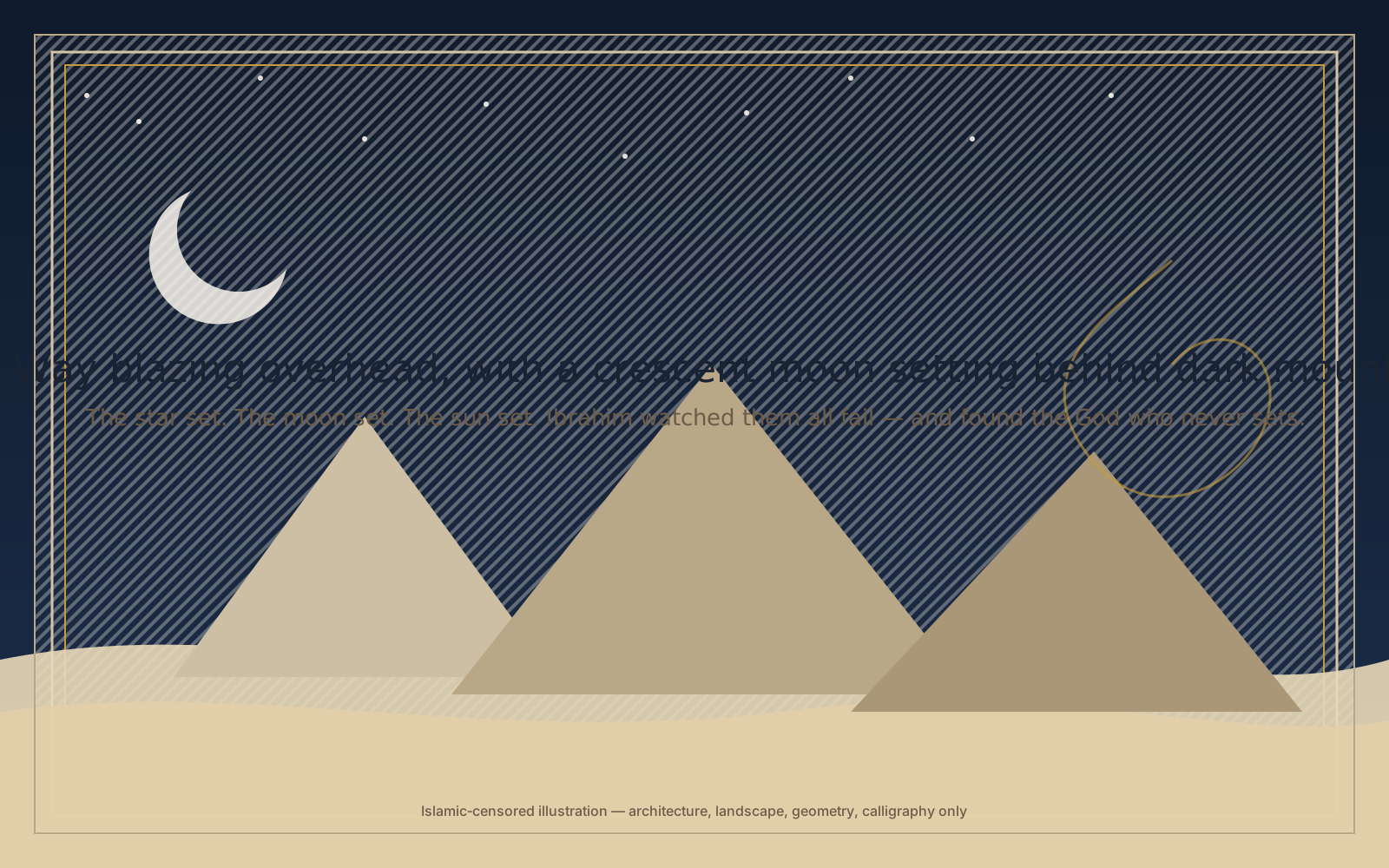
A night sky over the Arabian desert, the Milky Way blazing overhead, with a crescent moon setting behind dark mountains as the first light of dawn appears on the horizon
The star set. The moon set. The sun set. Ibrahim watched them all fail — and found the God who never sets.

Among all the long surahs of the Quran, Al-An'am holds a singular distinction: it was revealed whole. Tradition records that it descended in a single night in Mecca, accompanied by seventy thousand angels whose praise shook the heavens. This is not a surah assembled from fragments over months or years. It is a single, sustained, 165-verse argument delivered in one unbroken breath — and its subject is the most fundamental question a human being can ask: who deserves to be worshipped? The answer unfolds through the stars Ibrahim watched and abandoned, through a catalogue of eighteen prophets who carried the same message across centuries, through the exposure of pagan cattle rituals that dressed human invention in the costume of divine law, and through a closing ethical code so precise it reads like the Quran's own Ten Commandments. Al-An'am does not ask the polytheists to consider monotheism. It demolishes every alternative until monotheism is the only structure left standing.

“I have directed my attention towards Him Who created the heavens and the earth — a monotheist — and I am not of the idolaters.”
— Ibrahim (Abraham), after rejecting the star, the moon, and the sun 6:79
Spiritual Barometer
Force
strong
Tone
warning
Urgency
urgent

The Daily Revelation Edition 6

Lead Investigation

THE NIGHT SKY EXPERIMENT: How Ibrahim Used Astronomy to Destroy Idolatry

It is arguably the most elegant theological argument in all of scripture. No tablets of law. No parting of seas. No pillar of fire. Just a young man, a clear night, and three celestial objects that failed him one by one.

"Abraham said to his father Azar, 'Do you take idols for gods? I see that you and your people are in evident error'" 6:74. The rebellion begins at home. Ibrahim does not start with strangers or distant kings. He starts with his own father — an idol-maker by trade, according to tradition — and delivers a verdict that is as personal as it is theological. Evident error. No diplomatic softening. No respectful ambiguity. Ibrahim looks at the man who raised him and tells him the truth.

Then God shows Ibrahim the evidence: "Thus We showed Abraham the empire of the heavens and the earth, that he might be one of those with certainty" 6:75. The Arabic word malakut — the empire, the dominion, the inner workings — suggests that Ibrahim was given not merely a view of the sky, but an understanding of the machinery behind it. He was shown the system, not just the scenery.

Armed with this vision, Ibrahim conducts his famous experiment. "When the night fell over him, he saw a planet. He said, 'This is my lord.' But when it set, he said, 'I do not love those that set'" 6:76. The logic is devastating in its simplicity. A god that disappears cannot be God. Divinity requires permanence. If the object of your worship has an expiration time — if it rises and falls on a schedule it did not author — then it is a servant, not a lord. Ibrahim does not argue from scripture. He argues from observation. The star fails the most basic test of sovereignty: it cannot remain.

"Then, when he saw the moon rising, he said, 'This is my lord.' But when it set, he said, 'If my Lord does not guide me, I will be one of the erring people'" 6:77. The moon is larger, brighter, more commanding than the star. And it too sets. But notice what Ibrahim adds this time: a prayer. If my Lord does not guide me. He is not merely observing celestial mechanics. He is narrating a spiritual journey. Each failure pushes him closer to the truth, and he acknowledges that the journey itself requires divine assistance. Reason alone is insufficient. Reason needs guidance.

"Then, when he saw the sun rising, he said, 'This is my lord, this is bigger.' But when it set, he said, 'O my people, I am innocent of your idolatry'" 6:78. The sun — the most powerful visible object in the human experience, the source of light, heat, life itself — is Ibrahim's final candidate. And it too sets. The conclusion is now inescapable, and Ibrahim delivers it not as a philosophical musing but as a public declaration of separation: I am innocent of your idolatry. The Arabic bari' carries the force of legal divorce. He is severing himself from the entire religious system of his society.

The climax: "I have directed my attention towards Him Who created the heavens and the earth — a monotheist — and I am not of the idolaters" 6:79. Ibrahim's god is not in the sky. His god made the sky. Not the star, but the one who lit it. Not the moon, but the one who suspended it. Not the sun, but the one who set it on its course. The argument moves from the created to the Creator, from the visible to the invisible, from the transient to the eternal. This is pure rational theology — the kind of reasoning that Greek philosophers would attempt centuries later, but that Ibrahim performs on an Arabian hillside with nothing but his eyes and his intellect.

The Quran validates the method: "That was Our argument which We gave to Abraham against his people. We elevate by degrees whomever We will" 6:83. God calls it Our argumenthujjatuna. Not Ibrahim's argument. God's argument, delivered through Ibrahim's reasoning. The Quran is claiming that rational thought, properly guided, is a divine instrument. Ibrahim did not abandon reason for faith. He used reason to arrive at faith. And the Quran endorses this path as God's own methodology.

6:74 6:75 6:76 6:77 6:78 6:79 6:80 6:81 6:82 6:83

The Daily Revelation Edition 6

Prophetic History

THE EIGHTEEN: The Quran's Greatest Roll Call of Prophets — and the Message They All Shared

Nowhere in the Quran does God assemble so many prophets in so small a space. In just seven verses — 6:83 through 6:90 — eighteen named prophets are listed in a genealogical cascade that spans from Nuh to Isa, from the father of nations to the man born without a father. It is the Quran's most concentrated statement about the unity of the prophetic mission, and every name on the list carries the weight of an entire civilisation's encounter with God.

The list begins with the consequence of Ibrahim's argument: "And We gave him Isaac and Jacob — each of them We guided. And We guided Noah previously; and from his descendants David, and Solomon, and Job, and Joseph, and Moses, and Aaron. Thus We reward the righteous" 6:84. Nine prophets in a single verse. The Quran moves at a pace that permits no lingering — this is not a narrative passage but a roster, a witness list, a catalogue of divine interventions stretching across centuries and continents. Ishaq and Yaqub are named as direct gifts to Ibrahim. Nuh is mentioned as a predecessor — God guided him previously, before Ibrahim, establishing that monotheism did not begin with the star-gazer. It is older than human civilisation.

Then the genealogy deepens: Dawud the king, Sulayman the wise, Ayyub the patient, Yusuf the beautiful, Musa the liberator, Harun the priest. Each name is a library. Dawud ruled and sang. Sulayman commanded winds and jinn. Ayyub lost everything and praised God anyway. Yusuf was sold by his brothers, imprisoned by a king, and rose to govern the nation that enslaved him. Musa confronted the most powerful man on earth and led a nation through the sea. Harun stood beside his brother when speech failed him. The Quran does not retell their stories here — those narratives are scattered across other surahs. Here it simply names them, one after another, like witnesses called to testify that the message has always been the same.

"And Zechariah, and John, and Jesus, and Elias — every one of them was of the upright" 6:85. The second group includes two prophets whose stories intersect — Zakariya prayed for a son and received Yahya, who in turn prepared the way for Isa. The inclusion of Isa in this prophetic catalogue is one of the Quran's most theologically charged statements. He is not isolated as a unique case. He is not separated from the prophetic tradition. He is named alongside Zakariya, Yahya, and Ilyas as one of the upright — a prophet among prophets, remarkable but not categorically different. The Quran's Christology is embedded in this list: Isa is honoured, but he is not elevated above the pattern.

"And Ishmael, and Elijah, and Jonah, and Lot — We favored each one of them over all other people" 6:86. Ismail — Ibrahim's other son, the one through whom the Arab prophetic lineage would descend to Muhammad. Alyasa, the successor of Ilyas. Yunus, who fled his people and was swallowed by a whale. Lut, who stood alone against a civilisation devoted to corruption. Four prophets, four forms of trial: Ismail submitted to sacrifice, Alyasa continued a mission he did not begin, Yunus ran from his mission and was brought back, Lut endured the destruction of the society he tried to save.

The catalogue closes with a statement of inherited guidance: "And of their ancestors, and their descendants, and their siblings — We chose them, and guided them to a straight path" 6:87. Prophethood is not random. It moves through families, through lineages, through communities that God has chosen as vehicles for His message. And then the universal principle: "Such is God's guidance. He guides with it whomever He wills of His servants. Had they associated, their deeds would have gone in vain" 6:88.

This last sentence is the reason the catalogue exists. Eighteen prophets, spanning millennia, representing every major civilisation of the ancient world — and every one of them carried the same message: do not associate partners with God. The list is not decorative. It is an argument. If Nuh said it, and Ibrahim said it, and Musa said it, and Isa said it, and every prophet between them said it — then polytheism has no prophetic precedent. It is a human invention contradicted by every messenger God ever sent.

The conclusion is delivered to Muhammad directly: "Those are they whom God has guided, so follow their guidance. Say, 'I ask of you no compensation for it; it is just a reminder for all mankind'" 6:90. Muhammad's mission is not new. It is the continuation of a chain that the Quran has just enumerated by name. He is the latest link, not the first. And the message he carries is free — no compensation, no fee, no intermediary. Just a reminder. Eighteen prophets, one message, offered to all of humanity without charge.

6:83 6:84 6:85 6:86 6:87 6:88 6:89 6:90

The Daily Revelation Edition 6

Theology

THE LEAF THAT DOES NOT FALL WITHOUT HIS KNOWLEDGE: Verse 6:59 and the Omniscience That Governs Every Atom

There are verses in the Quran that describe God's power. There are verses that describe His mercy, His justice, His wrath. And then there are verses that describe His knowledge — and these may be the most unsettling of all, because they leave nowhere to hide.

"With Him are the keys of the unseen; none knows them except He. And He knows everything on land and in the sea. Not a leaf falls but He knows it; and there is not a single grain in the darkness of earth, nor is there anything wet or dry, but is in a clear record" 6:59.

Begin with the architecture of the verse. It moves from the cosmic to the microscopic in a single breath. The keys of the unseen — the Arabic mafatih al-ghayb — refers to the categories of hidden knowledge that no created being can access: the timing of the Hour, the contents of wombs, the events of tomorrow, the location of every soul's death, the precise moment rain will fall. These are God's alone. No prophet knows them. No angel has access. The unseen is a vault, and God holds every key.

Then the verse descends to the terrestrial: He knows everything on land and in the sea. Every creature in every ocean trench. Every insect in every forest canopy. Every organism in every ecosystem that humanity has never catalogued. The scope is total. Not general awareness. Not statistical knowledge. Total, particular, individual awareness of every living thing in every environment on the planet.

And then the image that has haunted theologians and poets for fourteen centuries: Not a leaf falls but He knows it. One leaf. One autumn day. One gust of wind detaching one leaf from one branch of one tree in one forest on one continent of one planet in one solar system in one galaxy among billions. God knows it. Not the category of falling leaves. That specific leaf. Its exact trajectory, its precise moment of separation, its final resting place on the earth below. The verse does not say God observes the fall. It says He knows it — implying awareness that precedes the event, surrounds it, and encompasses every variable that contributed to it.

The verse does not stop there. There is not a single grain in the darkness of earth. Below the surface, where no human eye reaches, where no satellite maps, where no instrument probes — in the absolute darkness of the deep earth — every particle of soil, every buried seed, every mineral deposit, every shifting tectonic grain is known. The zulumat — darknesses, plural — suggests layers of hiddenness. Not just underground, but in the deep underground, in the darkness within the darkness, where light has never reached and never will.

Nor is there anything wet or dry, but is in a clear record. The kitab mubin — the clear record — is not the Quran. It is the cosmic ledger, the divine database, the register of everything that exists, has existed, and will exist. Every raindrop. Every grain of sand. Every molecule of moisture and every particle of dust. Recorded. Not after the fact. Recorded as part of the fundamental architecture of reality.

This verse is not a comfort to the disobedient. It is an assurance to the faithful and a terror to the heedless. If God knows every falling leaf, He knows every falling tear. If He tracks every grain in darkness, He tracks every deed done in secret. If nothing wet or dry escapes His record, then no act of kindness is wasted and no act of cruelty is unnoticed. The omniscience described in 6:59 is not abstract. It is granular. It is personal. It is inescapable. And for those who worship a god of vague cosmic awareness — a deity who set the universe in motion and stepped back — this verse is a demolition. The God of the Quran does not step back. He counts the leaves.

6:59 6:60 6:61 6:62

The Daily Revelation Edition 6

Expose

THE CATTLE FRAUD: How Pagan Arabia Invented Religious Laws About Livestock and Attributed Them to God

The surah is called Al-An'am — The Cattle — and the name is not ceremonial. It is forensic. Verses 136 through 145 contain the Quran's most detailed exposure of how pre-Islamic Arabia fabricated religious laws about animals and then had the audacity to claim those laws came from God. It is an investigation into institutional religious fraud, and the Quran prosecutes it with the precision of a courtroom dismantling a forgery.

The fraud begins with division: "And they set aside for God a share of the crops and the livestock He created, and they say, 'This is for God,' according to their claim, 'and this is for our idols.' But the share of their idols does not reach God, yet the share of God reaches their idols. Evil is their judgment" 6:136. The pagans divided their agricultural produce and their livestock into portions — some for God, some for their idols. But the accounting was rigged. When the idol's share was abundant, they kept it for the idols. When God's share was abundant, they redirected it to the idols as well. The traffic was one-directional. Everything flowed toward the idols. The Quran calls it evil judgment — not merely poor theology, but corrupt accounting. The gods they worshipped were parasites on the resources they claimed to dedicate to the one true God.

The fraud deepened into child sacrifice: "Likewise, their idols entice many idolaters to kill their children, in order to lead them to their ruin, and confuse them in their religion" 6:137. The practice of burying infant daughters alive — a horror the Quran condemns in multiple surahs — is here attributed directly to the idol-system. The pagans did not consider themselves murderers. They considered themselves devout. The idol-worship did not merely corrupt their theology. It corrupted their humanity. When your god is a fabrication, your morality has no foundation, and atrocity can be dressed as piety.

Then came the arbitrary food laws: "And they say, 'These animals and crops are restricted; none may eat them except those we permit,' by their claims, and animals whose backs are forbidden, and animals over which they do not pronounce the name of God — fabricating lies against Him" 6:138. The pagans had an elaborate system of restrictions on livestock — certain animals could not be ridden, certain animals could not be eaten, certain offspring were reserved for men only. None of these laws had any basis in revelation. They were inventions, customs hardened into commandments, tribal preferences elevated to divine decree. And the Quran's word for this is iftira — fabrication. Not misunderstanding. Not misinterpretation. Fabrication. They made it up and said God said it.

The gender discrimination embedded in these customs receives particular attention: "And they say, 'What lies in the wombs of these animals is exclusively for our males, and prohibited to our wives.' But if it is stillborn, they can share in it" 6:139. The living offspring belonged to men. The dead ones — the worthless ones — could be shared with women. The Quran does not merely note this. It uses it as evidence of the entire system's moral bankruptcy. A religion that gives men the living and women the dead is not a religion. It is a racket.

The verdict is comprehensive: "Lost are those who kill their children foolishly, with no basis in knowledge, and forbid what God has provided for them — innovations about God. They have gone astray. They are not guided" 6:140. Two charges. First: murder — the killing of children based on fabricated religious obligation. Second: prohibition — forbidding what God made lawful, on no authority but their own invention. Both crimes share the same root: attributing to God what God never said. The pagans did not reject God. They hijacked Him. They kept the name and replaced the content. And the Quran identifies this as the most dangerous form of disbelief — not atheism, but religious forgery.

Against this web of fabrication, the Quran presents its own dietary code with devastating simplicity: "Say, 'In what was revealed to me, I find nothing forbidden to a consumer who eats it, except carrion, or spilled blood, or the flesh of swine — because it is impure — or a sinful offering dedicated to other than God'" 6:145. Four prohibitions. No complex caste system of permitted and forbidden livestock. No gender-based allocation of offspring. No tribal traditions dressed as divine command. Four items, clearly stated, with reasons given. The contrast between the pagan system and the Quranic system is the contrast between fabrication and revelation — between a religion humans invented to serve their power structures and a religion God revealed to dismantle them.

6:136 6:137 6:138 6:139 6:140 6:141 6:142 6:143 6:144 6:145

The Daily Revelation Edition 6

Ethics & Law

THE QURAN'S TEN COMMANDMENTS: Three Verses That Contain the Complete Islamic Ethical Code

The Torah has its Decalogue, delivered on stone tablets atop Mount Sinai. The Quran has its own version — not carved in stone, but embedded in three consecutive verses near the end of Al-An'am. Verses 6:151 through 6:153 contain what scholars have long recognised as the Quranic equivalent of the Ten Commandments: a comprehensive ethical code delivered in a single passage, covering theology, family, economics, justice, and the sanctity of human life.

The passage opens with an invitation, not a thunderclap: "Say, 'Come, let me tell you what your Lord has forbidden you'" 6:151. The Arabic ta'alaw — come — is intimate. This is not a distant god shouting from a mountaintop. This is a teacher calling students closer. Come. Let me tell you. The prohibitions are presented as wisdom to be shared, not punishments to be feared.

The first commandment: "That you associate nothing with Him." Monotheism. The foundation on which every subsequent ethical requirement rests. If your theology is wrong, your morality has no anchor. If you worship the wrong god — or multiple gods, or no god, or yourself — then every ethical calculation that follows is built on sand. The Quran places monotheism first because it is not merely a religious requirement. It is an epistemological one. You cannot know what is right until you know who defines right.

The second: "That you honour your parents." Immediately after God, parents. Not the state, not the tribe, not the community. The people who gave you life come second only to the one who gave them life. The Quran collapses the distance between the cosmic and the domestic in a single breath. Worship God. Honour your parents. The two commandments share a verse because they share a logic: gratitude to the source of your existence.

The third: "That you do not kill your children because of poverty — We provide for you and for them." In pre-Islamic Arabia, infanticide — particularly of daughters — was practiced by tribes that feared the economic burden of additional mouths. The Quran does not merely prohibit this. It demolishes the economic reasoning behind it. We provide for you and for them. The fear that drives infanticide is a lie. God's provision is sufficient. Kill your child and you have murdered not because of scarcity but because of a failure to trust the Provider.

The fourth: "That you do not come near indecencies, whether outward or inward." Not just the act. The approach. The Arabic la taqrabu — do not come near — prohibits the trajectory, not just the destination. Stay away from what leads to immorality, not just from immorality itself. The Quran regulates the path, not just the endpoint.

The fifth: "That you do not kill the soul which God has sanctified — except in the course of justice." Human life is haram — sacred, inviolable. The exception for justice is narrow and regulated. The default is protection. Every life is presumed sacred until the legal system — not personal vengeance, not tribal custom, not mob justice — determines otherwise.

Verse 6:152 continues the code: "And do not come near the property of the orphan, except with the best intentions, until he reaches maturity." Economic justice for the most vulnerable. "And give full weight and full measure, equitably." Commercial honesty. "We do not burden any soul beyond its capacity." The mercy clause — God's law accounts for human limitation. "And when you speak, be fair, even if it concerns a close relative." Impartial testimony — truth over tribal loyalty. "And fulfill your covenant with God." The summation: keep your promises.

The closing verse seals the code: "This is My path, straight, so follow it. And do not follow the other paths, lest they divert you from His path" 6:153. One path. Not paths, plural. The straight path is singular — and every deviation, no matter how slight, leads further from it. The Quran presents its ethical code not as a menu of options but as a single road. You walk it, or you lose it. There is no middle ground between the straight path and the others.

6:151 6:152 6:153

The Daily Revelation Edition 6

Metaphysics

NO VISION CAN GRASP HIM: The God Who Cannot Be Seen, Imagined, or Contained

In the middle of Al-An'am's relentless argument against polytheism, the Quran delivers a verse that stops every theological imagination in its tracks: "No vision can grasp Him, but His grasp is over all vision. He is the Subtle, the Expert" 6:103.

Consider the asymmetry. You cannot see God. But God sees you. You cannot contain Him in your perception. But He contains your perception — and everything else — in His. The Arabic la tudrikuhu al-absar literally means: the eyes do not reach Him. Not that He is hidden. Not that He is far away. He is beyond the category of things that eyes can reach. Vision itself — the most powerful cognitive tool a human possesses — is structurally incapable of grasping the divine reality. It is not a failure of effort. It is a limitation of the instrument.

But the second half reverses the relationship: wa huwa yudriku al-absar — He grasps the eyes. He reaches the vision. The same verb — idrak, to reach, to grasp, to comprehend — is used in both directions, but with opposite outcomes. You cannot reach Him. He reaches you. The verse establishes a one-way perceptual relationship: God perceives everything; everything perceives nothing of God's essence. This is not a deficiency in creation. It is a definition of what it means to be God. The moment you could see Him, He would be a thing among things, an object in a visual field, bounded by the same spatial constraints as the star Ibrahim rejected. A God you can see is a god that sets.

The verse closes with two divine names: Al-Latif — the Subtle, the Fine, the one whose knowledge penetrates the most hidden recesses of reality — and Al-Khabir — the Expert, the one whose awareness is not general but specific, detailed, and exhaustive. These names explain the mechanism. How can God see everything when nothing can see Him? Because He is Latif — subtle enough to penetrate any barrier — and Khabir — expert enough to comprehend what He finds there.

This verse has been the foundation of Islamic theology's opposition to anthropomorphism for fourteen centuries. When other traditions depicted God in human form — as an old man on a throne, as a young man on a cross, as a blue-skinned warrior, as a many-armed dancer — the Quran said: No vision can grasp Him. Not merely: do not make images of God. But: you cannot make images of God, because the reality you would be trying to depict is beyond the reach of the faculty you would use to depict it. Islamic art's famous aniconic tradition — the geometric patterns, the calligraphy, the arabesque — is not a cultural preference. It is a theological consequence of 6:103. You do not paint what cannot be seen. You do not sculpt what cannot be grasped. You create beauty that points upward without pretending to arrive.

Two verses earlier, the Quran had already closed the other theological exit: "Originator of the heavens and the earth — how can He have a son when He never had a companion? He created all things, and He has knowledge of all things" 6:101. And immediately before that: "Yet they attributed to God partners — the sprites — although He created them. And they invented for Him sons and daughters, without any knowledge" 6:100. The argument is sequential. First: God has no partners (6:100). Second: God has no children (6:101). Third: God has no form (6:103). Strip away every human projection — family, reproduction, visibility — and what remains is pure, uncontaminated divinity. Such is God, your Lord. There is no god except He, the Creator of all things; so worship Him 6:102. After removing everything God is not, the Quran states what He is: the Creator. And the only appropriate response: worship Him.

6:100 6:101 6:102 6:103 6:104

The Daily Revelation Edition 6

Special Report

THE CONSOLATION: 'It Is Not You They Reject' — God's Personal Reassurance to His Embattled Prophet

Halfway through Al-An'am's theological onslaught, the Quran pauses for something unexpected: tenderness. In the midst of arguments and warnings, God speaks directly to His Prophet — not to instruct him, not to command him, but to comfort him.

"We know that what they say grieves you. It is not you they reject, but it is God's revelations that the wicked deny" 6:33.

The verse acknowledges Muhammad's pain before addressing it. We know that what they say grieves you. God is not unaware of the cost of prophethood. The mockery, the accusations of madness and sorcery, the social isolation, the threats — God sees all of it, and the first thing He does is name it. You are grieving. I know. The validation comes before the correction.

Then the reframing: It is not you they reject. The Arabic is surgically precise. Fa-innahum la yukadhdhibunaka — they do not call you a liar. The attack feels personal — it is directed at Muhammad's character, his sanity, his integrity. But the Quran says the real target is elsewhere. It is God's revelations that the wicked deny. The rejection passes through Muhammad but its destination is God. The Prophet is the messenger, not the message. And the arrows aimed at him are really aimed at what he carries. This distinction is psychologically liberating. You are not the failure. The message is not the problem. Their denial is about them, not about you.

The consolation deepens in subsequent verses. "Other messengers before you were rejected, but they endured rejection and persecution until Our help came to them. There can be no change to God's words" 6:34. You are not alone in this. Every messenger before you faced the same wall. And every one of them endured it. And every one of them was eventually vindicated. The pattern is established. The outcome is guaranteed. There can be no change to God's words — the promise of eventual triumph is as certain as the laws of physics.

And then, remarkably, God addresses Muhammad's frustration at the pagans' stubbornness: "If you find their rejection hard to bear, then if you can, seek a tunnel into the earth, or a stairway into the heaven, and bring them a sign" 6:35. The tone is almost wry. If their refusal bothers you that much, go ahead — dig a tunnel, build a staircase to heaven, fetch a sign yourself. The point is not mockery. It is gentle realism. Had God willed, He could have gathered them to guidance. The fact that they are not guided is not Muhammad's failure. It is God's decision. And some people are not meant to be convinced. So do not be of the ignorant.

This sequence — verses 33 through 36 — is one of the most psychologically perceptive passages in the entire Quran. It addresses the emotional reality of a man carrying an impossible mission: the grief of rejection, the temptation to take it personally, the frustration of wanting people to believe when they will not, and the exhaustion of repeated failure. God does not tell Muhammad to stop feeling. He tells him to reinterpret what he is feeling. The grief is real. The cause of the grief is misidentified. They are not rejecting you. They are rejecting Me. And I am not defeated by their rejection. Neither should you be.

The passage closes with a principle that applies to every person who has ever tried to share truth with an unwilling audience: "Only those who listen will respond. As for the dead, God will resurrect them; then to Him they will be returned" 6:36. Your job is to speak. Their job is to listen. If they refuse, they are functionally dead — deaf to truth, blind to evidence, unresponsive to argument. And the dead are God's department, not yours.

6:33 6:34 6:35 6:36 6:37

The Daily Revelation Edition 6

Supernatural Affairs

THE JINN-HUMAN PACT: When Two Species Stand Trial for Exploiting Each Other

Al-An'am contains one of the Quran's most startling courtroom scenes — a trial in which both jinn and humans are arraigned together, and each species accuses the other of corruption. It is an eschatological confrontation that reveals the hidden economy between the seen and unseen worlds.

"On the Day when He gathers them all together: 'O assembly of jinn, you have exploited multitudes of humans.' Their adherents among mankind will say, 'Our Lord, we have profited from one another, but we have reached the term that you have assigned for us.' He will say, 'The Fire is your dwelling, wherein you will remain, except as God wills'" 6:128.

The charge is istakthartum — you have taken much, you have exploited, you have consumed in excess. The jinn used the humans. But the humans' response is not a denial. It is a confession disguised as a defence: We have profited from one another. The Arabic istamta'a implies mutual benefit, mutual pleasure, mutual exploitation. The humans do not claim innocence. They claim the relationship was transactional. We got something too. The partnership was consensual.

The Quran is describing a system. In pre-Islamic thought — and in the Quranic worldview — jinn could influence human behaviour: inspiring poets, whispering temptations, offering knowledge of the unseen in exchange for worship or devotion. The humans who engaged with this system did so willingly. They sought the jinn's power, their knowledge, their protection. And the jinn, in turn, used human worship to inflate their own status. It was a market. Both sides traded. Both sides profited. And both sides will burn for it.

The second charge is even more devastating: "O assembly of jinn and humans, did there not come to you messengers from among you, relating to you My revelations, and warning you of the meeting of this Day of yours?" 6:130. God sent messengers to both species. Neither can claim ignorance. The phrase messengers from among yourusulun minkum — has generated centuries of scholarly discussion. It implies that the jinn, like humans, received their own prophetic guidance. They were not left without a path. They were warned. And they, like their human partners, ignored the warnings.

Their response: "We testify against ourselves." The life of the world seduced them. They will testify against themselves that they were disbelievers 6:130. No more excuses. No more mutual blame. When the trial reaches its climax, both jinn and humans testify against themselves. The partnership that seemed profitable in the worldly life collapses under the weight of the Hereafter. Every advantage gained through the pact evaporates. Every profit is revealed as loss. The alliance was always temporary, and the bill was always coming.

The verse that frames this entire scene explains its logic: "Thus We make some of the wrongdoers befriend one another, because of what they used to do" 6:129. God does not prevent corrupt alliances. He allows them — as a consequence of prior choices. The wrongdoers cluster together not by accident but by spiritual gravity. Like attracts like. The jinn who exploit find the humans who are willing to be exploited. The humans who seek forbidden power find the jinn who are willing to provide it. And God lets the system run until the Day when every transaction is audited and every partnership is dissolved.

6:128 6:129 6:130 6:131 6:132

The Daily Revelation Edition 6

Faith & Society

DO NOT INSULT THEIR GODS: The Quran's Radical Instruction on Religious Coexistence

In a surah devoted entirely to demolishing polytheism — 165 verses of relentless theological argument against every form of idol worship — the Quran delivers a verse so counterintuitive it has astonished scholars for fourteen centuries.

"Do not insult those they call upon besides God, lest they insult God out of hostility and ignorance. We made attractive to every community their deeds. Then to their Lord is their return, and He will inform them of what they used to do" 6:108.

Read that again. The Quran — which has spent the preceding 107 verses arguing that the gods of the polytheists are frauds, that their worship is error, that their religious practices are inventions — now instructs the believers: do not insult those gods. Not because the gods are real. Not because the polytheists are right. But because insulting their gods will provoke them to insult yours. And God's name is too sacred to be dragged into a contest of mutual abuse.

The logic is pragmatic and principled simultaneously. Pragmatic: if you mock their gods, they will mock yours, and the conversation degenerates from theology into tribal hostility. Principled: protecting the sanctity of God's name takes precedence over the satisfaction of proving the polytheists wrong. Your theological correctness is less important than preserving the dignity of the divine name. You may be right. But being right does not entitle you to provoke a situation where God's name is blasphemed.

The verse also contains a psychological insight of the first order: We made attractive to every community their deeds. People love their religions. They are attached to their rituals, their traditions, their gods. This attachment is not purely rational — it is emotional, cultural, existential. God acknowledges this. He does not say the polytheists are stupid for loving their gods. He says He made their deeds attractive to them. The attachment is part of the human condition. It is a feature of how communities form identity. And it must be respected — not because the content is true, but because the psychology is real.

This verse has been the foundation of Islamic principles of religious coexistence for over a millennium. The great jurists derived from it the prohibition against gratuitous provocation of other faiths. You may argue. You may present evidence. You may debate theology with rigour and conviction. But you may not insult. The line is drawn not at disagreement but at contempt. You can tell a polytheist that his gods are not real. You cannot call his gods names. The distinction is everything. One is an argument. The other is an attack. And attacks produce counterattacks, and counterattacks produce a world in which every sacred name is profaned by someone else's anger.

In an age when religious provocation is often celebrated as free speech and theological mockery is treated as courage, 6:108 offers a radically different framework. Courage is not insulting what your opponent holds sacred. Courage is dismantling his argument without desecrating his sanctuary. The Quran models this throughout Al-An'am — 165 verses of devastating argument against polytheism, and not one verse that mocks the personal devotion of the polytheists. The system is attacked. The sincerity is respected. That is the Quranic method.

6:107 6:108 6:109 6:110 6:111 6:112

The Daily Revelation Edition 6

Cosmology

THE LIVING FROM THE DEAD: Al-An'am's Catalogue of Creation as Evidence for the Creator

Al-An'am opens with creation and returns to it again and again — not as decoration, but as evidence. The surah deploys the natural world as a witness stand, calling one phenomenon after another to testify that the universe is authored, not accidental, and that its Author is one.

The opening verse sets the frame: "Praise be to God, Who created the heavens and the earth, and made the darkness and the light. Yet those who disbelieve ascribe equals to their Lord" 6:1. The Quran begins Al-An'am exactly where Ibrahim's argument will end — with creation. If the heavens and the earth have a Creator, and if darkness and light are His making, then every alternative object of worship is disqualified before the argument even begins. The verse does not prove God exists. It assumes God exists and asks why, given the evidence of creation, anyone would worship something else.

The biological argument arrives at verse 95: "It is God Who splits the grain and the seed. He brings the living from the dead, and He brings the dead from the living. Such is God. So how could you deviate?" 6:95. The image is agricultural and universal. Every farmer in Arabia understood what it meant for a dead seed to produce a living plant. The transformation from inert grain to green shoot is so ordinary it is invisible — and so miraculous it is inexplicable. Who authors the transition from death to life? Who encodes the instructions in the seed? The Quran presents this daily phenomenon as an argument more powerful than any miracle the pagans demanded.

The cosmological sweep continues: "It is He Who breaks the dawn. And He made the night for rest, and the sun and the moon for calculation. Such is the disposition of the Almighty, the All-Knowing" 6:96. Dawn is not random. Night is not accidental. The sun and moon are not decorative — they are instruments of measurement, the original clocks. The word taqdir — disposition, calculation, precise measurement — implies that the celestial system is engineered to mathematical specification. The Quran presents astronomy not as evidence of randomness but as evidence of design.

"And it is He Who created the stars for you, that you may be guided by them in the darkness of land and sea" 6:97. Navigation. The stars are not merely beautiful. They are functional. They are a guidance system embedded in the sky for the benefit of travellers, sailors, caravans crossing featureless deserts at night. The Quran asks: who put the map in the ceiling? If the stars are navigation aids, they presuppose a navigator — and a navigator who cares enough about human beings to light the way.

Then the hydrological cycle: "And it is He who sends down water from the sky. With it We produce vegetation of all kinds, from which We bring greenery, from which We produce grains in clusters. And palm-trees with hanging clusters, and vineyards, and olives, and pomegranates — similar and dissimilar" 6:99. From a single substance — water — comes an astonishing diversity of life. Grains and palms and grapes and olives and pomegranates, each with different tastes, textures, colours, nutritional profiles. The same rain falls on the same earth and produces incomparable variety. The Quran's word for this diversity — mushtabihan wa ghayra mutashabih, similar and dissimilar — captures the paradox at the heart of creation: unity of source producing infinite variety of outcome.

The passage closes with an instruction that doubles as an argument: "Watch their fruits as they grow and ripen. Surely in this are signs for people who believe" 6:99. The Quran does not ask you to take creation on faith. It asks you to watch. Observe. Pay attention. The evidence is not hidden. It is growing in your garden, hanging from your palm tree, ripening on your vine. The sign is not in the extraordinary. It is in the ordinary. And those who believe are simply those who looked long enough to see what was always there.

6:1 6:95 6:96 6:97 6:98 6:99

The Daily Revelation Editorial Edition 6

✸ ✸ ✸

Letter from the Editor: The Surah That Arrived Complete

Most of the Quran's long surahs were revealed in fragments — a verse here, a passage there, assembled over months or years as circumstances demanded. Al-An'am is different. Tradition records that all 165 verses descended in a single night, accompanied by a host of angels whose praise filled the heavens. When the revelation was complete, the Prophet is reported to have said Subhan Allah — glory be to God — and the chapter was recorded as it arrived: whole, unbroken, a single sustained argument from the first verse to the last.

This matters. It means Al-An'am was composed — if that word can be applied to revelation — as a unity. It is not a collection of independent passages on loosely related themes. It is one argument. Every verse connects to the verse before it and the verse after it. The cosmological opening (6:1) leads to the historical warning (6:6), which leads to the pagan objections (6:7-9), which leads to God's response (6:12-18), which leads to the eschatological confrontation (6:22-32), which leads to the consolation of the Prophet (6:33-36), which leads to Ibrahim's rational monotheism (6:74-83), which leads to the prophetic catalogue (6:84-90), which leads to the exposure of the cattle fraud (6:136-145), which leads to the ethical code (6:151-153), which leads to the closing declaration of total submission (6:162-163). One thread. One argument. One night.

The argument, stripped to its essence, is this: everything that exists points to one God. The heavens testify to Him. The earth testifies to Him. The seed splitting in the dark soil testifies to Him. The star that sets testifies — by its inadequacy — to a God who does not set. The eighteen prophets testify to Him across centuries and civilisations. The cattle that the pagans divided testify to the absurdity of every system that contradicts Him. And the human conscience, properly oriented, testifies to Him in those three final verses that read like a universal ethical code.

What makes Al-An'am extraordinary is not merely its theological content but its emotional texture. This surah is angry. Not petulant, not vindictive — but righteously, precisely, architecturally angry at the human capacity to look at a universe designed by one God and worship a stone instead. The anger is controlled, argued, evidenced, and relentless. It does not let up for 165 verses. It prosecutes idolatry from every conceivable angle — cosmological, historical, rational, prophetic, ethical, agricultural, astronomical — and it does not rest until it has delivered its closing declaration: "Say, 'My prayer and my worship, and my life and my death, are devoted to God, the Lord of the Worlds. No associate has He'" 6:162-163.

That declaration is not merely theological. It is total. Prayer. Worship. Life. Death. Every category of human existence, surrendered to the one God whose existence has been argued for 160 verses. Al-An'am does not end with a prayer. It ends with a surrender. Because that is what 165 verses of irrefutable evidence demand: not agreement, but submission. Not intellectual assent, but the reorientation of an entire life toward the only being who deserves it.

For Reflection
Al-An'am asks one question 165 times in different ways: who deserves your worship? Not abstractly — concretely. What do you organise your life around? What do you sacrifice for? What do you fear losing most? Whatever that thing is — if it is not God — Ibrahim's argument applies to it. It will set. It will disappear. It will fail you. Today, identify the star in your sky. The thing you worship that is not God. And watch it set.
Supplication
O Allah, You showed Ibrahim the empire of the heavens and the earth so that he might be among those with certainty. Show us what You showed him. Give us eyes that see past the star, past the moon, past the sun, past every created thing that dazzles and then disappears. Let us arrive where Ibrahim arrived — at the God who made the sky, not the lights that decorate it. And when we arrive, let us say what he said with the same conviction: I have directed my attention toward the One who created the heavens and the earth, a monotheist, and I am not of the idolaters. Make our prayer and our worship and our life and our death devoted to You alone. No associate. No partner. No rival. You alone. Ameen.
✸ ✸ ✸

The Daily Revelation Tadabbur Edition 6

Preparing contemplation…

The Daily Revelation Back Page Edition 6

“I have directed my attention towards Him Who created the heavens and the earth — a monotheist — and I am not of the idolaters.”
6:79
Today's Action
Tonight, go outside and look at the sky. Find the brightest object you can see — a star, the moon, a planet. Watch it for sixty seconds. Then say to yourself what Ibrahim said: I do not love those that set. Then look past it — past every visible thing — and direct your attention to the one who made them all. That is the exercise Ibrahim performed. That is how monotheism was born. Try it once. See what shifts.
Weekly Challenge
Read verses 6:151-153 — the Quran's Ten Commandments — once each day this week, in your own language. On the first day, simply read them. On the second, identify which one you struggle with most. On the third, take one concrete action to improve in that area. By the end of the week, you will have a personal ethical assessment based on the Quran's own summary of what God requires.
Related Editions
Edition 2 Ibrahim's story expanded — smashing idols, building the Ka'bah, the sacrifice. Al-Baqarah shows what Ibrahim did after the night-sky argument concluded.
Edition 7 The companion surah to Al-An'am — also long, also Meccan, also about the consequences of rejecting prophets. Al-A'raf tells the stories; Al-An'am makes the arguments.
Edition 14 The surah named after the patriarch himself — his prayer for Mecca, his gratitude, and his plea that his descendants remain monotheist.
Edition 21 The Prophets — an extended meditation on the entire prophetic chain that Al-An'am compresses into seven verses.
Edition 37 Ibrahim and the sacrifice of his son — the ultimate test of the monotheism declared in 6:162: 'My life and my death are devoted to God.'
Characters in This Edition
Allah Ibrahim Muhammad Disbelievers Ishaq Yaqub Nuh Dawud Sulayman Ayyub Yusuf Musa Harun Zakariya Yahya Isa Ilyas Ismail Alyasa Yunus Lut Iblis Jinn
Coming Next
NEXT EDITION: Surah Al-A'raf — The Heights. Where Al-An'am argued, Al-A'raf narrates. Adam's fall, Noah's flood, Hud's storm, Salih's she-camel, Lot's destruction, Shu'ayb's earthquake, Moses versus Pharaoh. Seven civilisations. Seven warnings. Seven destructions. The longest narrative surah in the Quran — and a wall between Paradise and Hell where souls wait for judgment.
Page 1 of 14
Ed. 5 Ed. 7