Edition 17 of 114 Mecca Bureau 111 Verses

The Daily Revelation

Revelation. Reported. Truth.
الإسراء

Al-Isra — The Night Journey
Force: Strong Tone: Warning Urgency: Urgent

THE NIGHT JOURNEY: One Night, Two Sanctuaries, and the Blueprint for a Just Society

In a single night — before the migration, before the state, before any army or treasury — God transported His Prophet from the Sacred Mosque in Mecca to the Farthest Mosque in Jerusalem, and what He brought back was not a trophy or a miracle to display. It was a moral constitution. Surah Al-Isra opens with the most extraordinary journey in prophetic history and then spends its remaining 110 verses answering the question: now that you have seen what lies beyond the heavens, how should you live on earth?


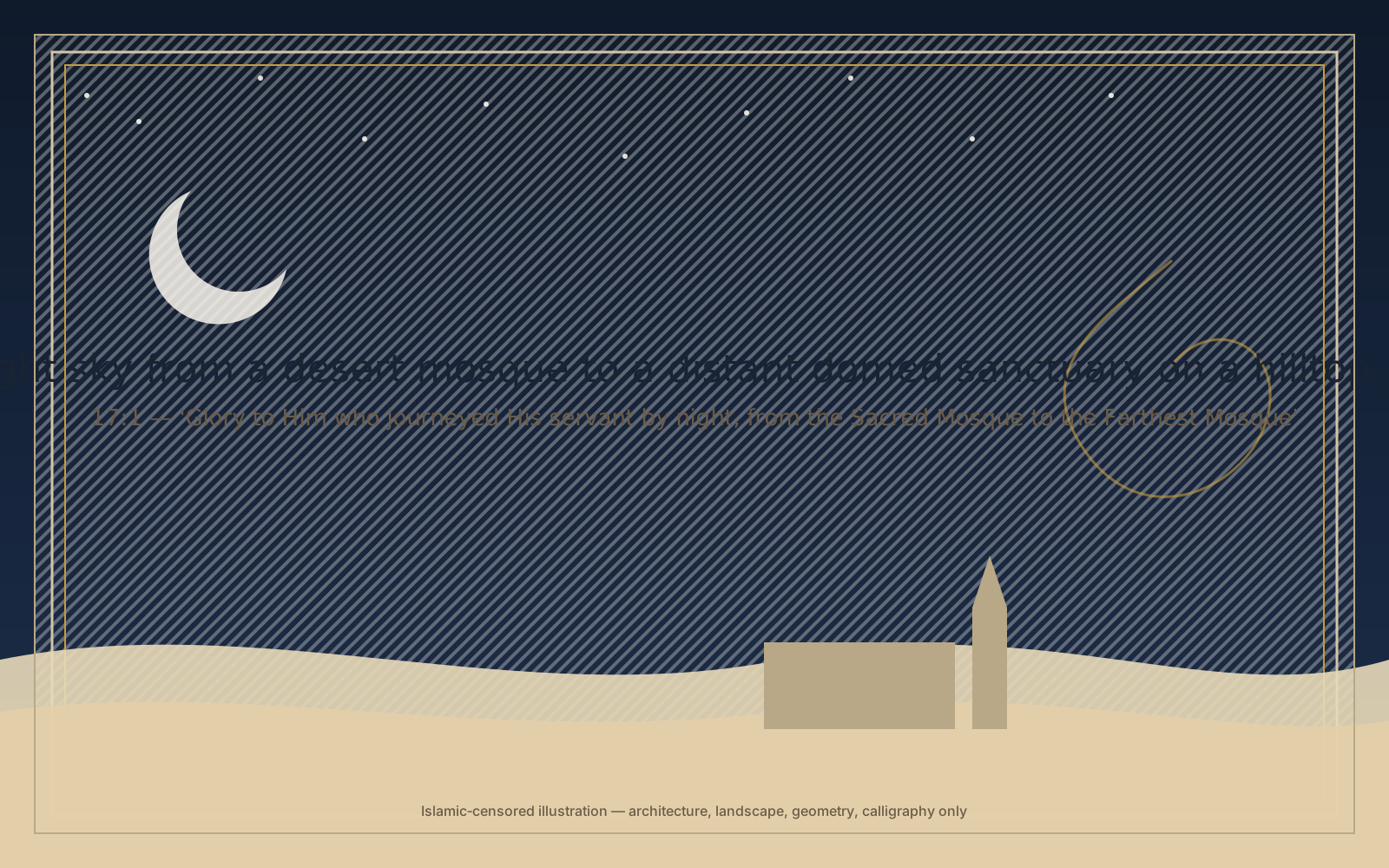
A luminous arc of light stretching across a night sky from a desert mosque to a distant domed sanctuary on a hilltop, stars scattered beneath the arc as though the traveller passed above them
17:1 — 'Glory to Him who journeyed His servant by night, from the Sacred Mosque to the Farthest Mosque'

There is no verse in the Quran quite like the first verse of Surah Al-Isra. It stands alone — a single sentence, dense with theology and geography and wonder, describing an event that has no parallel in any religious tradition. God took Muhammad, peace be upon him, by night from the Sacred Mosque in Mecca to the Farthest Mosque in Jerusalem. The Arabic is precise: 'asra bi-abdihi' — He journeyed with His servant. Not 'He sent His servant.' Not 'He commanded His servant to travel.' He went with him. The journey was not a solo flight. It was an escorted passage, and the escort was God Himself. The purpose, stated in the verse, was 'to show him of Our wonders.' God wanted Muhammad to see. And the place He chose to take him — Jerusalem, the city of Abraham and David and Solomon and Jesus — was not random. It was the spiritual capital of every previous revelation. Before Islam could build its own civilisation, its Prophet had to stand in the place where every earlier civilisation of faith had stood and fallen. He had to see the wreckage of those who came before. And then he had to come back to Mecca with a programme that would not repeat their failures. That programme is Surah Al-Isra: a social ethics code stretching from verses 23 to 39, covering parental duty, economic justice, the sanctity of life, sexual morality, orphan protection, honest trade, intellectual humility, and the prohibition of arrogance — seventeen commandments delivered with the force of divine decree. The Night Journey was the credential. The constitution was the cargo.

“Your Lord has commanded that you worship none but Him, and that you be good to your parents. If either of them or both of them reach old age with you, do not say to them a word of disrespect, nor scold them, but say to them kind words.”
— God 17:23
Spiritual Barometer
Force
strong
Tone
warning
Urgency
urgent

The Daily Revelation Edition 17

Lead Story

ONE VERSE, TWO MOSQUES, AND THE GEOGRAPHY OF PROPHECY: Why God Linked Mecca to Jerusalem Before Islam Had Either

Verse 17:1 is the only verse in the Quran that describes the Isra — the Night Journey — and it does so with a compression that rewards a lifetime of study. Every word is load-bearing.

"Glory to Him who journeyed His servant by night, from the Sacred Mosque, to the Farthest Mosque, whose precincts We have blessed, in order to show him of Our wonders. He is the Listener, the Beholder."

The verse opens with subhana — glory, exaltation, the declaration that God is beyond any limitation or imperfection. The scholars note that this word appears at the opening of a verse when the event described is so extraordinary that the listener needs to be prepared: whatever follows is beyond the normal order of things. The journey itself is introduced as God's act, not Muhammad's. Asra bi-abdihi — He journeyed with His servant. The Prophet is described not by his name, not by his title, not by his role as messenger, but as abd — servant. At the moment of his greatest honour, he is identified by his deepest humility. This is not a contradiction. In the Quran's framework, servanthood to God is the highest station a human being can achieve. Muhammad was not elevated despite being a servant. He was elevated because he was one.

The departure point: al-Masjid al-Haram, the Sacred Mosque in Mecca. The destination: al-Masjid al-Aqsa, the Farthest Mosque. At the time of this revelation, neither building existed in the form we know today. The Kaaba was still surrounded by idols. Jerusalem's temple had been destroyed centuries earlier. God was linking two sites not by their current physical state but by their eternal spiritual identity. Mecca was the house Abraham built for the worship of one God. Jerusalem was the city where David reigned and Solomon raised a temple to the same God. The Night Journey did not merely transport a man across geography. It stitched together two threads of prophetic history into a single garment.

The Quraysh found this claim absurd. A man who had never travelled beyond the Hijaz was claiming to have visited a city hundreds of miles away, in a single night, with no caravan, no provisions, no witnesses. They interrogated him. Describe the mosque in Jerusalem. Describe the route. Describe the caravans you passed over. According to the traditions, Muhammad described everything — details he had never seen with his waking eyes — and still they disbelieved. Not because the evidence was insufficient, but because the conclusion was intolerable. If the journey was real, then the man was what he claimed to be. And they were not prepared to accept what that meant for their lives.

The purpose of the journey is stated in the verse itself: li-nuriyahu min ayatina — to show him of Our wonders. God did not transport Muhammad to impress him. He transported him to educate him. The ayat — signs, wonders — that Muhammad witnessed during the Isra and the subsequent ascension through the heavens were not spectacle for spectacle's sake. They were the credentials of a man about to deliver the most comprehensive moral programme in the Quran. What follows verse 1 in Surah Al-Isra is not more wonder. It is law. It is ethics. It is the social contract of a civilisation that does not yet exist. The Night Journey gave Muhammad the authority. The remaining 110 verses deployed it.

And the verse closes with two divine names: al-Sami', al-Basir — the Listener, the Beholder. God hears everything and sees everything. After describing an event that the Quraysh would refuse to hear and refuse to see, the Quran reminds them: the One who arranged this journey misses nothing. He heard your mockery before you spoke it. He sees your denial before you express it. The journey happened whether you accept it or not. And the One who made it happen is watching.

17:1

The Daily Revelation Edition 17

Investigation

THE RISE AND RUIN OF BANI ISRAEL: Two Corruptions, Two Punishments, and a Warning That Echoes Into Every Century

Immediately after the Night Journey — before the ethics code, before the challenge to the Quraysh, before anything else — Surah Al-Isra pivots to a subject that seems, at first glance, disconnected: the history of the Children of Israel. Verses 2 through 8 deliver a compressed, devastating account of a nation given scripture, blessed with power, warned of consequences, and destroyed twice for its own corruption. The placement is not accidental. Muhammad has just returned from Jerusalem — the city where this history played out. What he saw there was not a thriving civilisation of faith. It was ruins. And the ruins had a lesson.

"And We conveyed to the Children of Israel in the Scripture: You will commit evil on earth twice, and you will rise to a great height" 17:4. The prophecy is remarkable for its specificity. Not once, but twice. Not minor transgressions, but fasad — corruption, spreading disorder. And the corruption would coincide with power: "you will rise to a great height"la-ta'lunna 'uluwwan kabiran. The Quran is identifying a pattern that political scientists would later call the corruption of power: it is precisely when a nation reaches its zenith of material strength that it becomes most vulnerable to moral collapse.

"When the first of the two promises came true, We sent against you servants of Ours, possessing great might, and they ransacked your homes. It was a promise fulfilled" 17:5. The identity of these 'servants of Ours' has been debated for centuries — Nebuchadnezzar and the Babylonians are the most common identification, their destruction of Solomon's Temple in 586 BCE matching the description. What is theologically significant is the language: ibadan lana — servants of Ours. The army that destroyed Jerusalem was not operating outside divine authority. It was executing divine judgment. The conquerors did not know they were instruments of God. But they were.

Then the cycle: "Then We gave you back your turn against them, and supplied you with wealth and children, and made you more numerous" 17:6. Restoration. Recovery. A second chance. The nation that was punished was rebuilt — not by its own effort alone, but by divine permission. Wealth returned. Numbers increased. Power was restored. And with it, the test: would they learn from the first destruction, or repeat the pattern?

"If you work righteousness, you work righteousness for yourselves; and if you commit evil, you do so against yourselves" 17:7. The Quran pauses the narrative to state a principle that applies not only to Bani Israel but to every nation in every era: the consequences of your choices are your own. Righteousness benefits you. Corruption destroys you. God is not affected either way. The universe is structured so that moral choices have material consequences, and no nation — no matter how chosen, how blessed, how historically significant — is exempt from this law.

The second destruction follows: "Then, when the second promise comes true, they will make your faces filled with sorrow, and enter the Temple as they entered it the first time, and utterly destroy all that falls into their power" 17:7. The Temple — al-Masjid — is entered and desecrated again. The Roman destruction of 70 CE, under Titus, fits the description: the Second Temple was razed, Jerusalem was sacked, and the Jewish population was scattered across the empire. History repeated itself because the choices repeated themselves.

And then the conditional that turns history into prophecy for every generation: "Perhaps your Lord will have mercy on you. But if you revert, We will revert" 17:8. The door is not closed. Mercy remains possible. But the warning is permanent: if the pattern returns — power without righteousness, strength without justice — then the consequences return with it. This is not a threat specific to Bani Israel. It is a law of civilisational physics, demonstrated through their history but applicable to any nation that inherits power and forgets what it is for.

Muhammad stood in Jerusalem and saw this history written in stone. He returned to Mecca and delivered it as a warning to a new community that was about to inherit the prophetic tradition. The message was not subtle: you are next. What you build will be tested by the same laws. Learn from the ruins, or become them.

17:2 17:3 17:4 17:5 17:6 17:7 17:8

The Daily Revelation Edition 17

Law & Ethics

THE SEVENTEEN COMMANDMENTS: Islam's Social Constitution, Delivered in Seventeen Verses Before the State Even Existed

Verses 23 through 39 of Surah Al-Isra contain the most concentrated passage of ethical legislation in the entire Meccan Quran. Seventeen verses. Seventeen commandments. A complete social ethics code covering the relationship between a human being and God, between a human being and family, between a human being and society, and between a human being and their own soul. The scholars have called it the Quran's Decalogue — but it exceeds Moses's Ten Commandments both in scope and in the psychological precision of its language.

The code opens and closes with the same command: "Do not set up another god with God" 17:22, 17:39. Monotheism is the bookend. Every social ethic in between is framed as a consequence of tawhid — the oneness of God. The logic is structural: if there is one God, then there is one moral law, and it applies to everyone equally. Social justice is not an optional add-on to theology. It is theology's first application.

The second commandment, and the one that receives the most elaborate treatment, concerns parents: "Your Lord has commanded that you worship none but Him, and that you be good to your parents. If either of them or both of them reach old age with you, do not say to them a word of disrespect, nor scold them, but say to them kind words. And lower to them the wing of humility, out of mercy" 17:23-24. The Arabic is extraordinary. The word for 'a word of disrespect' is uff — the smallest possible expression of annoyance, a sigh, a grunt, a barely audible exhale of impatience. The Quran does not prohibit hitting your parents, or cursing them, or abandoning them — all of which are obviously forbidden. It prohibits the sigh. It legislates at the level of the breath. If even the smallest sound of irritation is forbidden, then everything above it on the scale of disrespect is forbidden by implication. The prohibition starts at the floor and seals every exit above it.

The image that follows is among the most beautiful in the Quran: "lower to them the wing of humility"ikhfid lahuma janaha al-dhulli. A bird sheltering its young. The parent who once carried you now needs you to carry them, and the Quran's instruction is not merely to provide for them but to cover them — with tenderness, with protection, with the same instinctive devotion that a bird shows when it spreads its wings over a nest. The prayer that follows completes the cycle: "My Lord, have mercy on them, as they raised me when I was a child" 17:24. You were helpless once. They cared for you. Now they are helpless. The debt is not financial. It is existential.

The code then moves outward — from the self and parents to the wider community. Give relatives their rights. Give to the poor and the wayfarer. Do not be extravagant, for the wasteful are 'brethren of the devils' 17:27. Do not be miserly either: "Do not keep your hand tied to your neck, nor spread it out fully" 17:29 — the image of a hand chained to the neck (total stinginess) versus a hand flung wide open (reckless spending) captures the entire spectrum of economic vice in a single physical metaphor. The Quran wants balance. Moderation is not timidity. It is the discipline of knowing when to give and when to withhold.

Then the sanctity of life: "Do not kill your children for fear of poverty. We provide for them, and for you" 17:31. In pre-Islamic Arabia, female infanticide was practised by tribes who feared the economic burden of daughters. The Quran does not merely prohibit the act. It dismantles the reasoning. Fear of poverty is not a reason to kill, because provision comes from God, not from the child's potential earning power. The economic argument for infanticide collapses when you believe in a Provider who has already allocated sustenance for every soul He creates.

"Do not come near adultery" 17:32 — not 'do not commit adultery,' but 'do not come near it.' The prohibition extends to everything that leads toward the act: the glance, the private meeting, the gradual erosion of boundaries. The Quran legislates prevention, not merely punishment.

"Do not kill the soul which God has made sacred, except in the course of justice" 17:33. The right to life is described as haram — sacred, inviolable, protected by divine decree. The exception — bil-haqq, in the course of justice — is narrow: legal due process, not personal revenge. Even the next of kin who has a right to seek justice is warned: "he should not be excessive in killing". The right to redress does not become the right to rampage.

Protect the orphan's property 17:34. Honour your pledges 17:34. Give full measure in trade 17:35. Do not speak on matters you know nothing about — "the hearing, and the sight, and the brains — all these will be questioned" 17:36. Do not walk with arrogance 17:37. The final verse of the code delivers the summary: "That is some of the wisdom your Lord has revealed to you" 17:39. Some. Not all. The Quran is aware that it is giving a sample, a concentrated dose of divine wisdom that could fill volumes. And the code closes exactly where it opened: "Do not set up with God another god, or else you will be thrown in Hell, rebuked and banished."

This is the Quran's social constitution, delivered in Mecca, years before there was a Muslim state, a Muslim economy, or a Muslim legal system. The laws came before the nation. The ethics preceded the power. And that sequence — morality first, authority second — is itself the deepest commandment of all.

17:22 17:23 17:24 17:25 17:26 17:27 17:28 17:29 17:30 17:31 17:32 17:33 17:34 17:35 17:36 17:37 17:38 17:39

The Daily Revelation Edition 17

Theology

THE DEVIL'S BUSINESS PLAN: How Iblis Pitched His Strategy to God — and God Let Him Proceed

Surah Al-Isra contains one of the most psychologically revealing exchanges in the Quran: a negotiation between God and Iblis that reads less like a theological dialogue and more like a business pitch from a competitor who has just been fired and wants to sabotage his former employer's favourite project. The exchange runs from verse 61 to verse 65, and in those five verses, Satan lays out his entire strategy — target market, tactics, timeline, and projected outcomes — while God listens, permits, and then delivers the counterpoint that demolishes the entire proposal.

The backdrop: the angels have been commanded to bow before Adam. All comply except Iblis. And his objection is not theological — it is hierarchical. "Shall I bow down before someone You created from mud?" 17:61. The Arabic tin — clay, mud, earth — is spoken with contempt. Iblis does not dispute that God created Adam. He disputes that Adam deserves honour. The argument is about rank, not reality. And this is the Quran's diagnosis of the original sin: not disobedience in the abstract, but the refusal to accept God's judgment about who deserves what. Iblis wanted to be the judge. God had already judged. The rebellion was not against a command. It was against a verdict.

Then comes the pitch: "Do You see this one whom You have honored more than me? If You reprieve me until the Day of Resurrection, I will bring his descendants under my sway, except for a few" 17:62. Note the confidence. Not 'I will try.' Not 'I will attempt.' La-ahtanikanna — I will absolutely, certainly bring them under my control. The verb carries the sense of leading by the nose, of pulling a bridle. Iblis is claiming he can domesticate humanity — make them his livestock. And the exception he concedes — "except for a few" — is not humility. It is calculation. He knows that some humans will resist. He does not care. The business plan accounts for losses. The margins are still profitable.

God's response is not to argue. It is to authorise: "Begone! Whoever of them follows you — Hell is your reward, an ample reward" 17:63. The permission is total. God does not prevent Iblis from executing his strategy. He turns the strategy into a test. If humans follow Satan, they fail. If they resist, they pass. The exam has been designed, the examiner has been deployed, and the grading criteria are clear. God is not threatened by Iblis's pitch. He is using it.

Then God lists the tactics Satan may employ — and the list is comprehensive: "Entice whomever of them you can with your voice, and rally against them your cavalry and your infantry, and share with them in wealth and children, and make promises to them" 17:64. The voice of Satan — sawt — is traditionally understood as every seductive call that draws a person away from God: music that corrupts, rhetoric that misleads, whispers that erode resolve. The cavalry and infantry — khayl and rajil — are the human agents who carry out Satan's agenda without knowing they serve him: the enablers, the influencers, the systems that normalise sin. Sharing in wealth and children means the corruption of economic and family life — money earned through exploitation, children raised without moral formation. And the promises: "Satan promises them nothing but delusion" 17:64. The Quran provides the product review before the product is even launched. Every promise Satan makes is a lie. Every deal he offers is a fraud. And God is telling you this in advance, on the record, so that when the offer arrives — and it will — you cannot claim you were not warned.

And then the line that renders the entire satanic enterprise irrelevant: "As for My devotees, you have no authority over them. Your Lord is an adequate Guardian" 17:65. No authority. Zero. The Arabic sultan means power, control, coercive influence. Over God's sincere servants, Satan has none of it. Not reduced authority. Not limited authority. No authority. The business plan fails completely against anyone who is genuinely devoted to God. Satan can tempt. He can whisper. He can decorate falsehood. But he cannot compel. The door of the heart has a lock, and only the person inside can open it. If they do not open it, Satan stands outside forever.

The entire exchange reveals the Quran's psychology of evil. Evil is not an independent force. It is a permitted test, operating within boundaries set by the One who permitted it, effective only against those who consent to its influence, and powerless against anyone who says no. The devil has a strategy. God has a guarantee. And the guarantee outranks the strategy.

17:61 17:62 17:63 17:64 17:65

The Daily Revelation Edition 17

Literary Analysis

THE CHALLENGE THAT SILENCED ARABIA: 'If All Mankind and All the Jinn Combined Their Genius, They Could Not Produce the Like of This Quran'

Every major surah in the Quran contains some version of the challenge — the tahaddi — daring humanity to produce something comparable to the Quran. But nowhere in the entire revelation is the challenge stated with the cosmic scope it receives in verse 88 of Surah Al-Isra: "Say: If mankind and jinn came together to produce the like of this Quran, they could never produce the like of it, even if they backed up one another" 17:88.

The challenge elsewhere is literary: produce a surah, produce ten surahs, produce anything comparable. Here, the terms expand beyond literature into the realm of the absolute. Not just mankind — ins — but the jinn as well. Every rational being in creation, visible and invisible, human and non-human. Not just working independently, but collaborating: "even if they backed up one another"wa law kana ba'duhum li-ba'din zahira. Pool your resources. Share your intelligence. Unite across species. The Quran does not merely claim to be the best book. It claims to be the only book of its kind that any rational being could ever produce.

This verse was revealed in Mecca, to a community of Arabs who were, by every account, the finest literary culture on earth at that time. Arabic poetry in the seventh century was not a hobby. It was the highest art form, the supreme social currency, the standard by which intelligence and nobility were measured. A single poem could elevate a tribe's status for generations. The poets of pre-Islamic Arabia — Imru al-Qais, Labid, Zuhayr — were celebrities, legislators, historians. Their mu'allaqat — the 'hanging poems' displayed in the Kaaba — were considered the pinnacle of human linguistic achievement.

And into this culture, a man who was not a poet, who had never composed verse, who was known as al-Amin (the trustworthy) rather than al-Sha'ir (the poet), delivered a text that did not fit any existing literary category. The Quran is not poetry — it does not follow the metres and rhyme schemes of Arabic verse. It is not prose — it has a rhythmic, cadenced structure that prose lacks. It is not oratory — it exceeds the conventions of the khutba in both length and complexity. It is something else entirely. The Arabs, who had a classification system for every form of linguistic expression, had no category for the Quran. They could not even name what it was.

The Quraysh tried several labels. Sihr — sorcery. Shi'r — poetry. Asatir al-awwalin — tales of the ancients. None stuck, because none fit. The Quran's language does something that no human language was observed to do before or since: it sustains a style across 6,236 verses, revealed over 23 years, in response to wildly different circumstances — battles, legal disputes, personal grief, theological challenges, social reform — and maintains an internal consistency that no human author, working without revision over two decades under extreme duress, could plausibly achieve.

The verses following the challenge capture the absurdity of the Quraysh's counter-demands: "We will not believe in you unless you make a spring burst from the ground for us. Or you have a garden of palms and vines. Or make the sky fall on us in pieces. Or bring God and the angels before us. Or you possess a house of gold. Or you ascend into the sky" 17:90-93. The list is deliberately extravagant — each demand more theatrical than the last, escalating from hydrology to meteorology to a personal audience with the divine. And the Quran's response, placed in Muhammad's mouth, is devastating in its simplicity: "Glory be to my Lord. Am I anything but a human messenger?" 17:93. The Prophet does not claim to be a magician. He does not perform on demand. He is a man delivering a message. The miracle is the message itself. And they are too busy demanding special effects to read it.

17:88 17:89 17:90 17:91 17:92 17:93 17:94 17:95

The Daily Revelation Edition 17

Human Condition

THE HASTY ANIMAL: What Surah Al-Isra Reveals About the Psychology of the Human Being

Surah Al-Isra is, among other things, a sustained psychological portrait of the human species. Scattered across its 111 verses are observations about human nature so precise that they read like clinical notes — and the diagnosis is not flattering. The Quran loves humanity. But it does not pretend humanity is easy to love.

The first diagnosis arrives in verse 11: "The human being prays for evil as he prays for good. The human being is very hasty". The word is ajulan — hasty, impetuous, impatient, rushing. The human being, according to the Quran, does not merely make mistakes. He rushes toward them. He prays for things that would destroy him with the same fervour he prays for things that would save him — because he cannot tell the difference fast enough. Haste is not a flaw of the body. It is a flaw of perception. The human being wants immediately, and 'immediately' does not leave time for wisdom.

Verse 67 extends the portrait to ingratitude: "When harm afflicts you at sea, those you pray to vanish, except for Him. But when He saves you to land, you turn away. The human being is ever thankless." The Arabic kafura — from the same root as kafir — means actively ungrateful, aggressively forgetful of blessings. The scene is vivid: a man at sea, in a storm, terrified, calls on every idol and intermediary he can think of. None answer. Only God answers. The storm passes. Land appears. And the moment his feet touch dry ground, the gratitude evaporates. The God he screamed for in the waves becomes the God he ignores on shore. The cycle is not described as exceptional. It is described as typical: "The human being is ever thankless" — present tense, perpetual, built into the operating system.

Verse 83 adds another dimension: "When We bless the human being, he turns away and distances himself. But when adversity touches him, he is in despair." The psychology is precise. In prosperity, arrogance. In adversity, collapse. The human being has no middle register. He is either swaggering or crumbling. He takes credit for blessings as though he earned them and blames God for hardships as though he was promised immunity. The Quran's portrait is of a creature with an almost infinite capacity for self-deception: attributing success to his own genius and failure to cosmic injustice.

And verse 100 delivers the economic diagnosis: "If you possessed the treasuries of my Lord's mercy, you would have withheld them for fear of spending. The human being has always been stingy." Even if a human being had infinite resources — literally God's own treasury of mercy — he would hoard. The scarcity mindset is not a product of actual scarcity. It is a property of the human heart. Give a person everything, and he will still clutch it. The problem is not the size of the pile. The problem is the grip.

But the Quran does not leave the diagnosis without a remedy. Between these unflattering portraits, Al-Isra provides the counterweight: "We have honored the Children of Adam, and carried them on land and sea, and provided them with good things, and greatly favored them over many of those We created" 17:70. The human being is hasty, thankless, despairing, stingy — and honoured. Both things are true simultaneously. The honour is not earned by good behaviour. It is granted by divine decree. The Quran does not honour humanity because humanity is virtuous. It honours humanity because God chose to. And the ethics code of verses 23-39 is the Quran's answer to the question: you have been honoured beyond what you deserve — now how will you live up to it?

17:11 17:67 17:68 17:69 17:70 17:83 17:84 17:100

The Daily Revelation Edition 17

Spiritual Life

TRUTH HAS COME, AND FALSEHOOD HAS WITHERED: The Prayer Programme That Anchors an Entire Civilisation

In the closing third of Surah Al-Isra, after the ethics code and the psychological diagnosis and the prophetic debates, the surah narrows its focus to the most personal dimension of faith: the individual standing before God in prayer. Verses 78 through 82 are among the most concentrated devotional instructions in the Quran, and they reveal a spiritual programme designed not for monks or hermits but for people who live in the world and need an anchor to survive it.

"Perform the prayer at the decline of the sun, until the darkness of the night; and the Quran at dawn. The Quran at dawn is witnessed" 17:78. The verse establishes the timing of the five daily prayers by marking two boundaries — the decline of the sun (which initiates the afternoon prayers of Dhuhr and Asr) and the darkness of night (which encompasses Maghrib and Isha). Then it singles out one prayer for special attention: the Fajr prayer at dawn. "The Quran at dawn is witnessed"mashhudan — attended, observed, present at. The traditions explain that the angels of the night shift and the angels of the day shift overlap at Fajr, both groups witnessing the prayer. But even without the hadith, the verse establishes a principle: the dawn prayer has a unique spiritual weight. It is the prayer you perform when no one else is watching, when the world is asleep, when the only audience is the One you are praying to. Its difficulty is its credential. Its solitude is its distinction.

Then the night vigil: "And keep vigil with it during parts of the night, as an extra prayer. Perhaps your Lord will raise you to a laudable position" 17:79. The tahajjud — voluntary night prayer — is described as nafilatan laka — an extra, a surplus, a bonus specifically for Muhammad but available to every believer. The 'laudable position' — maqaman mahmudan — is traditionally understood as the station of intercession on the Day of Judgment, the highest honour any created being can receive. And the path to it passes through the darkest hours of the night, when sleep is sweet and no obligation compels you to rise. The Quran's economy of virtue is clear: the most valuable currency is the act that costs you the most comfort.

The prayer that follows is a masterpiece of spiritual compression: "My Lord, lead me in through an entry of truth, and lead me out through an exit of truth, and grant me from You a supporting power" 17:80. Entry and exit — mudkhala sidqin and mukhraja sidqin — are traditionally understood as entering and leaving Medina, or entering and leaving every situation, every endeavour, every phase of life. The prayer asks for truth at every threshold. Not success. Not comfort. Truth. And then the request for sultanan nasira — a supporting authority, a power that aids. The Prophet is being taught to ask not for ease but for alignment: let me enter truthfully, leave truthfully, and be supported by a power greater than my own.

And then verse 81 — one of the most famous declarations in the Quran: "The truth has come, and falsehood has withered away; for falsehood is bound to wither away." The Arabic zahuqa means to perish, to collapse, to deflate — like a punctured balloon, like a dying flame. Falsehood is not merely wrong. It is structurally unsustainable. It withers because its nature is to wither. Truth does not need to defeat falsehood in combat. It needs only to arrive. The arrival is the victory. Falsehood cannot coexist with truth any more than darkness can coexist with light. One enters, and the other ceases to exist.

The programme is complete. Pray at the appointed times. Wake before dawn. Rise in the night. Ask for truth at every doorway. And know that truth, by its nature, wins. Not because the righteous are powerful, but because falsehood is fragile. The entire devotional architecture of Islam is contained in these five verses — and it is offered not as theology but as therapy. A human being who prays five times a day, who rises before dawn, who interrupts his sleep for voluntary worship, who asks for truth before asking for success, and who lives in the certainty that falsehood will eventually collapse under its own weight — that human being is equipped to survive anything the world can throw at him. That is the point. The prayer programme is not ritual. It is infrastructure.

17:78 17:79 17:80 17:81 17:82

The Daily Revelation Editorial Edition 17

✸ ✸ ✸

Letter from the Editor: The Prophet Who Saw Everything and Came Back with Rules

The story of the Night Journey is, by any standard, the most extraordinary travel narrative in religious literature. A man is transported from one holy city to another, then lifted through the heavens, past the prophets, past the angels, to a proximity with God that no human being had reached before. He sees paradise and hell. He meets Abraham, Moses, Jesus. He is shown the mechanics of the unseen world. And when he returns to Mecca, standing in the same street where he started, he does not come back with stories of celestial wonders. He comes back with rules.

Be good to your parents. Do not sigh at them when they are old. Give to the poor. Do not waste money. Do not kill your children. Do not approach adultery. Protect orphans. Weigh your scales honestly. Do not pretend to know what you do not know. Do not strut.

This is what the Night Journey produced. Not theology floating in the clouds, but ethics rooted in the earth. The man who was shown the farthest limits of creation came back talking about how to treat your mother. The man who saw the rewards of paradise and the punishments of hell came back telling people to give full measure in the marketplace. The man who was granted an audience beyond the reach of any angel came back saying: do not walk proudly on the earth. You cannot pierce it. You cannot match the mountains.

There is a lesson in this sequence that Surah Al-Isra makes unavoidable. Spiritual experience, no matter how exalted, is not the destination. It is the fuel. Muhammad's ascension did not end with enlightenment. It ended with a social programme. The higher he went, the more practical the message became. The closer he drew to God, the more God talked about neighbours and orphans and honest trade. This is the Quran's hierarchy: the peak of spiritual experience produces the foundation of social responsibility. You go up to come back down. You see the heavens so that you can fix the earth.

Surah Al-Isra is 111 verses long, and its architecture mirrors this principle. It begins with wonder — one transcendent verse about a journey beyond time and space. It moves through history — the cautionary tale of Bani Israel, whose spiritual privilege did not protect them from their own corruption. It delivers its ethics code — the seventeen commandments that form Islam's social constitution. It diagnoses human nature — hasty, thankless, stingy, despairing. It confronts Satan — granting him permission to test and then guaranteeing his failure against the sincere. It challenges the world to match the Quran — and records the absurd demands of those who refused to even try. And it closes with prayer — the daily rhythm that holds everything together.

The Night Journey was real. The ascension was real. The wonders Muhammad saw were real. But the surah named after that journey spends exactly one verse describing it and 110 verses on what it means. Because the journey was never the point. The return was.

For Reflection
Muhammad was taken to the farthest reaches of heaven — and came back talking about being kind to parents and honest in trade. What does that tell you about what God considers truly important? Today, look at your own spiritual life: are your highest moments producing practical goodness in how you treat the people around you? Or does your worship float above your daily conduct, disconnected from it?
Supplication
O Allah, You took Your Prophet on a journey beyond the reach of any creation, and You brought him back with a programme for how to live on earth. Teach us the same lesson. When we pray, let the prayer change how we treat our parents. When we fast, let the fast change how we spend our money. When we read the Quran, let the reading change how we speak to those weaker than us. Do not let our worship become decoration. Make it architecture. Make our faith the foundation of our conduct, not an ornament on top of it. Grant us an entry of truth and an exit of truth, and from You a supporting power. Ameen.
✸ ✸ ✸

The Daily Revelation Back Page Edition 17

Today's Action
Verse 17:23 prohibits even the smallest sigh of irritation toward aging parents. Today, call or visit your parents — or the person who raised you — and consciously give them ten minutes of undivided, patient, gentle attention. No phone. No multitasking. No sighing. Lower the wing of humility, as Al-Isra commands, and be present with them the way a bird is present over its nest.
Weekly Challenge
The Seventeen Commandments of Al-Isra (17:22-39) are Islam's most concentrated ethical code. This week, read one commandment each day. On day one, examine your relationship with God (17:22). On day two, your relationship with your parents (17:23-24). On day three, your generosity to relatives and the poor (17:26-28). On day four, your financial discipline (17:29-30). On day five, the sanctity of life and sexual ethics (17:31-33). On day six, your honesty and intellectual humility (17:34-36). On day seven, your humility before God and creation (17:37-39). By the end of the week, you will have audited your entire moral life against the Quran's own checklist.
Related Editions
Edition 1 The five daily prayers — formalised during the Mi'raj that begins in 17:1 — each open with Al-Fatiha. The Night Journey gave the prayers; Al-Fatiha is their key.
Edition 2 The story of Bani Israel expanded across 40+ verses — the same nation whose two destructions Al-Isra compresses into seven verses (17:2-8).
Edition 7 The fall of Iblis before Adam — told in greater detail in 7:11-18, paralleling the exchange in 17:61-65.
Edition 15 'We have given you the Seven Oft-Repeated' (15:87) — the Night Journey formalized Al-Fatiha's role in the five prayers.
Edition 20 Musa and Firawn — the same confrontation referenced in 17:101-103, told in full dramatic detail.
Edition 55 The dual challenge structure: Al-Isra challenges humanity to match the Quran (17:88); Ar-Rahman challenges creation to deny God's favours.
Characters in This Edition
Allah Muhammad Iblis Musa Firawn Adam Angels Children of Israel Nuh Dawud Believers Mankind
Coming Next
NEXT EDITION: Surah Al-Kahf — The Cave, the sleepers, the companion with two gardens, Musa's journey with Khidr, and Dhul-Qarnayn's wall. Four parables about the tests that define every human life: faith under persecution, wealth versus gratitude, knowledge versus humility, and power versus justice. The most widely recited surah every Friday — and the Quran's answer to the question: what happens when you are tested in ways you did not expect?
Page 1 of 10
Ed. 16 Ed. 18