Edition 26 of 114 Mecca Bureau 227 Verses

The Daily Revelation

Revelation. Reported. Truth.
الشعراء

Ash-Shu'ara — The Poets
Force: Strong Tone: Warning Urgency: Urgent

SEVEN PROPHETS, ONE WARNING: Dispatches from Every Front in God's Longest Campaign Against Tyranny

Moses faces Pharaoh in the most dramatic courtroom confrontation in scripture. Abraham dismantles idolatry with logic. Noah endures centuries of mockery. Hud, Salih, Lot, and Shuayb each deliver the same message to different civilizations — and each is met with the same contempt. Then, in a stunning coda, the Quran turns on the poets themselves. The pattern is unmistakable. The question is whether anyone is listening.


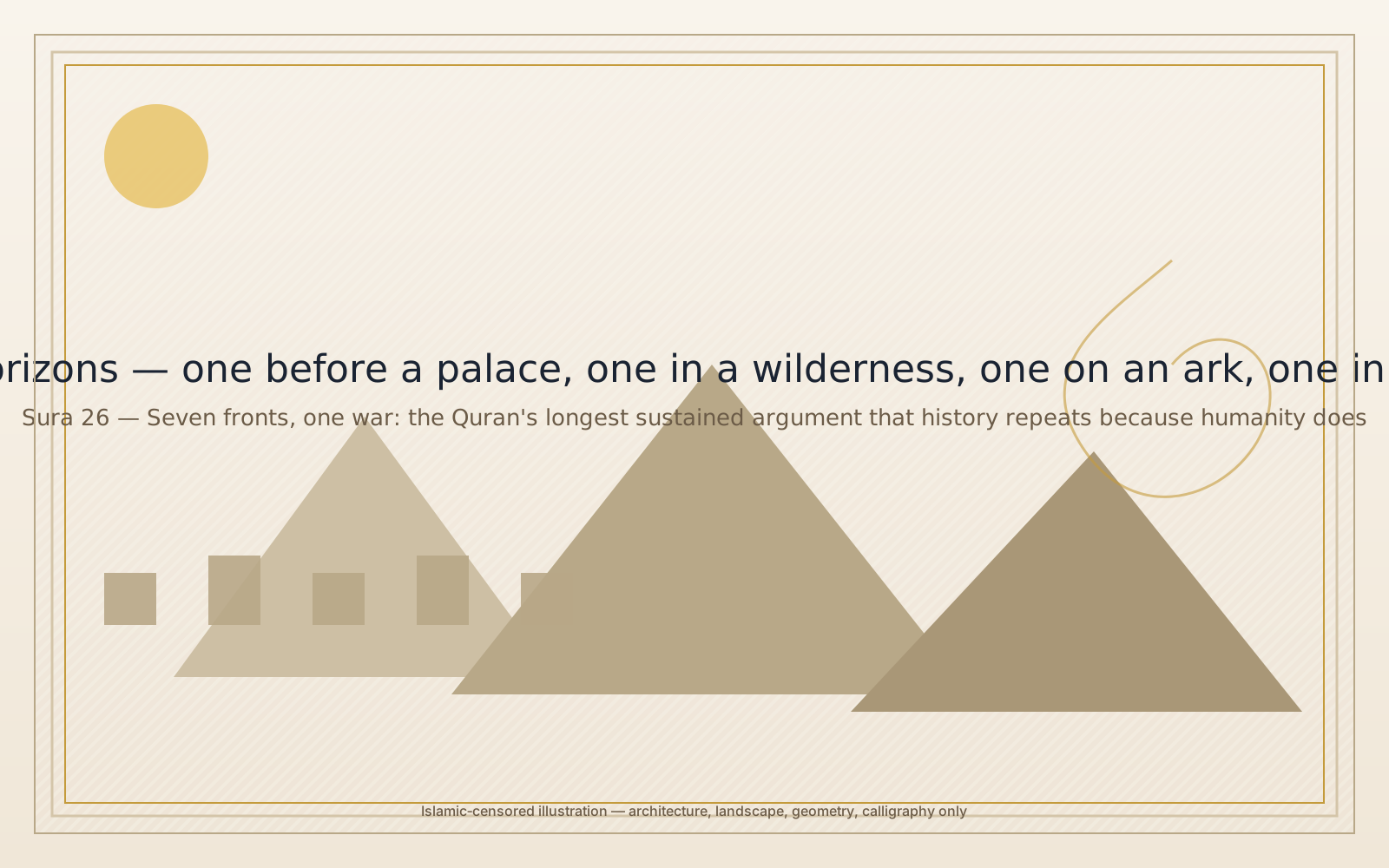
Seven prophets standing at seven different horizons — one before a palace, one in a wilderness, one on an ark, one in mountain ruins, one beside a she-camel, one at city gates, one in a marketplace — all facing away toward their respective peoples
Sura 26 — Seven fronts, one war: the Quran's longest sustained argument that history repeats because humanity does

It begins with a heartbroken messenger. 'Perhaps you will destroy yourself with grief, because they do not become believers' (26:3). God is speaking to Muhammad — and the concern is not rhetorical. The Prophet is killing himself over Mecca's refusal to listen. God's response is not comfort. It is evidence. What follows is the most relentless prosecutorial brief in the Quran: seven consecutive case studies, drawn from the full span of prophetic history, each proving the same thesis. A messenger is sent. He asks for nothing. He delivers the warning. The people mock him, threaten him, demand miracles or silence. Destruction comes. Then the refrain — repeated seven times, like a judge's gavel striking after each verdict: 'Surely in this is a sign, but most of them are not believers. Your Lord is the Almighty, the Merciful.' This is Sura Ash-Shu'ara. Two hundred and twenty-seven verses. Ninety-eight direct quotes. Seven prophets. One question: if every civilization before you rejected the warning and was destroyed, what makes you think you are the exception?

“Surely in this is a sign, but most of them are not believers. Your Lord is the Almighty, the Merciful.”
— God — the sevenfold refrain 26:8-9 (repeated at 26:67-68, 103-104, 121-122, 139-140, 158-159, 174-175, 190-191)
Spiritual Barometer
Force
strong
Tone
warning
Urgency
urgent

The Daily Revelation Edition 26

Dispatch I — Egypt

'WHAT IS THE LORD OF THE WORLDS?': Moses and Pharaoh in the Greatest Theological Debate Ever Recorded

The confrontation opens not with thunder but with anxiety. Moses, commanded by God to face the most powerful ruler on earth, responds with the most human confession in prophetic literature: "My Lord, I fear they will reject me. And I become stressed, and my tongue is not fluent, so send Aaron too" 26:12-13. And then the real fear — the one buried beneath the stammer: "And they have a charge against me, so I fear they will kill me" 26:14. Moses had killed an Egyptian years earlier. He was a wanted man returning to the scene of his crime. God's answer cut through every objection: "No. Go, both of you, with Our proofs. We will be with you, listening" 26:15.

The audience with Pharaoh is the most extraordinary dialogue in the Quran — a three-round theological debate conducted at the highest possible stakes. Pharaoh opens with psychology, not theology. He tries to humiliate Moses personally: "Did we not raise you among us as a child, and you stayed among us for many of your years? And you committed that deed you committed, and you were ungrateful" 26:18-19. You are ours. We made you. You owe us. And you are a killer.

Moses does not flinch. He concedes the killing — "I did it then, when I was of those astray" 26:20 — and then pivots with devastating precision: "Is that the favor you taunt me with, although you have enslaved the Children of Israel?" 26:22. You raised one child in luxury while enslaving his entire nation. That is not generosity. That is exhibit A.

Then comes the theological exchange that shook the foundations of Pharaoh's court. Pharaoh asks the question he believes will expose Moses as a fraud: "And what is the Lord of the Worlds?" 26:23. Moses answers: "The Lord of the heavens and the earth, and everything between them, if you are aware" 26:24. Pharaoh turns to his courtiers with theatrical disbelief: "Do you not hear?" 26:25. Moses escalates: "Your Lord and the Lord of your ancestors of old" 26:26. Pharaoh escalates in response: "This messenger of yours, who is sent to you, is crazy" 26:27. And Moses delivers the final answer — the one that leaves no room for Pharaoh's claim to divinity: "Lord of the East and the West, and everything between them, if you understand" 26:28.

Three answers. Each one larger than the last. The heavens and earth. Your own ancestors. The East and the West. Moses did not argue for God's existence. He simply described God's jurisdiction — and each description shrank Pharaoh's kingdom to insignificance. The Lord of the heavens makes Pharaoh's palace a footnote. The Lord of his ancestors makes his dynasty a tenant. The Lord of East and West makes his borders imaginary.

Pharaoh's response was the response of every tyrant cornered by truth: "If you accept any god other than me, I will make you a prisoner" 26:29. When the argument is lost, reach for the handcuffs. Moses offered evidence instead: his staff became a serpent, his hand shone white 26:32-33. Pharaoh called it magic and summoned his own magicians for a public showdown — the last gamble of a man who had already lost the debate but still held the instruments of power.

26:10 26:11 26:12 26:13 26:14 26:15 26:16 26:17 26:18 26:19 26:20 26:21 26:22 26:23 26:24 26:25 26:26 26:27 26:28 26:29 26:30 26:31 26:32 26:33 26:34 26:35

The Daily Revelation Edition 26

Dispatch I — Egypt (continued)

THE MAGICIANS WHO SWITCHED SIDES: How Pharaoh's Own Weapons Turned Against Him

Pharaoh's strategy was sound by every metric of political theatre. Gather the best magicians in the kingdom. Stage a public contest. Expose Moses as a fraud before the masses. The crowd was primed — "Are you all gathered? That we may follow the magicians, if they are the winners" 26:39-40. The people had already chosen their side before a single rope was thrown.

The magicians were professionals. They negotiated terms before performing: "Is there a reward for us, if we are the winners?" 26:41. Pharaoh promised them rank and proximity to power 26:42. They were mercenaries of illusion, men whose loyalty was to the highest bidder. They threw their ropes and sticks with a battle cry that tells us everything about the system they served: "By the majesty of Pharaoh, we will be the winners" 26:44. Their oath was to a man, not to truth.

Then Moses threw his staff. It swallowed their trickery 26:45. The verb the Quran uses — talqafu — means to devour rapidly, as if the staff were hungry for their lies. And what happened next remains one of the most psychologically stunning reversals in all of scripture: "And the magicians fell down prostrating. They said, 'We have believed in the Lord of the Worlds. The Lord of Moses and Aaron'" 26:46-48.

These men walked into the arena as Pharaoh's champions. They walked out — or rather, fell — as believers. The very experts Pharaoh had assembled to discredit Moses became Moses's most powerful witnesses. They knew magic. They had spent their lives perfecting illusion. And what Moses did was not magic. They recognised the difference instantly, the way a counterfeiter recognises genuine currency. The staff did not behave like a trick. It behaved like a truth.

Pharaoh's reaction was that of every authoritarian whose instruments of control malfunction in public. He did not engage with what had happened. He fabricated a conspiracy: "Did you believe in Him before I have given you permission? He must be your chief, who taught you magic" 26:49. The accusation was absurd — that Moses had secretly trained Pharaoh's own magicians as a fifth column. But absurdity has never stopped a dictator when the alternative is admitting defeat. Then came the threat: "I will cut off your hands and feet on opposite sides, and I will crucify you all" 26:49.

The magicians' response is the most courageous statement in the Quran. Moments ago they were careerists bargaining for promotion. Now, facing mutilation and execution, they said: "No problem. To our Lord we will return. We are eager for our Lord to forgive us our sins, since we are the first of the believers" 26:50-51. No problem. The Arabic is la dayra — no harm. They looked at crucifixion and called it acceptable. They had discovered something more real than Pharaoh's power, and having discovered it, they found that his threats — which had governed their entire lives until five minutes ago — simply did not matter anymore.

The exodus followed swiftly. God told Moses to travel by night 26:52. Pharaoh mobilised his army: "These are a small gang. And they are enraging us. But we are a vigilant multitude" 26:54-56. The language of every empire that has ever dismissed a liberation movement — small, annoying, insignificant. At sunrise, the two groups met at the sea. Moses's people panicked: "We are being overtaken" 26:61. Moses answered with seven words that defined prophetic certainty: "No; my Lord is with me, He will guide me" 26:62.

Then: "Strike the sea with your staff" 26:63. The sea parted. Each wall of water stood like a mountain. The Israelites crossed. Pharaoh's army followed. The waters closed. "And We saved Moses and those with him, all together. Then We drowned the others" 26:65-66. And then the refrain, for the second time: "Surely in this is a sign, but most of them are not believers. Your Lord is the Almighty, the Merciful" 26:67-68.

26:36 26:37 26:38 26:39 26:40 26:41 26:42 26:43 26:44 26:45 26:46 26:47 26:48 26:49 26:50 26:51 26:52 26:53 26:54 26:55 26:56 26:57 26:58 26:59 26:60 26:61 26:62 26:63 26:64 26:65 26:66 26:67 26:68

The Daily Revelation Edition 26

Dispatch II — Mesopotamia

ABRAHAM'S LOGICAL DEMOLITION: The Prophet Who Destroyed Idolatry With Five Questions

After the grand theatre of Moses and Pharaoh — the serpents, the sea, the drowning army — the Quran shifts to a quieter kind of confrontation. Abraham does not perform miracles. He does not face a king. He faces his own father and his own community, and his weapon is not a staff but a question.

"What do you worship?" 26:70. The simplest question in theology. His people answered honestly: "We worship idols, and we remain devoted to them" 26:71. Abraham followed with two more: "Do they hear you when you pray? Or do they benefit you, or harm you?" 26:72-73. These are not rhetorical questions. They are diagnostic. They test whether the worshipper has ever examined the transaction. You give devotion. What do you receive?

The answer was devastating in its honesty: "But we found our ancestors doing so" 26:74. Not 'they answer our prayers.' Not 'they protect us.' Not 'they have proven their power.' We do it because our fathers did it. The only justification was precedent — the weight of inherited habit masquerading as faith.

Abraham seized on this with surgical precision: "Have you considered what you worship. You and your ancient ancestors? They are enemies to me, but not so the Lord of the Worlds" 26:75-77. He did not merely reject the idols. He declared them adversaries. And then he described what a real God does — not in abstract theology but in the language of daily life:

"He who created me, and guides me. He who feeds me, and waters me. And when I get sick, He heals me. He who makes me die, and then revives me" 26:78-81. Creation. Guidance. Food. Water. Health. Death. Resurrection. Abraham mapped the entire human experience and attributed every station to one source. The idols could not compete because they had never competed — they had never done anything at all.

Then came the prayer — one of the most beautiful in the Quran, and the one that reveals Abraham's deepest yearning: "My Lord! Grant me wisdom, and include me with the righteous. And give me a reputation of truth among the others. And make me of the inheritors of the Garden of Bliss. And forgive my father — he was one of the misguided" 26:83-86. Even as he dismantled his father's religion, he prayed for his father's forgiveness. The intellectual rejection was total. The filial love was unbroken.

And then the verse that transcends the entire surah: "The Day when neither wealth nor children will help. Except for him who comes to God with a sound heart" 26:88-89. A sound heart. In Arabic: qalbin saleem. Not a heart that has never sinned. Not a heart that has performed every ritual. A heart that is sound — whole, uncorrupted, oriented toward truth. Abraham's argument was never really about idols. It was about what you bring to God when everything else is stripped away.

26:69 26:70 26:71 26:72 26:73 26:74 26:75 26:76 26:77 26:78 26:79 26:80 26:81 26:82 26:83 26:84 26:85 26:86 26:87 26:88 26:89 26:90 26:91 26:92 26:93 26:94 26:95 26:96 26:97 26:98 26:99 26:100 26:101 26:102 26:103 26:104

The Daily Revelation Edition 26

Dispatches III-V — The Brief Reports

THREE CIVILIZATIONS, THREE WARNINGS, THREE RUINS: Noah's Flood, Hud's Wind, Salih's Earthquake

After the extended dispatches from Egypt and Mesopotamia, the Quran shifts to a rapid-fire sequence — three prophet stories told with compressed urgency, each following an identical structure so precise it reads like a legal template. The repetition is the argument. These are not three different stories. They are the same story, happening to different people who all made the same mistake.

Dispatch III: Noah and the Elitists (26:105-122)

Noah's people rejected him with a class-based argument: "Shall we believe in you, when it is the lowliest who follow you?" 26:111. They looked at Noah's followers and saw the poor, the marginal, the powerless. They concluded that any truth embraced by such people could not be worth following. It is the oldest form of intellectual snobbery — judging a message by the social status of its audience.

Noah's response demolished the premise: "What do I know about what they do? Their account rests only with my Lord, if you have sense. And I am not about to drive away the believers" 26:112-114. He refused to curate his congregation for the comfort of the elite. He would not perform the gatekeeping his opponents demanded. When they escalated to threats — "If you do not refrain, O Noah, you will be stoned" 26:116 — he turned to God with a stark appeal: "My Lord, my people have denied me. So judge between me and them decisively" 26:117-118. The Ark came. The flood came. The verdict was delivered.

Dispatch IV: Hud and the Builders of Vanity (26:123-140)

The people of Ad were builders. Monumental, ambitious, ostentatious builders. Hud diagnosed their civilisation with four indictments: "Do you build a monument on every height for vanity's sake? And you set up fortresses, hoping to live forever? And when you strike, you strike mercilessly?" 26:128-130. Vain architecture. Delusions of immortality. Brutal power. Three symptoms of a civilisation that has confused capability with legitimacy.

Their response was the most chilling dismissal in the surah: "It is the same for us, whether you lecture us, or do not lecture. This is nothing but morals of the ancients" 26:136-137. They were not merely rejecting Hud's message. They were rejecting the very category of moral discourse. Lecture or do not lecture — it makes no difference. We are beyond being spoken to. The wind that destroyed them was not just punishment. It was the natural consequence of a civilisation that had declared itself immune to correction.

Dispatch V: Salih and the She-Camel Test (26:141-159)

The people of Thamud demanded proof. "You are nothing but a man like us. So bring us a sign, if you are truthful" 26:154. Salih provided it — a she-camel, miraculously produced, with a simple condition: "This is a she-camel; she has her turn of drinking, and you have your turn of drinking — on a specified day. And do not touch her with harm" 26:155-156. It was the gentlest possible test. Share water with an animal. Do not harm it. That was all.

They slaughtered it 26:157. The Quran does not explain why. It does not need to. The she-camel was not a practical problem — it was a symbolic one. Its presence was a daily reminder that they were under observation, that their autonomy was conditional, that someone else had authority over their resources. They killed it for the same reason every tyrant destroys the evidence of a higher law: because its existence was intolerable to their self-image.

After each of these three dispatches — Noah's flood, Hud's wind, Salih's earthquake — the same refrain: "Surely in this is a sign, but most of them are not believers. Your Lord is the Almighty, the Merciful". The Quran is not just telling stories. It is building a case. And each repetition of the refrain is another piece of evidence entered into the record.

26:105 26:106 26:107 26:108 26:109 26:110 26:111 26:112 26:113 26:114 26:115 26:116 26:117 26:118 26:119 26:120 26:121 26:122 26:123 26:124 26:125 26:126 26:127 26:128 26:129 26:130 26:131 26:132 26:133 26:134 26:135 26:136 26:137 26:138 26:139 26:140 26:141 26:142 26:143 26:144 26:145 26:146 26:147 26:148 26:149 26:150 26:151 26:152 26:153 26:154 26:155 26:156 26:157 26:158 26:159

The Daily Revelation Edition 26

Dispatches VI-VII — The Final Two

LOT'S DOOMED CITY AND SHUAYB'S CORRUPT MARKETPLACE: The Last Two Fronts Before the Verdict

The final two dispatches accelerate the pattern to its conclusion. By this point in the surah, the reader knows the template — messenger arrives, delivers warning, asks nothing in return, is rejected, destruction follows. The Quran knows the reader knows. And it uses that foreknowledge as pressure. You can see the ending coming. So could they. The difference is that we have the hindsight they refused to develop.

Dispatch VI: Lot and the City Without Shame (26:160-175)

Lot's confrontation is the most personal of the seven. He is not facing a king or an empire. He is facing his neighbours. The people he lives among. And the corruption he addresses is not idolatry or political tyranny but the social fabric itself: "Do you approach the males of the world? And forsake the wives your Lord created for you? Indeed, you are intrusive people" 26:165-166.

Their response was not argument. It was expulsion: "Unless you refrain, O Lot, you will be expelled" 26:167. The threat reveals the nature of the community. They did not say 'you are wrong.' They said 'you will be removed.' Dissent was not tolerated, not because it was irrational, but because it was inconvenient. Lot's answer carried the weight of a man who had tried everything: "I certainly deplore your conduct" 26:168. Then the prayer of a prophet who knew he had failed to change his people: "My Lord, save me and my family from what they do" 26:169.

God answered. Lot and his family were saved — "except for an old woman among those who tarried" 26:171. His wife. The woman who stayed behind, not because she was physically unable to leave but because something held her to the city she should have fled. The Quran does not elaborate. It does not need to. Some attachments are stronger than survival.

Then the rain — not water, but destruction: "And We rained down on them a rain. Dreadful is the rain of those forewarned" 26:173. Forewarned. The word is crucial. They had been told. The rain was not a surprise. It was a fulfilment.

Dispatch VII: Shuayb and the Fraudulent Scales (26:176-191)

The final dispatch is unique among the seven. Shuayb's people — the People of the Woods, inhabitants of Madyan — are not condemned for idolatry, sexual immorality, or political tyranny. They are condemned for cheating in business: "Give full measure, and do not cheat. And weigh with accurate scales. And do not defraud people of their belongings, and do not work corruption in the land" 26:181-183.

This is the Quran placing commercial fraud in the same catalogue as Pharaoh's despotism and the destruction of Sodom. The message is unmistakable: dishonesty in the marketplace is not a minor infraction. It is a civilisational sin of the same order as tyranny and moral collapse. Shuayb's indictment is the only one in the seven dispatches that modern readers might recognise as a regulatory violation rather than a theological crisis — and that is precisely the point. The line between sacred and secular does not exist in the Quran's moral architecture.

The people of Madyan responded with contempt: "You are one of those bewitched. And you are nothing but a man like us; and we think that you are a liar. So bring down on us pieces from the sky, if you are truthful" 26:185-187. They dared God to punish them. Shuayb's answer was quiet and final: "My Lord is Well Aware of what you do" 26:188. And then: "The punishment of the day of gloom gripped them. It was the punishment of a great day" 26:189.

The seventh refrain falls. "Surely in this is a sign, but most of them are not believers. Your Lord is the Almighty, the Merciful" 26:190-191. Seven messengers. Seven rejections. Seven destructions. Seven identical refrains. The prosecution rests.

26:160 26:161 26:162 26:163 26:164 26:165 26:166 26:167 26:168 26:169 26:170 26:171 26:172 26:173 26:174 26:175 26:176 26:177 26:178 26:179 26:180 26:181 26:182 26:183 26:184 26:185 26:186 26:187 26:188 26:189 26:190 26:191

The Daily Revelation Edition 26

Special Investigation

THE SEVENFOLD REFRAIN: Why the Quran Repeats the Same Two Verses Seven Times in One Chapter

No serious reader of Sura Ash-Shu'ara can miss the refrain. After every prophet's story — after Moses and Pharaoh, after Abraham and the idolaters, after Noah and the mockers, after Hud and the builders, after Salih and the she-camel, after Lot and the city, after Shuayb and the merchants — the same two verses appear:

"Surely in this is a sign, but most of them are not believers. Your Lord is the Almighty, the Merciful."

Seven times. Word for word. In a Book that never wastes a syllable.

The question is not whether the repetition is deliberate — of course it is. The question is what it does. And the answer lies in the psychology of accumulation.

When you hear a verdict once, you process it as information. When you hear it twice, you notice a pattern. By the third time, you feel the weight of precedent building. By the fourth and fifth, you begin to sense that this is not a narrative technique but a judicial procedure — evidence being entered into the record, exhibit after exhibit, each one strengthening the case. By the sixth and seventh, the refrain has become inescapable. It is not repeating the same fact. It is compounding the same indictment.

Consider the structure. "Surely in this is a sign" — the evidence was presented. "But most of them are not believers" — the evidence was rejected. "Your Lord is the Almighty" — God has the power to enforce His judgement. "The Merciful" — and yet He sends another messenger first. The pattern itself is an argument: power restrained by mercy, mercy exhausted by rejection, rejection followed by consequence.

The refrain also functions as a structural device that turns seven separate stories into a single prosecutorial argument. Without it, Sura 26 would be an anthology — a collection of interesting historical vignettes. With it, the surah becomes a courtroom. Each prophet's story is a witness called to the stand. Each refrain is the prosecution pausing to address the jury: have you heard enough yet?

By the time the seventh refrain falls at verse 191, the reader is not merely informed. The reader is convicted. The stories are no longer about Noah or Hud or Salih. They are about whoever is reading — about any person, any society, any civilisation that hears a warning and chooses comfort over truth. The refrain's final function is a mirror. "Most of them are not believers." The question it leaves hanging is: are you?

26:8 26:9 26:67 26:68 26:103 26:104 26:121 26:122 26:139 26:140 26:158 26:159 26:174 26:175 26:190 26:191

The Daily Revelation Edition 26

Arts & Letters

THE PARADOX OF THE POETS: Why the Most Beautiful Arabic Text in History Condemns the Poets

The surah is named after them. And it condemns them. The final section of Ash-Shu'ara pivots from prophetic history to literary criticism — and the transition is one of the most intellectually provocative moves in the entire Quran.

After seven stories, after seven refrains, after 191 verses of evidence that divine revelation is consistently rejected by human civilisations, the Quran turns to defend itself. Against what charge? The charge that Muhammad was a poet. That the Quran was poetry. That what sounded like revelation was really just eloquent verse from a gifted wordsmith.

The defence begins by establishing the Quran's provenance: "It is a revelation from the Lord of the Worlds. The Honest Spirit came down with it. Upon your heart, that you may be one of the warners. In a clear Arabic tongue" 26:192-195. Not composed by a human mind. Delivered by Gabriel. Placed upon the heart — not the tongue, not the pen, the heart. The medium of reception is emotional and spiritual, not literary.

Then the Quran addresses the Meccan accusation directly, in a passage of extraordinary bluntness: "It was not the devils that revealed it. It is not in their interests, nor in their power. They are barred from hearing" 26:210-212. The pre-Islamic Arabs believed poets were inspired by jinn — demonic muses who whispered verses into receptive ears. The Quran categorically rejects this mechanism. Whatever this Book is, it is not that.

And then, in verses 224-227, the famous condemnation: "And as for the poets — the deviators follow them. Do you not see how they ramble in every style? And how they say what they do not do?" 26:224-226. The indictment is precise. Poets are condemned not for their craft but for their hypocrisy. They say what they do not do. They praise virtue they do not practise. They lament injustice they do not resist. They celebrate love they do not honour. The crime is the gap between word and deed — the defining characteristic of poetry in every age.

But then — and this is the stroke of genius — the exception: "Except for those who believe, and do good deeds, and remember God frequently, and defend themselves after they are wronged" 26:227. Not all poets are condemned. Only the ones whose words are disconnected from action. The ones who believe, do good, remember God, and use their art to resist oppression — they are exempt. The Quran is not anti-poetry. It is anti-hypocrisy. It condemns the poet who performs righteousness on the page while living otherwise.

The paradox is intentional and profound. The Quran itself is the most celebrated Arabic text in history — its language is so extraordinary that its literary quality is presented as evidence of its divine origin. It is, in the broadest sense, the ultimate poem. And yet it condemns poets. The resolution is that the Quran does not merely say — it demands that its hearers do. Every verse about mercy requires the practice of mercy. Every verse about justice requires the pursuit of justice. The Quran refuses to be an aesthetic object. It insists on being an operational programme. And it condemns any text — any speech, any art — that settles for beauty without accountability.

For Muhammad's opponents in Mecca, who dismissed the Quran as the ravings of a poet, this closing section was a direct response: your poets say what they do not do. This Book says what must be done — and it has just shown you, through seven consecutive case studies, what happens to civilisations that hear the words and ignore them.

26:192 26:193 26:194 26:195 26:196 26:197 26:198 26:199 26:200 26:201 26:202 26:203 26:204 26:205 26:206 26:207 26:208 26:209 26:210 26:211 26:212 26:213 26:214 26:215 26:216 26:217 26:218 26:219 26:220 26:221 26:222 26:223 26:224 26:225 26:226 26:227

The Daily Revelation Edition 26

Psychology & Faith

THE PROPHET'S GRIEF AND THE PSYCHOLOGY OF REJECTION: Why Moses Stuttered and Muhammad Nearly Broke

Sura Ash-Shu'ara opens with a God who is worried about His own prophet. "Perhaps you will destroy yourself with grief, because they do not become believers" 26:3. The Arabic is bakhi'un nafsaka — you are killing yourself. Not figuratively. The grief of rejection was physically destroying Muhammad. The Meccans would not listen, and the Prophet was absorbing that failure as a wound.

God's response to this grief was not 'be stronger' or 'their loss.' It was the entire surah — 227 verses of evidence that rejection is the normal response to truth, that every prophet before Muhammad faced the same wall of denial, and that the pattern says nothing about the messenger's failure and everything about the audience's condition. The surah is, in psychological terms, a massive reframe. Your grief is based on the assumption that if your message were true enough, they would believe. Here are seven case studies proving that assumption wrong.

Moses provides the most psychologically detailed case. Before facing Pharaoh, he confesses three distinct fears: rejection ("I fear they will reject me" 26:12), communication failure ("I become stressed, and my tongue is not fluent" 26:13), and physical danger ("they have a charge against me, so I fear they will kill me" 26:14). Modern psychology would recognise these as social anxiety, speech anxiety, and legitimate threat assessment — three layers of fear, each rational, each paralysing.

God does not dismiss these fears. He does not tell Moses to simply trust. He provides a concrete accommodation: Aaron will go with him. And a concrete assurance: "We will be with you, listening" 26:15. The divine response to prophetic anxiety is not the elimination of the anxiety but the provision of support within it. Moses goes to Pharaoh still afraid. He goes anyway.

This psychological realism extends through all seven dispatches. Noah prays with the exhaustion of a man who has preached for centuries: "My Lord, my people have denied me" 26:117. Lot's single word — "I certainly deplore your conduct" 26:168 — carries the fatigue of a man who has said everything there is to say and been ignored. Shuayb's quiet "My Lord is Well Aware of what you do" 26:188 is the voice of someone who has stopped arguing with humans and started reporting to God.

The surah presents a psychological taxonomy of prophetic resilience. Muhammad's grief. Moses's anxiety. Noah's exhaustion. Lot's disgust. Shuayb's surrender to divine knowledge. Abraham's intellectual clarity as a shield against emotional turbulence. Each prophet manages the pain of rejection differently — but they all feel it. The Quran does not present its messengers as emotionally invulnerable. It presents them as emotionally devastated and functionally persistent. That is the model it offers. Not freedom from pain. Faithfulness through pain.

26:3 26:4 26:12 26:13 26:14 26:15 26:62 26:117 26:118 26:168 26:169 26:188

The Daily Revelation Editorial Edition 26

✸ ✸ ✸

Letter from the Editor: The Pattern That Never Breaks

Seven prophets. Seven nations. Seven warnings. Seven rejections. Seven destructions. Seven identical refrains. Sura Ash-Shu'ara is not a collection of stories. It is a mathematical proof.

The theorem it demonstrates is simple: when a civilisation is warned by a truthful messenger who asks nothing in return, that civilisation will reject the warning, persecute the messenger, and be destroyed. The variables change — the prophet's name, the people's culture, the specific sin, the form of punishment. The outcome does not. The Quran is arguing that this is not coincidence but law. As reliable as gravity. As predictable as tides.

And the intended audience for this proof is not the seven destroyed civilisations — they are gone. It is Muhammad's contemporaries in Mecca, who are doing exactly what Pharaoh did, exactly what the people of Ad did, exactly what every other civilisation in this catalogue did. The surah is a mirror held up to the Quraysh, and it says: you are not the exception. You are the next exhibit.

But the surah's most unsettling quality is not its catalogue of destruction. It is its refrain's second half: "Your Lord is the Almighty, the Merciful." Almighty and Merciful. Power and compassion. The God who drowned Pharaoh's army is the same God who sent Moses to Pharaoh first. The God who flooded Noah's world is the same God who gave Noah's people centuries of warning. Destruction in this surah is never sudden. It is always the last resort of a mercy that has been exhausted — not because God's mercy runs out, but because the recipients refuse to receive it.

The poets' condemnation at the end is the surah's final stroke. After proving that civilisations fall when they reject truth, the Quran turns to the specific mechanism by which truth is diluted in Meccan culture: poetry. Beautiful words disconnected from righteous action. Eloquence without accountability. The poets say what they do not do. The prophets do what they say. That is the difference between entertainment and revelation, between art and scripture, between the words that decorate a society and the words that could save one.

Today's edition contains seven dispatches from seven fronts. Each front is lost. Each civilisation is rubble. The question Sura 26 poses to every reader, in every age, is brutally direct: which dispatch will be written about yours?

For Reflection
The surah shows seven civilizations that all believed they were the exception — that the warnings applied to others, not to them. In what areas of your own life do you hear a clear warning and tell yourself it does not apply to you? Where are you living as if you are the exception to the pattern?
Supplication
O Allah, do not make us among those who hear the warning and remain unmoved. Do not let our hearts grow so comfortable with repetition that we mistake it for irrelevance. Grant us the courage of Moses, who went to Pharaoh afraid but went anyway. Grant us the clarity of Abraham, who saw through inherited tradition to the truth beneath it. Grant us the humility of the magicians, who recognised reality the moment they encountered it and chose it over everything — over career, over safety, over life itself. And when the refrain falls upon our ears — 'Surely in this is a sign' — make us among the few who believe. You are the Almighty, the Merciful. Ameen.
✸ ✸ ✸

The Daily Revelation Back Page Edition 26

Today's Action
Read verses 26:77-82 — Abraham's description of God — aloud. 'He who created me, and guides me. He who feeds me, and waters me. And when I get sick, He heals me. He who makes me die, and then revives me.' For each line, pause and identify one specific instance in your life where this was true. Creation. Guidance. Provision. Healing. This is not theology. It is autobiography.
Weekly Challenge
The seven prophets of Sura 26 each encountered a different form of rejection: mockery, class snobbery, apathy, violence, expulsion, and mocking dares. This week, identify which form of resistance you most often use when confronted with an uncomfortable truth — whether from a friend, a teacher, or your own conscience. Name it. That naming is the first step toward not being the eighth exhibit in the pattern.
Related Editions
Edition 7 The extended parallel — Sura 7 tells many of the same prophet stories at greater length, the Quran's other great 'catalogue of warnings'
Edition 11 Noah, Hud, Salih, Lut, and Shuayb appear again with additional narrative detail and emotional depth
Edition 12 Joseph in Egypt — the counter-narrative where a prophet enters Pharaoh's world and transforms it from within rather than confronting it from outside
Edition 14 Abraham's prayers and his arguments against idolatry expanded — including the debate with Nimrod
Edition 20 Moses and Pharaoh retold with emphasis on Moses's childhood and the burning bush — the backstory to this surah's confrontation
Edition 28 The most detailed Moses narrative — his birth, flight to Midian, marriage, and calling at the burning bush
Characters in This Edition
Allah Musa Firawn Muhammad Ibrahim Nuh Hud Salih Lut Shuayb Harun Children of Israel Disbelievers Believers The Magicians
Coming Next
NEXT EDITION: Sura An-Naml (The Ants) — Solomon speaks to birds, understands the language of ants, receives intelligence from a hoopoe, and summons the Queen of Sheba to the most extraordinary diplomatic encounter in scripture. Power meets wisdom meets humility — in a court where the smallest creature has a voice.
Page 1 of 11
Ed. 25 Ed. 27