Edition 114 of 114 Mecca Bureau 6 Verses

The Daily Revelation

Revelation. Reported. Truth.
الناس

An-Nas — Mankind
Force: Moderate Tone: Compassionate Urgency: Timeless

THE LAST WORD: The Quran Ends Not With Triumph — But With a Prayer for Protection

After 6,236 verses of law, narrative, warning, and promise — after prophets and tyrants, paradise and hellfire, cosmic creation and intimate counsel — the Quran's final instruction to humanity is devastatingly simple: Ask for help. You are not safe alone.


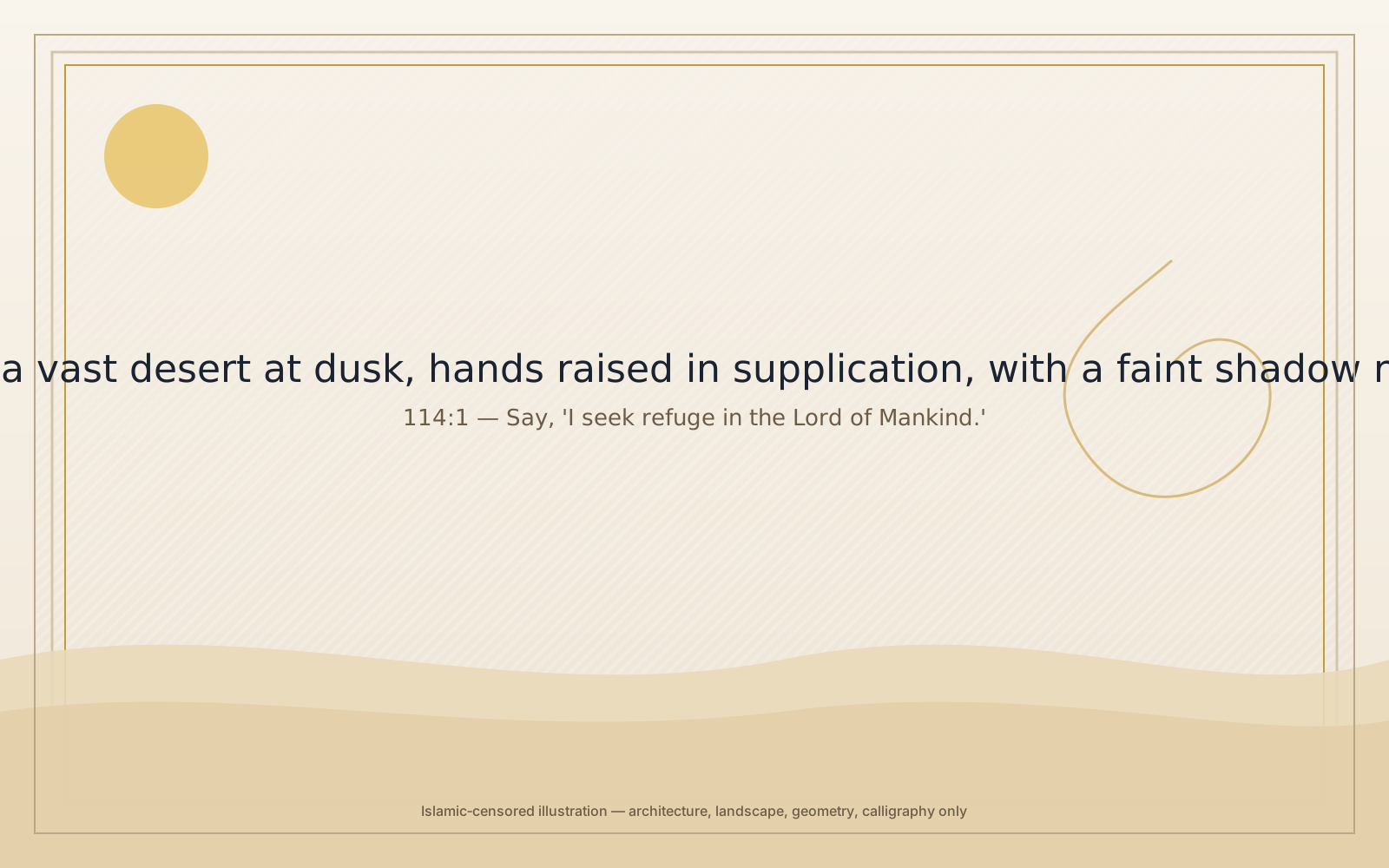
A solitary figure standing at the edge of a vast desert at dusk, hands raised in supplication, with a faint shadow retreating behind them into the darkness
114:1 — Say, 'I seek refuge in the Lord of Mankind.'

The Quran could have ended anywhere. It could have closed with a declaration of divine power — and there are verses that would have served magnificently. It could have ended with a promise of paradise so vivid that the listener would weep with longing. It could have ended with a warning so final that no soul would dare disobey. It could have ended, as many sacred texts do, with a triumphant proclamation that the truth has been delivered and the mission accomplished. Instead, the last revelation — the very last words God chose to place at the end of His final Book to humanity — is a prayer. Not a prayer of thanksgiving. Not a prayer of praise. A prayer of refuge. 'Say: I seek refuge in the Lord of Mankind. The King of Mankind. The God of Mankind. From the evil of the sneaking whisperer. Who whispers into the hearts of people. From among jinn and among people.' Six verses. No narrative. No law. No theology beyond the most elemental kind: you are vulnerable, there is an enemy you cannot see, and the only fortress that will hold is God Himself. The Quran ends by telling you that you are not finished. The battle is not over. The whisperer is still whispering. And your only weapon is the word that opens this surah: 'I seek refuge.' This is not an ending. It is a permanent instruction.

“Say, 'I seek refuge in the Lord of Mankind.'”
— God (commanding Muhammad and every believer) 114:1
Spiritual Barometer
Force
moderate
Tone
compassionate
Urgency
timeless

The Daily Revelation Edition 114

Lead Story

THE FINAL WORD IS NOT VICTORY — IT IS VULNERABILITY: Why the Quran Closes With Seeking Refuge

Consider what the Quran has accomplished in the 6,230 verses that precede these final six.

It has narrated the entire arc of human history from Adam's creation to the Day of Judgment. It has delivered a complete legal code governing marriage, inheritance, commerce, warfare, and worship. It has told the stories of twenty-five prophets, each carrying the same message through different centuries and civilisations. It has described paradise in such sensory detail that you can almost taste the rivers of honey, and hellfire with such precision that you can almost feel the heat. It has addressed philosophers and farmers, kings and slaves, believers and deniers, humans and jinn. It has answered every major question a conscious being can ask: Where did I come from? Why am I here? Where am I going? What does God want from me?

And after all of that — after the complete revelation, the final message, the sealed Book — God's last instruction is not a declaration of completeness. It is not 'the mission is accomplished' or 'go forth in victory.' It is: seek refuge.

The Arabic word a'udhu — I seek refuge — is not a word of strength. It is a word of need. It is the word a child uses when running to a parent. It is the word a traveller uses when seeking shelter from a storm. It is, linguistically and psychologically, an admission of insufficiency. I cannot protect myself. I need protection. I am asking for it.

This is the posture God wants humanity to maintain after receiving the entire Quran. Not confidence. Not self-sufficiency. Not theological mastery. Refuge. The scholar who has memorised all 6,236 verses is instructed to say the same words as the new convert who knows nothing but this surah: I seek refuge. Knowledge does not graduate you from vulnerability. Piety does not exempt you from the whisperer. The Quran's final message is that the human condition is permanently, structurally exposed to an enemy that never stops working — and the only adequate response is permanent, structural dependence on God.

Ibn al-Qayyim wrote that this is the deepest wisdom of the Quran's arrangement. The Book opens with Al-Fatiha — a prayer for guidance: "Guide us to the straight path" 1:6. It closes with An-Nas — a prayer for protection from the force that pulls you off that path. The first surah asks God to show you the way. The last surah asks God to protect you from the enemy who will try to make you lose it. Between these two prayers — between the request for direction and the request for safety — lies the entire Quran. Every verse, every story, every law is contained between 'guide me' and 'protect me.' That is the human condition in six words.

The Prophet Muhammad, peace be upon him, reportedly recited Al-Falaq (113) and An-Nas (114) together before sleeping every night, blowing into his hands and passing them over his body. The last act of his day — every day — was to seek refuge. If the most guided human being in Islamic theology did not consider himself exempt from the whisperer's reach, the message to every other soul is unambiguous: neither are you. Neither will you ever be.

114:1 114:2 114:3 114:4 114:5 114:6 1:6

The Daily Revelation Edition 114

Theology

LORD, KING, GOD: The Three Names That Escalate in a Single Breath

In the entire Quran, there is no passage where God introduces Himself with three consecutive titles addressed to the same audience in the same breath. Surah An-Nas does this in its opening three verses, and the arrangement is not decorative. It is architectural.

"The Lord of Mankind" 114:1. Rabb. This is the most intimate of God's names. It means sustainer, nourisher, the one who raises and develops. A rabb is not a distant sovereign — a rabb is the one who feeds the infant, who tends the garden, who brings something from nothing to completion. When you say 'Lord of Mankind,' you are invoking the God who created you, who shaped you in the womb, who gave you your first breath and your first thought. This is the personal God. The God of origins.

"The King of Mankind" 114:2. Malik. The register shifts. From the nursery to the throne room. A king is not intimate — a king is sovereign. A king has authority, jurisdiction, the power to command and enforce. When you say 'King of Mankind,' you are invoking the God who governs, who legislates, who holds dominion over every human institution and hierarchy. Every earthly king is a tenant. This is the landlord. This is the God of authority.

"The God of Mankind" 114:3. Ilah. And now the final escalation — not to a higher administrative title but to the most fundamental theological category available in any language. Ilah is the one who is worshipped. Not merely the one who nurtures (Rabb) or the one who rules (Malik) — but the one before whom you prostrate, the one who deserves your ultimate devotion, the one for whom the word 'god' was invented. When you say 'God of Mankind,' you are making the Tawhid declaration itself — there is no deity but Him.

Al-Razi observed that the three titles correspond to three dimensions of the divine-human relationship, and their sequence is deliberate. Rabb addresses God's relationship to you before you were conscious — He was your Lord when you were a cluster of cells, when you had no awareness, no choice, no agency. Malik addresses God's relationship to you during your conscious life — He is your King now, in the world of decisions and consequences. Ilah addresses God's relationship to you at the deepest level of your being — He is the one your soul was created to worship, the one whose absence creates the void that no earthly substitute can fill.

The escalation also serves a strategic purpose within the surah itself. You are about to ask God for protection from the whisperer — from Iblis, from Shaytan, from the invisible saboteur of your spiritual life. And before you make that request, God ensures that you understand exactly who you are asking. Not a local deity. Not a tribal protector. Not a philosophical concept. You are asking the one who made you (Rabb), who governs you (Malik), and who alone deserves your worship (Ilah). The three titles are not a liturgical flourish. They are credentials. They are God establishing, in three verses, that His authority to protect you is total — from the cellular to the cosmic to the spiritual.

There is also a subtle psychological architecture at work. The whisperer's strategy, as the surah will describe it, is to infiltrate the heart — to make you forget who God is, to make you feel alone, to convince you that the fortress has no walls. The three names are the antidote applied before the diagnosis. Before God names the disease (the whisperer), He administers the cure (the reminder of who He is). Lord. King. God. By the time you reach verse 4 and encounter the enemy, you have already been armed with the most complete description of your Protector that language can provide.

114:1 114:2 114:3

The Daily Revelation Edition 114

Investigative Report

THE SNEAKING WHISPERER: Inside the Psychology of Waswas — And Why the Quran's Final Enemy Is Not Fire or Flood, But a Voice in Your Head

The Quran has described many enemies of the human soul across its 114 chapters. Pharaoh, who declared himself a god and drowned for it. The people of 'Ad, obliterated by a wind that raged for seven nights. The people of Thamud, who hamstrung the she-camel and were seized by a blast. Qarun, swallowed by the earth along with his treasure. Armies, floods, fires, plagues — the Quran's catalogue of divine punishment is vast and varied.

And yet, when God selects the final enemy to warn against — the one danger He wants echoing in humanity's ears as the Book closes — He does not choose a tyrant or a natural disaster or an army. He chooses a whisperer.

"From the evil of the sneaking whisperer. Who whispers into the hearts of people" 114:4-5.

The Arabic is precise and devastating. Al-waswas al-khannas. Two words that contain an entire psychology of temptation. Waswas means a whisper — not a shout, not a command, not even a suggestion made at conversational volume. A whisper. Something so quiet you might mistake it for your own thought. Something so subtle you might not recognise it as external at all. And khannas — the one who withdraws, who retreats, who sneaks away. This is not an enemy that stands and fights. This is an enemy that advances when you are inattentive and retreats the moment you turn to God. It is, in military terms, a guerrilla — never engaging in open battle, always operating in the margins of your awareness.

Al-Ghazali devoted entire chapters of the Ihya Ulum al-Din to this concept, and his analysis remains the most penetrating in Islamic scholarship. The whisperer, he wrote, does not create desires — it redirects them. It does not introduce new sins — it reframes existing impulses. The hungry person does not need Shaytan to feel hunger. Shaytan whispers that the stolen bread tastes better than the earned one. The ambitious person does not need Shaytan to want success. Shaytan whispers that the shortcut is justified, that the compromise is minor, that no one will know.

The genius of the whisper — and the reason the Quran selects it as the final threat — is that it operates at the level of thought itself. You can build walls against armies. You can flee from floods. You can resist a visible temptation by an act of will. But how do you resist a voice that sounds like your own mind? How do you fight an enemy whose primary weapon is making you believe it does not exist?

This is why verse 114:5 specifies the target: "Who whispers into the hearts of people." Not the ears. Not the eyes. The heartssudur, literally the chests, the seat of intention, the place where decisions are formed before they become actions. The whisperer does not attack the body. It attacks the decision-making apparatus. It corrupts the source code. By the time a sinful action is visible, the whisperer's work was completed long before, in the silent interior where thought becomes intention and intention becomes choice.

And then the final verse delivers the most unsettling revelation of all: "From among jinn and among people" 114:6. The whisperer is not only Iblis. It is not only the unseen jinn. It is also people. Human beings whispering into the hearts of other human beings. The toxic friend who normalises what should alarm you. The culture that celebrates what should concern you. The inner circle that tells you what you want to hear instead of what you need to hear. The Quran's final verse tells you that the most dangerous enemy in your life may not be a supernatural being at all — it may be the person sitting next to you, or the voice in your own head that has internalised their whispers so completely that you can no longer tell the difference.

This is why a'udhu — seeking refuge — is the only appropriate response. You cannot outsmart a whisperer whose strategy is to make you believe your compromised thoughts are your own. You cannot outrun an enemy that lives in the space between your intentions. The only escape is to flee to a fortress the whisperer cannot enter: the remembrance of God. The khannas — the withdrawer — withdraws precisely when you remember God. That is its weakness. That is the surah's prescription. Not willpower. Not vigilance alone. Dhikr — remembrance. The whisperer advances in forgetfulness and retreats in remembrance. The battle for the human soul is fought, ultimately, between forgetting and remembering.

114:4 114:5 114:6

The Daily Revelation Edition 114

Analysis

THE CIRCLE CLOSES: How Al-Fatiha and An-Nas Form the Quran's Perfect Bookend

Open a Quran to its first page and its last. Place them side by side. What you will find is not coincidence. It is architecture of the highest order.

Al-Fatiha, the first surah, opens with praise — "Praise be to God, Lord of the Worlds" 1:2 — and culminates in a request: "Guide us to the straight path" 1:6. An-Nas, the last surah, opens with refuge — "I seek refuge in the Lord of Mankind" 114:1 — and culminates in a warning: the whisperer who would pull you off that path 114:4-6.

The first surah asks for the road. The last surah asks for protection from what lurks along it.

Al-Suyuti, the great Egyptian polymath who authored the monumental Al-Itqan fi Ulum al-Quran — the definitive work on Quranic sciences — devoted specific analysis to this structural pairing. He argued that the Quran's arrangement was not merely thematic but therapeutic. Al-Fatiha diagnoses the human condition: you are a creature who needs guidance, who cannot find the straight path without divine help, who must distinguish between the blessed, the condemned, and the lost. An-Nas prescribes the ongoing treatment: even after receiving guidance, you must seek protection, because the enemy does not stop working simply because you have found the path.

The symmetry runs deeper than theme. Both surahs are prayers. Both are spoken by the human being to God. Both use the imperative voice — Al-Fatiha through the first-person plural (ihdina, 'guide us'), An-Nas through the singular command (qul a'udhu, 'say: I seek refuge'). The Quran opens with 'we' and closes with 'I.' The communal prayer and the individual prayer. The public journey and the private battle. The straight path is walked together. The whisper is fought alone.

There is also the matter of the divine names. Al-Fatiha introduces God as Rabb al-Alamin — Lord of all the Worlds 1:2. An-Nas introduces God as Rabb an-Nas — Lord of Mankind 114:1. The scope has narrowed. From the cosmic to the human. From the Lord of every world — angelic, terrestrial, celestial — to the Lord of this particular species, this particular vulnerability, this particular battle. The Quran begins with the widest possible lens and closes with the most intimate. It starts by telling you that God governs galaxies. It ends by telling you that God guards your heart.

And then there is Al-Falaq — Surah 113 — which stands between Al-Fatiha's request and An-Nas's defence like a sentry at the gate. Al-Falaq seeks refuge from external dangers: the darkness of night, the envy of the envious, the evil of created things. An-Nas seeks refuge from the internal danger: the whisper that enters the heart itself. Together, the two protection surahs — Al-Mu'awwidhatain — form a complete defensive perimeter. Al-Falaq guards the exterior. An-Nas guards the interior. Between them, there is no angle of attack left unaddressed.

The Prophet paired them in practice as well as in revelation. He recited them together before sleeping. He recited them when ill. He blew them over his body as a spiritual shield. Aisha, may God be pleased with her, reported that in his final illness, he recited the two protection surahs and she would take his hand and pass it over his own body, because the blessing of his hands was greater than hers. The last surahs recited by the last Prophet in the last days of his life. There is a reason these words were placed at the end of the Book: they are meant to be the last thing you carry. Not a trophy. A shield.

The circle is perfect. Al-Fatiha: guide me. The Quran: here is your guidance, all 6,236 verses of it. An-Nas: now protect me while I walk the path you showed me. The human story, according to the Quran's own structure, is not a journey from ignorance to mastery. It is a journey from asking to asking — from requesting guidance to requesting protection. The believer never graduates from need. The last word of the Quran is not 'triumph.' It is 'people' — an-nas — because in the end, the entire Book was always about us: fragile, whisperable, perpetually in need of the Lord and King and God of Mankind.

114:1 114:2 114:3 114:4 114:5 114:6 1:2 1:6

The Daily Revelation Editorial Edition 114

✸ ✸ ✸

Letter from the Editor: The Book That Ends by Admitting You Are Not Safe

We have reached the end.

One hundred and fourteen editions. Six thousand two hundred and thirty-six verses. Twenty-five prophets. Dozens of tyrants. Civilisations raised and razed. Laws for the living. Descriptions of the dead. The most detailed map of paradise and hellfire ever committed to language. Armies of angels. Councils of jinn. A sea that splits. A fire that does not burn. A spider whose web shelters a prophet. A whale whose belly becomes a prison and a prayer room.

All of that — every last word of it — leads here. To six verses. To a prayer you can recite in a single breath. To the admission that after receiving the entire guidance of God, you still need God to protect you from the thing that wants to make you forget it.

There is no triumphalism in Surah An-Nas. There is no victory lap. The Quran does not end by congratulating its reader on having reached the end, or by declaring that the truth has prevailed and the mission is complete. It ends by saying: the mission is never complete. The whisperer is still working. He was working while you read these verses. He will be working when you put this book down. He works in the space between your intention and your action, in the gap between what you know and what you do, in the silence where you forget to remember God.

And this is not despair. This is the most profound form of hope the Quran offers. Because the surah does not merely name the enemy — it names the cure. Three names of God, each one a wall of the fortress. Rabb: He made you, He knows what you are made of, He knows your vulnerabilities better than the whisperer does. Malik: He has jurisdiction, He has authority, nothing operates outside His dominion — not even Iblis. Ilah: He is the one your heart was designed to orient toward, and when it does, the whisperer has no foothold.

The khannas — the sneaking withdrawer — has a fatal weakness. It cannot operate in the presence of dhikr. It cannot whisper when you are remembering. It cannot redirect your intentions when your intentions are pointed at God. The entire strategy of the whisperer depends on a single condition: that you forget. And the entire strategy of the Quran, from Al-Fatiha to An-Nas, is a sustained, 6,236-verse campaign against forgetting.

I think about the posture this surah demands. Not the posture of the scholar who has mastered the text. Not the posture of the warrior who has defeated his enemies. Not even the posture of the worshipper who has completed all five prayers and fasted all thirty days. The posture is simpler and more honest than any of those: it is the posture of a human being who knows — who has been told by God Himself — that they are not self-sufficient. That they need refuge. That the battle is not behind them but around them, always, in the quiet interior where thought becomes choice.

The Quran begins with "In the name of God, the Gracious, the Merciful" and ends with "from among jinn and among people." It begins with God's name and ends with ours. It begins with His mercy and ends with our vulnerability. It begins with the Compassionate addressing His creation, and it ends with creation running back to its Creator. The circle is closed. The Book is complete. The whisperer is still out there.

Seek refuge. It is the last thing God told you to do. Do it every day. Do it every night. Do it when the voice in your head sounds a little too much like yours and suggests something a little too easy to justify. Do it when you are strong and especially when you are tired. Do it as the Prophet did — with his own blessed hands, with his own whispered breath, until the very last night of his life on earth.

The Quran's final word is not 'Amen.' It is 'people.' An-Nas. Because this Book — all of it, every syllable — was always, only, and forever about us.

For Reflection
The Quran is finished, but its work in you is not. The whisperer described in these final verses is not a historical figure — it is present tense. Right now, in this moment, there is a thought in your mind that is not entirely yours. A rationalisation. A compromise. A lowering of a standard you once held. Can you identify it? Can you hear the whisper behind the thought? That is what this surah trains you to do: to distinguish between your voice and the voice that mimics it.
Supplication
O Allah — Rabb of Mankind, Malik of Mankind, Ilah of Mankind — I seek refuge in You from the whisperer who retreats. From the one who whispers when I forget and hides when I remember. From the jinn I cannot see and the people I trust too easily. Guard my heart, for the whisperer knows its doors better than I do. Make my remembrance of You stronger than his whisper. Make my refuge in You so constant that he finds no opening, no silence, no moment of forgetfulness to exploit. You ended Your Book with this prayer. Help me never stop saying it. Ameen.
✸ ✸ ✸

The Daily Revelation Tadabbur Edition 114

Preparing contemplation…

The Daily Revelation Back Page Edition 114

“From the evil of the sneaking whisperer. Who whispers into the hearts of people.”
114:4-5
Today's Action
Tonight before you sleep, recite Surah Al-Falaq (113) and Surah An-Nas (114) — the two protections — three times each, as the Prophet did. Blow gently into your hands and pass them over your body. But this time, do it with awareness: you are sealing yourself inside a fortress built from God's own names. The whisperer cannot follow you there.
Weekly Challenge
For seven days, keep a 'whisper journal.' Each evening, write down one moment during the day when you noticed a thought that subtly pushed you toward compromise, laziness, resentment, or rationalisation. Do not judge the thought — just notice it. By the seventh day, you will begin to recognise the pattern: the whisper is quietest when you are most awake, and loudest when you are running on autopilot. That recognition is the beginning of spiritual vigilance.
Related Editions
Edition 1 The opening prayer — 'Guide us to the straight path.' An-Nas is its mirror: 'Protect me from what pulls me off it.' Together, they bookend the entire Quran.
Edition 113 The companion surah — together called Al-Mu'awwidhatain (The Two Protections). Al-Falaq guards against external evil; An-Nas guards against internal evil.
Edition 7 The origin story of the whisperer: Iblis refuses to bow, is expelled, and vows to attack humanity from every direction (7:16-17) — the threat An-Nas defends against.
Edition 36 'Did I not charge you, O children of Adam, that you shall not worship Satan?' (36:60) — the covenant that the whisperer seeks to break.
Edition 2 The first story of Iblis's disobedience (2:34) and Adam's fall through whispered temptation (2:36) — the prototype of every waswas that followed.
Characters in This Edition
Allah Mankind Iblis Muhammad Jinn
Coming Next
This is the final edition. The Quran has been covered, surah by surah, from the Opening to Mankind. But the Book does not end when you close it — it ends when you stop living it. Return to Al-Fatiha. Begin again. The circle was always meant to be walked more than once.
Page 1 of 8
Ed. 113 Ed. --