Edition 43 of 114 Mecca Bureau 89 Verses

The Daily Revelation

Revelation. Reported. Truth.
الزخرف

Az-Zukhruf — Ornaments of Gold
Force: Moderate Tone: Warning Urgency: Important

ORNAMENTS OF GOLD: The Quran's Devastating Critique of Wealth-Worship and the Civilisations It Destroys

In 89 Meccan verses, God dismantles the logic of materialism — from the pagan Arabs who worshipped their ancestors' customs, to Pharaoh who boasted of his rivers, to the Quraysh who dismissed Muhammad because he was not rich enough to be a prophet


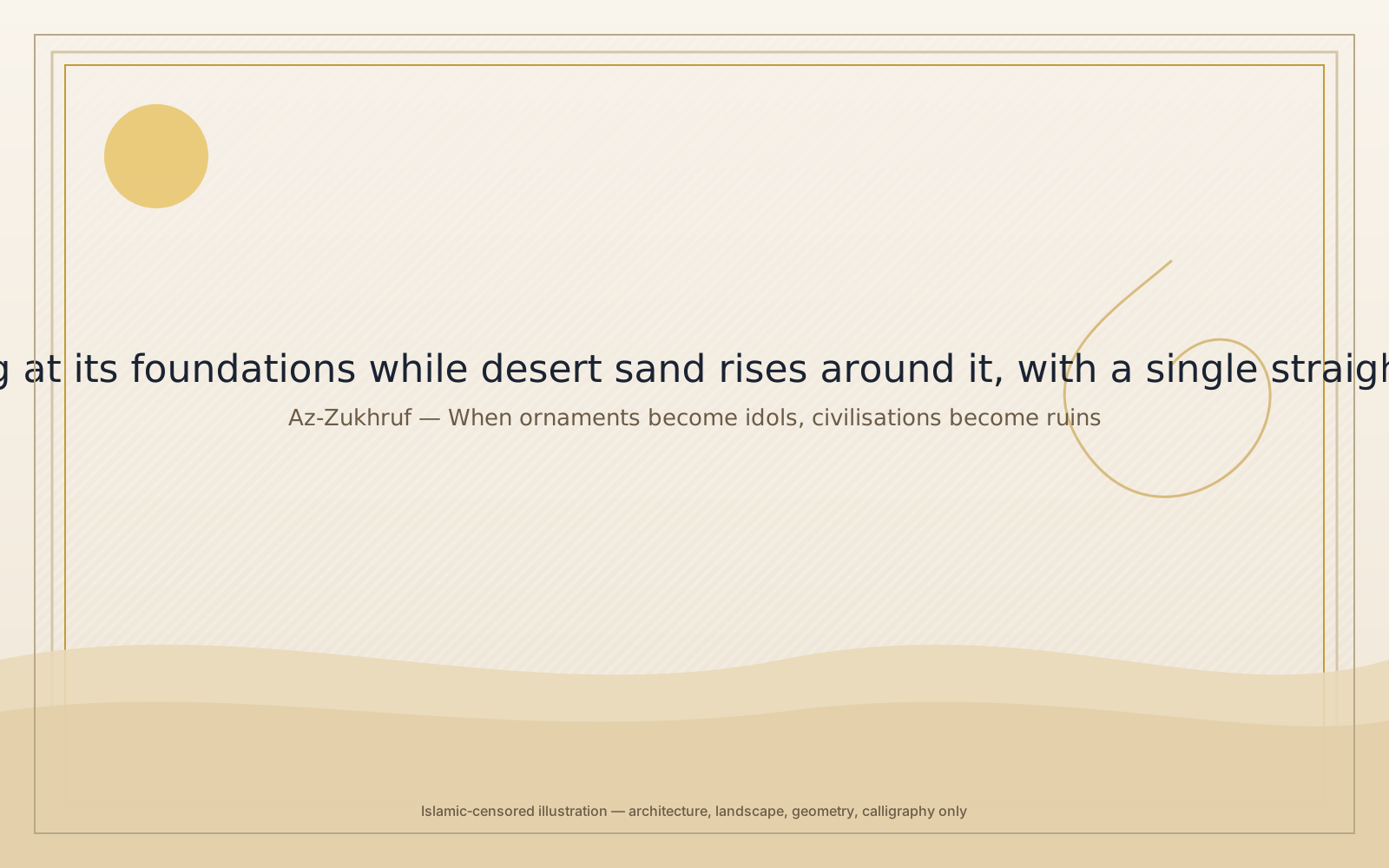
An opulent golden palace crumbling at its foundations while desert sand rises around it, with a single straight road leading away into clear light
Az-Zukhruf — When ornaments become idols, civilisations become ruins

The argument is devastatingly simple. God created the heavens and the earth, sends down rain, provides ships and animals for transport, and no one disputes this — even the pagans admit it when asked directly. Yet these same people, when a messenger arrives without gold bracelets on his wrists, dismiss him as unworthy. They inherit their religion from their fathers the way they inherit their furniture. They assign daughters to God while preferring sons for themselves. They measure prophets by their bank accounts. Surah Az-Zukhruf — Ornaments of Gold — takes this collision between materialism and truth and follows it across three civilisations: the Quraysh of Mecca, the court of Pharaoh in Egypt, and the community that divided over Isa ibn Maryam. In each case, the pattern is identical. Wealth blinds. Tradition paralyses. And God's messengers are rejected not because their message is wrong, but because the messengers themselves do not look the part. The surah's verdict is unflinching: everything that glitters in this life is temporary decoration. The Hereafter — with your Lord — is for the righteous alone.

“And decorations. Yet all that is nothing but the stuff of this life. Yet the Hereafter, with your Lord, is for the righteous.”
— God 43:35
Spiritual Barometer
Force
moderate
Tone
warning
Urgency
important

The Daily Revelation Edition 43

Lead Story

THE INHERITANCE TRAP: How 'We Found Our Fathers Doing This' Became the Most Dangerous Sentence in History

The surah opens with a provocation. God made the Quran in Arabic "so that you may understand" 43:3. And it sits with Him in the Source Book — "sublime and wise" 43:4. Then the challenge: "Shall We hold back the Reminder from you, since you are a transgressing people?" 43:5. The tone is not gentle. It is the tone of a teacher who has exhausted patience with students who refuse to open their textbooks.

And then the diagnosis. Why do people reject prophets? Not ignorance in the strict sense — when asked who created the heavens and the earth, even the pagans answer correctly: "The Mighty, the Knower created them" 43:9. They know God exists. They know He created everything. Their problem is not theological ignorance. It is cultural inertia.

"We found our parents on a course, and we are guided in their footsteps" 43:22. This sentence appears twice in the surah, once from the Meccan pagans and once as a universal pattern: "Likewise, We sent no warner before you to any town, but the wealthy among them said, 'We found our parents on a course, and we are following in their footsteps'" 43:23. Notice who speaks this line. Not the poor. Not the uneducated. The wealthy. The people with the most to lose from change. The ones whose social position depends on the existing order remaining exactly as it is.

The Quran identifies this as a civilisational disease, not an individual failing. Every society that rejected a prophet did so through the same mechanism: the ruling class declared that tradition was sufficient, that innovation was suspicious, and that the status quo — which happened to benefit them enormously — was divinely ordained simply because it was old. The logic is circular and impregnable: we do what our fathers did because our fathers did it. No evidence can penetrate a closed loop.

God's response through His messenger is blunt: "Even if I bring you better guidance than what you found your parents following?" 43:24. Better. Not different. Not novel. Better. The offer is an upgrade, and it is rejected on principle — not because the content is evaluated and found wanting, but because accepting it would mean admitting that the fathers were wrong. And that, for a society built on ancestral authority, is unthinkable.

The consequence is equally blunt: "So We wreaked vengeance upon them. Behold, then, what was the fate of those who deny" 43:25. The surah does not argue with tradition-worship. It presents the evidence — historical, logical, theological — and then delivers the verdict. The inheritance trap is not merely wrong. It is fatal.

43:1 43:2 43:3 43:4 43:5 43:6 43:7 43:8 43:9 43:10 43:11 43:12 43:13 43:14 43:15 43:20 43:21 43:22 43:23 43:24 43:25

The Daily Revelation Edition 43

Theology

DAUGHTERS FOR GOD, SONS FOR YOURSELVES: The Surah That Exposed Pagan Arabia's Deepest Hypocrisy

The argument is surgical, and it cuts to the bone of pre-Islamic Arab theology. The pagans assigned daughters to God — claiming the angels were female — while they themselves preferred sons and recoiled at the birth of girls. The Quran forces them to confront the absurdity of their own position.

"Or has He chosen for Himself daughters from what He creates, and favoured you with sons?" 43:16. The question is rhetorical. God does not have children at all — but even within the pagans' own broken logic, the arrangement makes no sense. They assigned to God what they considered inferior and kept what they valued for themselves. The surah names the emotional evidence: "Yet when one of them is given news of what he attributes to the Most Gracious, his face darkens, and he suppresses grief" 43:17. The man who claims angels are God's daughters cannot even hear the word 'daughter' applied to his own family without visible distress.

Then comes the contemptuous caricature of how they described these supposed divine daughters: "Someone brought up to be beautiful, and unable to help in a fight?" 43:18. This is the pagans' own characterisation of femininity — ornamental and useless. And this is what they attributed to the Creator of the universe. The surah does not merely refute the theology. It exposes the misogyny that produced it. The assignment of daughters to God was not a sincere religious belief. It was a projection of their own contempt onto the divine.

"And they appoint the angels, who are servants to the Most Gracious, as females. Have they witnessed their creation?" 43:19. The demand for evidence is pointed. You claim to know the gender of beings you have never seen, while dismissing the testimony of a messenger standing in front of you. "Their claim will be recorded, and they will be questioned." The surah treats this not as harmless folk religion but as a serious crime — fabricating claims about God's nature without knowledge, then defending those claims by citing ancestral custom.

The pagans' final defence is predestination turned into excuse: "Had the Most Gracious willed, we would not have worshiped them" 43:20. If God did not want us to worship idols, He would have stopped us — therefore our worship must be acceptable. The Quran's response is devastating in its brevity: "But they have no knowledge of that; they are merely guessing." Six words that dismantle an entire theological framework. You do not know what God wills. You are speculating. And speculation about God is not theology. It is gambling.

43:15 43:16 43:17 43:18 43:19 43:20

The Daily Revelation Edition 43

Special Investigation

SILVER ROOFS AND GOLDEN STAIRS: God's Thought Experiment on Why He Does Not Make Every Disbeliever Rich

In the middle of its argument against materialism, the surah pauses for one of the most extraordinary thought experiments in the entire Quran. God explains what He could do — and why He chooses not to.

"Were it not that humanity would become a single community, We would have provided those who disbelieve in the Most Gracious with roofs of silver to their houses, and stairways by which they ascend. And doors to their houses, and furnishings on which they recline. And decorations" 43:33-35. The image is staggering. God could give every disbeliever a mansion of silver with golden staircases and ornate couches. He has the resources. He has the power. And He deliberately withholds it — not out of inability but out of mercy.

Why? Because "humanity would become a single community" — a single community of disbelievers. If wealth always correlated with disbelief, and poverty always with faith, then every rational person would choose disbelief. The test would be rigged. The correlation between material success and spiritual truth would be so clear that faith would become meaningless — no one would need to believe; they would simply calculate. God preserves the ambiguity of the test by distributing wealth across believers and disbelievers alike, ensuring that the choice to believe remains genuinely free.

Then the surah delivers its thesis statement on the value of worldly goods: "Yet all that is nothing but the stuff of this life. Yet the Hereafter, with your Lord, is for the righteous" 43:35. The Arabic mata' al-hayat al-dunya — the stuff, the equipment, the temporary furnishings of this lower life. Not evil in themselves. Simply irrelevant to the only question that matters. Silver roofs and golden stairs are stage props. The performance ends. The props go back to storage. Only the actor's character endures.

The passage then shifts to the psychological consequences of choosing ornaments over God. "Whoever shuns the remembrance of the Most Gracious, We assign for him a devil, to be his companion" 43:36. The mechanism is precise. You do not merely forget God and remain neutral. You forget God and are assigned a replacement companion — a whisperer who "hinders them from the path, though they think they are guided" 43:37. The most dangerous feature of this spiritual blindness is that it feels like vision. The person led astray by their devil-companion believes they are walking straight. They will not discover the deception until the Day of Judgment, when they will turn to their companion and cry: "If only there were between me and you the distance of the two Easts" 43:38.

The two Easts — mashriqayn — is a phrase of maximum distance: as far apart as sunrise can be from sunrise. The companionship that felt so natural in life becomes an unbearable proximity in the Hereafter. "It will not benefit you on that Day, since you did wrong. You are partners in the suffering" 43:39. Partners. The devil and the human, bound together in the consequences of a partnership the human did not even recognise as one.

43:32 43:33 43:34 43:35 43:36 43:37 43:38 43:39 43:40

The Daily Revelation Edition 43

World Affairs

PHARAOH'S RIVERS: How Egypt's Tyrant Confused Real Estate with Divine Authority

The surah's second major confrontation shifts from Mecca to ancient Egypt, and the antagonist is the most theatrical villain in the Quran: Pharaoh. His clash with Musa follows a familiar arc — but Az-Zukhruf adds a dimension found nowhere else. Here, Pharaoh's argument is explicitly economic. He does not merely claim divinity. He claims it on the basis of his portfolio.

"We sent Moses with Our revelations to Pharaoh and his dignitaries. He said, 'I am the Messenger of the Lord of the Worlds'" 43:46. The response was not theological debate. It was laughter. "But when he showed them Our signs, they started laughing at them" 43:47. Even as each sign proved more extraordinary than the last, even as the plagues descended and they begged for relief — "O sorcerer, pray to your Lord for us, according to His pledge to you, and then we will be guided" 43:49 — even then, the moment the pressure lifted, they broke their promises 43:50.

Then comes Pharaoh's defining speech — the moment the surah has been building toward. "Pharaoh proclaimed among his people, saying, 'O my people, do I not own the Kingdom of Egypt, and these rivers flow beneath me? Do you not see?'" 43:51. The Nile. The lifeblood of the ancient world. Pharaoh does not claim philosophical superiority or theological knowledge. He claims real estate. He owns the rivers. He controls the water. And in a desert civilisation, water is everything.

Then the personal attack: "Am I not better than this miserable wretch, who can barely express himself?" 43:52. Musa — whom Islamic tradition identifies as having a speech impediment — is dismissed as inarticulate. The standard is not truth but presentation. And then the ultimate materialist criterion: "Why are bracelets of gold not dropped on him, or the angels came with him in procession?" 43:53. If Musa were truly sent by God, where is his gold? Where is his entourage? The logic is identical to the Quraysh who asked why the Quran was not sent to "a man of importance from the two cities" 43:31. Both Pharaoh and the Meccan elite share the same assumption: God's messenger should look like a king.

The Quran's verdict is terse: "Thus he fooled his people, and they obeyed him. They were wicked people" 43:54. He fooled them. The Arabic fa-istakhaffa qawmahu means he made them light — he reduced them, diminished their judgment, made them intellectually weightless. He waved the Nile in their faces and they forgot to ask whether owning a river makes a man God. "And when they provoked Our wrath, We took retribution from them, and We drowned them all. Thus We made them a precedent and an example for the others" 43:55-56.

A precedent. Not merely a punishment but a case study, filed permanently in the record of human civilisation. The man who owned the rivers drowned in one.

43:46 43:47 43:48 43:49 43:50 43:51 43:52 43:53 43:54 43:55 43:56

The Daily Revelation Edition 43

Faith & Doctrine

THE SON OF MARY CONTROVERSY: How Isa Became a Weapon in the Wrong Argument

The third civilisational confrontation in Az-Zukhruf is the most theologically charged. After the Quraysh and their ancestors, after Pharaoh and his rivers, the surah turns to Isa ibn Maryam — and the factions that twisted his legacy into something he never claimed.

"And when the son of Mary was cited as an example, your people opposed" 43:57. The context, according to the scholars, is that when the Quran declared that those worshipped besides God would be fuel for Hellfire, the Quraysh seized on the opportunity: "Are our gods better, or he?" 43:58. If everything worshipped besides God enters Hell, they argued, then Jesus must be in Hell too, since Christians worship him. It was not a sincere theological question. It was a debating trick: "They cited him only for argument. In fact, they are a quarrelsome people."

The Quran's response redefines Isa's entire identity in two sentences. "He was just a servant whom We blessed, and We made him an example for the Children of Israel" 43:59. A servant. Blessed, yes. Given miraculous powers, yes. But fundamentally a human servant of God — not a divine being, not a partner with God, not a figure whose nature should be the subject of endless sectarian dispute. An example. A model. A demonstration of what God can do through a willing human vessel.

Then comes the verse that Islamic eschatology has meditated on for fourteen centuries: "He is a portent of the Hour, so have no doubt about it, and follow Me. This is a straight way" 43:61. Isa as a sign of the end times. His return — affirmed across Sunni and Shia scholarship — is presented here not as a Christian doctrine adopted by Islam, but as a Quranic declaration: the son of Mary will come again, and his coming will signal the approach of the final reckoning.

The surah then gives Isa his own voice. "When Jesus came with the clarifications, he said, 'I have come to you with wisdom, and to clarify for you some of what you differ about. So fear God, and obey me'" 43:63. His message is wisdom and clarification — not a new theology of incarnation, not a claim to divinity, but a prophetic call to God-consciousness and obedience. And then the declaration that the Quran places in Jesus' own mouth: "God is my Lord and your Lord, so worship Him — this is a straight path" 43:64.

The surah's verdict on what happened after Isa delivered his message is sharp: "But the factions differed among themselves. So woe to the wrongdoers from the suffering of a painful Day" 43:65. The factions. Not the pagans, not the idol-worshippers, but the followers themselves — those who received the message and then split into competing interpretations, each claiming exclusive truth, turning a prophet of clarification into the most disputed figure in religious history.

Az-Zukhruf does not resolve Christological debates. It reframes them. The question is not what Isa's nature is — the Quran has already answered that: he is a servant, blessed and exemplary. The question is why humans persist in arguing about what a prophet himself made plain. "God is my Lord and your Lord." The straight path is not complicated. The complications are human additions.

43:57 43:58 43:59 43:60 43:61 43:62 43:63 43:64 43:65

The Daily Revelation Edition 43

Analysis

IBRAHIM'S DECLARATION: The Patriarch Who Broke the Chain of Inherited Belief

Between the surah's critique of ancestor-worship and its case studies of Pharaoh and Isa, there stands a single, pivotal figure: Ibrahim. And his appearance in Az-Zukhruf is surgically placed — he is the answer to the problem the surah diagnoses.

The problem: "We found our parents on a course, and we are guided in their footsteps" 43:22. The answer: a man who said the opposite. "When Abraham said to his father and his people, 'I am innocent of what you worship. Except for He who created me, for He will guide me'" 43:26-27.

Ibrahim did not merely disagree with his father's religion. He declared bara'a — formal disassociation, legal and spiritual severance. In a society where filial loyalty was the supreme virtue, where a son's identity was inseparable from his father's lineage and his father's gods, Ibrahim looked at his father Azar and said: I reject everything you stand for. Except God. The exception is critical. Ibrahim was not rebelling against authority as such. He was transferring his allegiance from inherited authority to discovered truth. He did not reject his father in order to be free. He rejected his father in order to submit — but to the right master.

The Quran then reveals the lasting consequence: "And he made it an enduring word in his progeny, so that they may return" 43:28. The word — la ilaha illa Allah, there is no god but God — became Ibrahim's inheritance to his descendants. He broke one chain of tradition and forged another. His children and grandchildren — Isma'il, Ishaq, Yaqub, Yusuf, and ultimately Muhammad himself — would carry not the customs of Azar but the monotheism that Ibrahim extracted from the wreckage of his father's world.

The placement is deliberate. The surah has just finished describing how every civilisation's wealthy elite used ancestral tradition to reject God's messengers. Ibrahim is the proof that the chain can be broken. That a single person, standing against family, tribe, and civilisation, can redirect the course of human spiritual history. The inheritance trap is powerful — but it is not invincible. It took one man's declaration to shatter it, and that declaration echoed through every generation of prophets that followed.

The surah's implicit challenge to its Meccan audience is unmistakable: you claim to honour Ibrahim as your ancestor. You built the Kaaba on his foundations. You trace your lineage through his son Isma'il. And yet you are doing the exact thing he refused to do — following your fathers' religion without question. Ibrahim's legacy is not obedience to tradition. It is the courage to interrogate tradition and keep only what is true.

43:26 43:27 43:28 43:29

The Daily Revelation Edition 43

The Hereafter

TRAYS OF GOLD, CRIES TO MALEK: The Two Eternal Destinations and the Friendship Test That Separates Them

The surah's final movement shifts from this world to the next — and the transition is announced with one of the Quran's most chilling social observations: "On that Day, friends will be enemies of one another, except for the righteous" 43:67. Every friendship built on anything other than righteousness will invert. The companions who encouraged each other's indulgence, who validated each other's neglect of God, who made sin feel like sophistication — on the Day of Judgment, they will turn on each other. Only friendships rooted in faith will survive the transition.

For the righteous, the address is intimate: "O My servants, you have nothing to fear on that Day, nor will you grieve" 43:68. God speaks to them directly — My servants. The possessive is not accidental. These are the ones who chose servitude to God over servitude to ornaments, and their reward reflects the inversion: "Enter the Garden, you and your spouses, joyfully" 43:70. Then the details: "They will be served around with trays of gold, and cups. Therein is whatever the souls desire and delights the eyes. Therein you will stay forever" 43:71.

Trays of gold. The surah that spent its first half dismantling the worship of gold and silver now reveals where gold actually belongs — not as roofing material for the mansions of disbelievers, but as serving ware in the eternal garden of the righteous. The ornaments rejected as ultimate value in this life reappear as incidental decoration in the next. Gold is not evil. It is simply misplaced when it becomes an object of worship rather than a gift of service.

The contrast is immediate and total. "As for the sinners, they will be in the torment of Hell forever. It will never be eased for them. In it, they will be devastated" 43:74-75. And then a sentence of perfect divine justice: "We did them no injustice, but it was they who were the unjust" 43:76.

The surah's most harrowing exchange follows. "And they will cry, 'O Malek, let your Lord finish us off.' He will say, 'You are staying'" 43:77. Malek — the guardian of Hell — is asked for annihilation. Not relief. Not pardon. Annihilation. The suffering is so complete that non-existence becomes the most desirable outcome. And Malek's response is two words in Arabic: innakum makithun. You are staying. No explanation. No negotiation. The door is closed. The verdict is permanent.

"We have given you the truth, but most of you hate the truth" 43:78. The final diagnosis. It was not that truth was unavailable. It was not that the evidence was insufficient. It was not that the messengers failed to communicate. The truth was given. And it was hated. Not misunderstood. Hated. Because it demanded the surrender of ornaments — material and psychological — that people preferred to keep.

43:67 43:68 43:69 43:70 43:71 43:72 43:73 43:74 43:75 43:76 43:77 43:78

The Daily Revelation Editorial Edition 43

✸ ✸ ✸

Letter from the Editor: The God Who Could Make Every Disbeliever a Billionaire

There is a thought experiment in the middle of Surah Az-Zukhruf that deserves to haunt every person who has ever measured a human being's worth by their wealth. God says, in effect: I could make every disbeliever on earth rich beyond imagination. Silver ceilings. Golden staircases. Ornate furniture. Luxury so total that belief in God would become economically irrational. I could do this. I choose not to.

Why? Because it would destroy the test. If wealth always meant divine displeasure and poverty always meant divine favour, the choice to believe would not be faith — it would be accounting. God preserves the ambiguity because ambiguity is what makes faith meaningful. The rich believer and the poor disbeliever, the struggling saint and the flourishing tyrant — these apparent contradictions are not bugs in the system. They are the system. They are what makes the choice to worship God, with no guaranteed worldly return, an act of genuine conviction rather than calculated self-interest.

This surah takes that principle and traces it across human history. The Quraysh rejected Muhammad because he was not a "man of importance from the two cities" 43:31 — not rich enough, not powerful enough to be God's spokesman. Pharaoh dismissed Musa because he had no gold bracelets and could barely speak fluently 43:52-53. The factions that divided over Isa turned a servant of God into an object of worship and then fought over the ontological details 43:65. In every case, the obstacle was the same: people expected God's truth to arrive dressed in God's ornaments. When it arrived dressed in humility, they sent it away.

Ibrahim is the exception. He looked at his father's religion — comfortable, established, woven into every social institution of his world — and said: I am innocent of this. He traded inherited wealth for discovered truth. He chose the unfurnished road. And his choice echoed through every prophet who followed, all the way to the last one, who stood in Mecca without gold bracelets and said the same thing Ibrahim said: there is no god but God.

The surah ends with a command of extraordinary restraint: "Pardon them, and say, 'Peace.' They will come to know" 43:89. After 88 verses of devastating argument — after exposing the inheritance trap, the Pharaonic ego, the sectarian fragmentation, the worship of decoration — the final instruction to Muhammad is not vengeance. It is peace. The truth has been delivered. The ornaments have been named for what they are. What remains is patience, and the certainty that clarity will come — in this life or the next.

Ornaments of gold. The surah names them, describes them, offers them hypothetically, then sets them aside. Because the only gold that matters is the gold on the trays in Paradise, served to those who chose God over everything that glittered.

For Reflection
What have you inherited — beliefs, assumptions, habits, loyalties — that you have never questioned? Not because questioning is rebellious, but because Ibrahim, the Quran's model believer, was the greatest questioner in prophetic history. What would you keep if you had to choose it fresh, with no ancestral pressure? What would you release?
Supplication
O Allah, protect us from the inheritance trap — from following what is familiar simply because it is familiar. Give us the courage of Ibrahim, who looked at his father's world and chose You over comfort. Protect us from Pharaoh's delusion, who mistook rivers for divinity and gold for truth. Protect us from measuring Your messengers by their wealth and Your message by its packaging. Let us see ornaments for what they are — the temporary furnishings of a temporary life. And when the trays of gold are served in Your Garden, let us be among those who earned them not by accumulating gold in this world, but by surrendering it. You are the Wise, the Knower. Ameen.
✸ ✸ ✸

The Daily Revelation Back Page Edition 43

Today's Action
Today, identify one thing you value primarily because you inherited the valuation — a status symbol, a social expectation, a career path, a religious practice you perform by rote. Ask yourself Ibrahim's question: is this from the One who created me, or from the course my parents were on? If it survives the interrogation, keep it with renewed conviction. If it does not, begin the work of letting it go.
Weekly Challenge
Read verses 43:33-35 every morning this week — the passage about silver roofs and golden stairs. Each time, name one specific material thing you are currently pursuing or anxious about. Then say the surah's verdict out loud: 'Yet all that is nothing but the stuff of this life. Yet the Hereafter, with your Lord, is for the righteous.' Track how your relationship with that thing changes over seven days of deliberate reframing.
Related Editions
Edition 14 Ibrahim's legacy of monotheism — the same patriarch whose declaration in 43:26-27 echoes through every surah that bears his name
Edition 26 Musa vs Pharaoh expanded — the full confrontation that Az-Zukhruf summarises in Pharaoh's boast about the rivers of Egypt
Edition 19 The surah named after Isa's mother — the detailed account of his miraculous birth that precedes the doctrinal clarification in 43:59-64
Edition 28 Qarun's wealth and its destruction — the fullest case study of what happens when ornaments become the measure of divine favour
Edition 18 The parable of the two gardens — another surah that tests the human response to material wealth against spiritual truth
Characters in This Edition
Allah Muhammad Ibrahim Musa Firawn Isa Disbelievers Angels Iblis Malik Maryam
Coming Next
NEXT EDITION: Surah Ad-Dukhan (The Smoke) — A night of destiny, a sky filled with smoke, and Pharaoh's people begging for relief from the same plagues they once laughed at. The warnings of Az-Zukhruf find their apocalyptic fulfilment.
Page 1 of 10
Ed. 42 Ed. 44