Edition 90 of 114 Mecca Bureau 20 Verses

The Daily Revelation

Revelation. Reported. Truth.
البلد

Al-Balad — The City
Force: Strong Tone: Warning Urgency: Urgent

THE STEEP PATH: God Swears by Mecca and Asks Why Humans Choose the Easy Descent When the Only Road Worth Climbing Costs Everything

Surah Al-Balad opens with God taking an oath by the city of Mecca and the Prophet who inhabits it, declares that humanity was created in struggle, then poses the question that defines every human life: you were given eyes, a tongue, and the knowledge of right and wrong -- so why did you not brave the ascent?


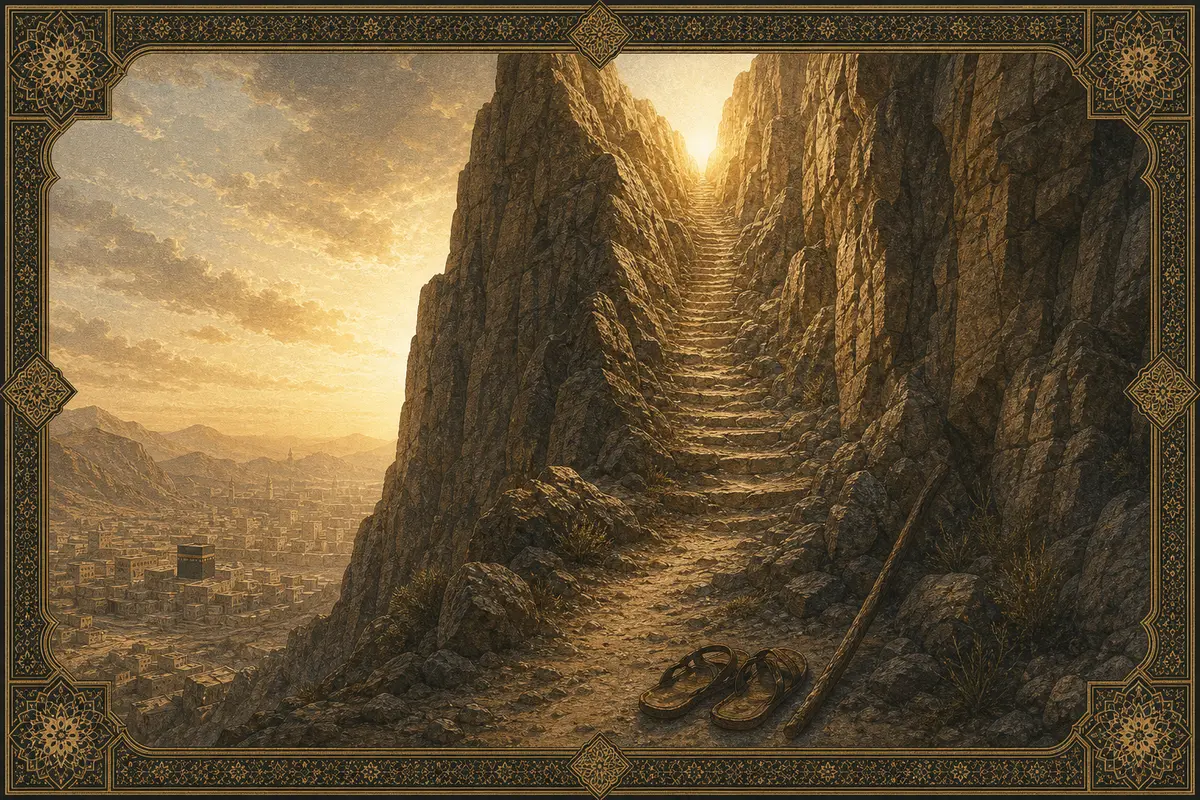
A narrow, steep mountain pass carved between massive cliffs, with golden light visible at the top and a figure at the base looking upward, the city of Mecca visible in the haze below
90:11 -- But he did not brave the ascent: the steep path that most refuse to climb

There are chapters in the Quran that open with the architecture of the cosmos -- sun and moon and stars summoned as witnesses. Then there are chapters that begin with dirt and stone and an address. Surah Al-Balad is the second kind. God does not swear by the heavens here. He swears by a city. By a specific, named, geographical location where people live and trade and argue and suffer: Mecca. And then, in a move that has astonished commentators for fourteen centuries, He swears by the man who lives in it. 'I swear by this land. And you are a resident of this land.' The Prophet Muhammad, peace be upon him, is being told: the city that persecutes you, that boycotts your clan, that plots against your life -- I swear by it. And I swear by your presence in it. Your suffering there is not incidental. It is the oath. Then comes the thesis, delivered in four words of Arabic that compress the entire human condition into a single breath: 'We created man in distress.' Not in comfort. Not in ease. Not in a garden -- that comes later, and it must be earned. The factory setting of human existence is struggle. And the rest of the surah is a blueprint for what to do with that struggle. God catalogues the gifts: two eyes, a tongue, two lips, the knowledge of good and evil. He names the price of ascent: free a slave, feed the hungry on a day of famine, care for the orphan who is kin, lift the destitute from the dust. And He delivers the verdict: those who do these things and wrap them in faith, patience, and kindness -- these are the people of happiness. Those who refuse -- upon them is a padlocked Fire. Twenty verses. No stories of prophets. No parables of ancient civilisations. Just the raw mechanics of moral life: you were born struggling, you were given tools, you were shown the path upward, and you chose. The ascent or the descent. The steep road or the easy one. The people of happiness or the people of misery. There is no third option.

“But he did not brave the ascent.”
— Allah (on humanity's failure) 90:11
Spiritual Barometer
Force
strong
Tone
warning
Urgency
urgent

The Daily Revelation Edition 90

Lead Story

THE OATH BY DIRT AND STONE: Why God Chose to Swear by a City -- and by the Man It Was Trying to Destroy

In Surah Al-Fajr, God swore by the dawn. In Surah Ash-Shams, He will swear by the sun. In Surah At-Tin, by the fig and the olive. The Quran's oaths are cosmic in scale, pulling the fabric of creation into the courtroom as evidence. But here, in Al-Balad, God swears by something you can walk to. Something with markets and alleys and dust and noise. A city.

"I swear by this land" 90:1. The Arabic la uqsimu bi-hadha al-balad is grammatically unusual. The particle la before the oath has been debated for centuries. Some scholars read it as an emphatic intensifier -- 'I do indeed swear.' Others see it as a negation that paradoxically heightens attention -- 'I need not even swear, so obvious is what follows.' Either way, the effect is the same: the city of Mecca is elevated from geography to theology. The ground the Prophet walks on is sacred enough to bear the weight of a divine oath.

But the second verse is what stops the reader cold. "And you are a resident of this land" 90:2. God does not say 'and by Mecca's sacred precincts.' He does not reference the Kaaba, the Well of Zamzam, the Station of Abraham. He references a person. You. Muhammad. You who live there. You who are being hunted there. You who have been orphaned, impoverished, mocked, threatened, boycotted, and plotted against in that very city -- you are the reason I am swearing by it.

The commentator Fakhr al-Din al-Razi made an observation that has never been improved upon: the city of Mecca was already sacred before Muhammad was born. It housed the Kaaba, the first house of worship built for humanity. But when God swears by Mecca in this verse, He does not mention any of that ancient sanctity. The sanctity He invokes is the Prophet's presence in it. The city is honoured not because of its stones but because of its resident. The oath is not 'by this sacred land.' It is 'by this land in which you are a resident.' The suffering Prophet sanctifies the city more than the city sanctifies the Prophet.

This carries an implication that the early Muslim community in Mecca would have felt in their bones. They were being persecuted. They were being told they did not belong. The Quraysh were saying, in effect, this is our city and you are unwelcome in it. And God responds: not only does he belong there -- his presence there is the very thing I swear by. The persecutor's city is the prophet's oath.

"And by a father and what he fathered" 90:3. The third element of the oath expands from the geographical to the genealogical. Most scholars identify the father as Adam -- the first human, the prototype, the origin of every lineage and every struggle that follows. What he fathered is all of us. The oath has now moved from a specific city to a specific man to the entire human species. Mecca. Muhammad. Mankind. Three concentric circles, each inside the other, each held up before the verdict that follows.

And the verdict is one sentence: "We created man in distress" 90:4. The Arabic word kabad means toil, hardship, struggle, suffering. Not occasionally. Not as punishment. As design specification. The human being was manufactured for difficulty. From the trauma of birth to the anxieties of childhood to the labours of adulthood to the frailty of old age to the terror of death -- kabad is the constant. Comfort is the exception. Struggle is the rule.

This single verse demolishes one of the most persistent illusions in human psychology: the belief that the default state of life should be ease, and that suffering is an aberration that requires explanation. The Quran says the opposite. Suffering is the design. Ease is the gift. And everything that follows in this surah -- the anatomy of the body, the knowledge of good and evil, the steep path, the acts of mercy -- is God's answer to a question that the verse does not ask but that every human being feels: if I was created in struggle, what am I supposed to do with it?

90:1 90:2 90:3 90:4

The Daily Revelation Edition 90

Investigation

THE MAN WHO THOUGHT NO ONE WAS WATCHING: Portrait of the Arrogant Spender Who Missed the Point of Every Gift He Was Given

After the oath and the thesis, the Quran introduces a character. Not by name -- Al-Balad does not name anyone. But by psychology. And the portrait it draws in four verses is one of the most clinically precise depictions of moral failure in the entire revelation.

"Does he think that no one has power over him?" 90:5. The Arabic ayahsabu an lan yaqdira alayhi ahad exposes the core delusion: invincibility. The man in question -- and this is a type, not an individual, a species of human rather than a specimen -- believes himself to be beyond consequence. No one can overpower him. No authority exceeds his own. He has confused his temporary autonomy with permanent sovereignty. The rhetorical question does not wait for an answer because the answer is self-evident: of course someone has power over him. The One who made him has power over him. The delusion of invulnerability is the first symptom.

"He says, 'I have used up so much money'" 90:6. The second symptom is the boast. The Arabic ahlaktu malan lubada means 'I have destroyed heaps of wealth' -- the verb ahlaka carries connotations of squandering, consuming, annihilating. The man does not say 'I have invested wisely' or 'I have given generously.' He says 'I have consumed enormously.' And he says it with pride. The spending is the achievement. The consumption is the credential. He measures his significance by the volume of wealth that has passed through his hands -- not by what it built, not by whom it fed, not by what it changed, but simply by how much of it there was.

The Quran's response is devastating in its brevity: "Does he think that no one sees him?" 90:7. Two rhetorical questions, back to back. The first challenged his belief in his own invulnerability. This one challenges his belief in his own invisibility. The man who spends ostentatiously while the orphan starves assumes that his ledger is private. That consumption without consequence is possible. That wealth is a transaction between himself and the marketplace, with no third party observing. But there is a third party. There has always been a third party. "Does he think that no one sees him?"

The psychological sequence is precise: first invulnerability (no one has power over me), then exhibitionism (look how much I have spent), then the paradoxical assumption of privacy (no one sees what I really am). The man performs wealth publicly but assumes his moral account is unaudited. He broadcasts his status while concealing his soul. He lives simultaneously in the spotlight and in the shadows -- visible to everyone except the One whose observation matters.

What follows is God's inventory of the gifts this man has squandered: "Did We not give him two eyes?" 90:8. "And a tongue, and two lips?" 90:9. "And We showed him the two ways?" 90:10. Three gifts. Three questions. And each one is an indictment.

The eyes were given to see -- not just the physical world, but the truth. To see the orphan in the street. To see the destitute in the dust. To see past the surface of things to the reality beneath. The tongue and the lips were given to speak -- to testify to truth, to counsel patience, to advise kindness, to articulate the faith that the heart holds. And the two ways -- an-najdayn, the two steep paths, the two elevated roads -- were shown to him so that he could choose. He was not left in the dark. He was not abandoned to guesswork. He was given perception, expression, and moral knowledge. Everything required for the ascent was placed in his hands.

And yet: "But he did not brave the ascent" 90:11. The Arabic fala iqtahama al-aqabah uses a verb -- iqtahama -- that means to plunge into, to storm, to break through by force. The aqabah is not a gentle hill. It is a steep mountain pass. The imagery is of a man standing at the base of a cliff, equipped with everything he needs to climb, and choosing instead to stay where he is. Not because the climb is impossible. Because it is hard. Because it costs something. Because the easy ground is more comfortable.

This is not a portrait of ignorance. It is a portrait of refusal. The man sees. The man speaks. The man knows the two ways. He does not climb because climbing is expensive -- and he has already spent all his money on himself.

90:5 90:6 90:7 90:8 90:9 90:10 90:11

The Daily Revelation Edition 90

Deep Dive

WHAT THE ASCENT COSTS: The Five Acts That Define the Steep Path -- and Why Every One of Them Requires Sacrifice

The rhetorical pivot of Surah Al-Balad occurs in verse 12, and it is one of the most carefully constructed questions in the Quran: "And what will explain to you what the ascent is?" 90:12. The Arabic formula wa ma adraka -- 'and what will make you know' -- appears several times in the Quran, always to introduce something whose gravity exceeds ordinary comprehension. It is used for the Night of Power (97:2), for the Striking Hour (101:3), for the Crushing Fire (104:5). Each time, the formula signals: what follows is beyond your current understanding. Pay closer attention than you have ever paid.

The answer comes in staccato bursts -- short, sharp, syntactically stripped. No adjectives. No qualifications. No ambiguity.

"The freeing of a slave" 90:13. The first act of the ascent is liberation. The Arabic fakku raqabah -- literally 'the releasing of a neck' -- is one of the Quran's most visceral images. A neck in a collar. A human being in chains. And the ascent begins not with prayer, not with fasting, not with pilgrimage, but with the act of physically releasing another person from bondage. This is not metaphorical. In seventh-century Arabia, slavery was an institution, and the Quran's repeated insistence on manumission as a supreme act of worship was, in its time, revolutionary. The steepest path begins with someone else's freedom.

The implications extend far beyond the historical context of chattel slavery. Every generation has its own forms of bondage -- debt, trafficking, systemic oppression, coercive labour, addiction, abuse. The principle encoded in 90:13 is timeless: the person attempting the ascent must begin by looking at another human being who is trapped, and spending whatever it costs to get them out. The ascent is not an internal journey. It begins with an external act. It begins with money leaving your wallet to enter someone else's liberation.

"Or the feeding on a day of hunger" 90:14. The specification matters: fi yawmin dhi masghabah -- on a day of hunger. Not on any day. Not when surplus overflows and charity costs nothing. On a day when food is scarce. On a day when keeping the bread for yourself is not greed but survival instinct. On a day when generosity means going hungry so that someone else does not. The ascent demands sacrifice when sacrifice is hardest -- not when you have excess to share but when you have barely enough to survive.

And then the Quran specifies who must be fed: "An orphan near of kin" 90:15. "Or a destitute in the dust" 90:16. Two categories, each selected with surgical precision.

The orphan is not any orphan. The Arabic dha maqrabah -- of kinship, of nearness -- means the orphan who is related to you. The orphan whose face reminds you of your brother's face, your sister's face. The orphan whose claim on you is not abstract humanitarian principle but blood. The Quran begins with the hardest case: not the anonymous orphan in a distant country whose suffering you can acknowledge with a bank transfer, but the orphan at your door, in your family, whose need is your responsibility and whose neglect is your shame. The ascent begins at home.

The destitute is described as dha matrabah -- literally, 'of the dust.' Covered in dust. Lying in dust. So poor that the ground is both his bed and his blanket. This is not genteel poverty. This is the person whom society has abandoned so completely that they have become part of the landscape, invisible to the eyes that God gave you in verse 8. The ascent requires you to see this person. To bend down. To feed them. On the day when you yourself are hungry.

The final component of the ascent is verse 17, and it is the longest verse in the surah -- appropriately, because it carries the most weight: "Then he becomes of those who believe, and advise one another to patience, and advise one another to kindness" 90:17. Three elements, bound together with the conjunction wa -- and, and, and. Belief. Mutual counsel of patience. Mutual counsel of kindness.

This verse is the keystone of the entire structure. Without it, the preceding acts -- freeing slaves, feeding orphans, lifting the destitute -- could be reduced to secular philanthropy. Impressive, admirable, but incomplete. Verse 17 insists that the physical acts of mercy must be wrapped in a spiritual framework: faith in God, patience in difficulty, and -- the word that closes the list -- marhamah. Compassion. Tenderness. Mercy. The same root as Ar-Rahman, the Most Merciful. The ascent is not just about what you do. It is about the quality of heart with which you do it. You free the slave with mercy. You feed the orphan with patience. You lift the destitute with faith. The actions and the virtues are inseparable. Remove either, and you have not braved the ascent. You have only walked partway up the mountain and called it the summit.

90:12 90:13 90:14 90:15 90:16 90:17

The Daily Revelation Edition 90

Analysis

TWO DESTINIES IN TWO VERSES: The People of Happiness and the People of the Padlocked Fire

The Quran has a genius for compression. Entire eschatologies can be delivered in a handful of words. But nowhere is this gift more stark than in the final three verses of Surah Al-Balad, which take the entire moral architecture of the preceding seventeen verses and reduce it to a binary: happiness or misery, right or left, open or locked.

"These are the people of happiness" 90:18. The Arabic ashab al-maymanah -- the companions of the right hand, the people of the right side, the people of blessing. The word maymanah comes from the root yumn, meaning good fortune, blessing, auspiciousness. In the Quran's eschatological geography, the right hand is always the side of salvation. Those who receive their record in the right hand pass. Those who receive it in the left hand fail. And here, after twenty verses of moral anatomy, the Quran tells you who stands on the right: those who braved the ascent. Those who freed the slave, fed the orphan, lifted the destitute, believed, counselled patience, counselled kindness. These -- and only these -- are the people of happiness.

Notice what is absent from the list. There is no mention of ritual prayer. No mention of fasting. No mention of pilgrimage. No mention of theological correctness on doctrinal minutiae. The ascent that qualifies a person for the right side is entirely comprised of compassionate action wrapped in faith and mutual counsel. This does not mean that prayer and fasting are unimportant -- the Quran commands them elsewhere in dozens of passages. But it means that Surah Al-Balad's specific diagnosis of the human condition produces a specific prescription: the disease is selfishness, and the cure is sacrificial generosity. The man of verses 5-7 spent his wealth on himself and thought no one was watching. The person of verse 17 spends their life on others and knows that God sees everything.

"But as for those who defy Our revelations--these are the people of misery" 90:19. The Arabic ashab al-mash'amah -- the companions of the left hand, the people of ill omen. The word mash'amah comes from shu'm, meaning wretchedness, misfortune, doom. The binary is now complete. Right and left. Maymanah and mash'amah. Happiness and misery. And the dividing line is not intelligence or wealth or social status or even correct theology in the abstract. It is defiance of revelation -- kafaru bi-ayatina -- which in the context of this surah means the refusal to climb. The refusal to free, to feed, to care, to lift, to believe, to counsel, to show kindness. The defiance is not intellectual scepticism. It is moral refusal. It is the man of verse 11 who saw the mountain, was given the tools, and walked away.

"Upon them is a padlocked Fire" 90:20. The final verse is seven words in English. In Arabic, it is four: alayhim narun mu'sadah. Fire. Padlocked. Sealed. Closed over them. The image is not of a fire that burns from a distance. It is of a fire that encloses. That locks. That shuts its inhabitants inside with the same finality of a prison door. The word mu'sadah -- from the root a-s-d, meaning to close, to bar, to bolt -- appears nowhere else in the Quran in exactly this form. It is reserved for this moment. For this verdict. The fire does not merely punish. It imprisons. The man who refused to free the slave is himself locked inside a fire from which there is no liberation. The man who refused to feed the hungry is himself enclosed in a hunger that has no food and no end. The symmetry is devastating. What you refused to do for others is done to you -- in reverse, forever, with the door bolted shut.

Twenty verses. A city, a man, a species. Eyes, tongue, lips, the knowledge of right and wrong. An ascent that costs everything you love. And two doors at the top: one opens to happiness, one locks with fire. That is the entire surah. That is the entire test.

90:18 90:19 90:20

The Daily Revelation Edition 90

Psychology

CREATED IN DISTRESS: What Verse 90:4 Means for Every Human Being Who Has Ever Asked Why Life Is So Hard

Of all the verses in Surah Al-Balad, the one that has generated the most commentary across fourteen centuries is also the shortest: "We created man in distress" 90:4. Four words in English. Three in Arabic: laqad khalaqna al-insana fi kabad. And inside those three words is the Quran's most concise statement on what it means to be human.

The word kabad -- variously translated as distress, toil, hardship, struggle, suffering, fatigue -- does not describe a punishment. It describes a condition. This is not God saying 'I have cursed you with difficulty because of your sins.' This is God saying 'I designed you for difficulty.' The verse uses the creation verb khalaqna -- 'We created.' The struggle is not a consequence of the Fall, not a penalty for Adam's mistake, not a feature added after the prototype was built. It is the original specification. The human being comes off the assembly line wired for hardship.

The psychological implications are profound. Modern therapeutic frameworks spend enormous energy on a single question: why do I suffer? The industry of self-help is built on the implicit premise that suffering is abnormal, that the natural state of the human being is comfort, and that the gap between your current pain and your expected ease is a problem to be solved, a disorder to be diagnosed, a malfunction to be repaired. Verse 90:4 offers a radically different framework. What if suffering is not the malfunction? What if it is the function?

This does not mean the Quran endorses fatalism or discourages the alleviation of pain. The entire second half of the surah is a programme for reducing other people's suffering -- freeing slaves, feeding the hungry, lifting the destitute. The point is not that suffering should be accepted passively. The point is that suffering should not be treated as evidence that something has gone wrong with the universe. The universe is working exactly as designed. The question is not 'why am I struggling?' The question is 'what am I supposed to do with the struggle?'

And the surah answers that question with surgical clarity. You are created in distress. You are given eyes to see others in distress. You are given a tongue and lips to speak truth and counsel patience. You are shown the two ways -- the way up and the way down. The struggle is the raw material. The ascent is the product. You take the distress you were born into and you convert it -- through sacrifice, through compassion, through faith -- into the steep path that leads to the people of happiness. The man in verses 5-7 took his distress and converted it into arrogance and ostentatious spending. The person of verse 17 took the same distress and converted it into belief, patience, and kindness. Same raw material. Different product. Same factory setting. Different output.

The great Sufi psychologist Abu Zayd al-Balkhi, writing in ninth-century Baghdad, distinguished between two types of psychological distress: distress that arises from external circumstances and distress that arises from the soul's own condition. Verse 90:4 suggests a third category -- distress that is structural. Built-in. Pre-installed. Not because God is cruel, but because the mechanism requires friction to produce motion. A wheel that never meets resistance never turns. A soul that never meets difficulty never climbs. The kabad is not the obstacle to the ascent. It is the gradient that makes the ascent meaningful. Without it, there is no mountain to climb. Without it, there is no difference between the people of happiness and the people of misery. Without it, there is no test at all.

90:4 90:5 90:6 90:7 90:8 90:9 90:10 90:17

The Daily Revelation Editorial Edition 90

✸ ✸ ✸

Letter from the Editor: The Mountain You Were Built to Climb

I have read many chapters of the Quran that are longer than Al-Balad, more dramatic, more narratively rich, more cosmically spectacular. Surah Yusuf tells a better story. Surah Ar-Rahman paints a more beautiful picture. Surah Al-Mulk asks a more terrifying question. But no chapter in the Quran has ever made me feel more personally accountable than these twenty verses.

The reason is that Al-Balad leaves no room for abstraction. There are no prophets to admire from a distance. No ancient nations to shake your head at. No cosmic phenomena to contemplate philosophically. There is only you. Your eyes. Your tongue. Your lips. Your knowledge of right and wrong. Your bank account. Your orphan. Your destitute neighbour. Your steep path.

I keep returning to verse 11: "But he did not brave the ascent." The verb iqtahama haunts me because it implies that the ascent was available. The path was there. The equipment was issued. The man stood at the base and chose not to climb. Not because the mountain was hidden. Not because the route was unclear. Because it was steep. Because it would cost him something. Because the ground level -- where you spend your money on yourself and assume no one is watching -- is more comfortable than the altitude where you spend your life on others and know that God sees everything.

The genius of Al-Balad is that it makes the moral test entirely concrete. There is no theological abstraction to hide behind. The ascent is not 'believe the right things about God.' The ascent is: free someone. Feed someone. Care for the orphan at your door. Lift the person in the dust. And then -- only then -- does verse 17 add the spiritual dimension: believe, counsel patience, counsel kindness. The actions come first. The faith wraps around them. You cannot climb this mountain with theology alone. You need your hands.

I also keep returning to verse 4: "We created man in distress." Not as a threat. As a liberation. Because if the default state of being human is struggle, then I can stop being surprised by it. I can stop interpreting every difficulty as God's displeasure and every ease as God's approval -- the exact error that Surah Al-Fajr diagnosed in the edition before this one. Struggle is not the exception. It is the terrain. The question is not whether the mountain is steep. It always was. The question is whether I will climb.

Twenty verses. No stories. No parables. No metaphors that require scholarly interpretation. Just the raw blueprint: you are here, you were given these tools, the path is that way, it is steep, here is what it costs, and here are the two doors at the top. One opens. One locks. Choose.

I do not know a more honest chapter in any scripture.

For Reflection
Think of one person in your life -- a relative, a neighbour, a colleague -- who is in genuine need right now. Not a cause. A person. With a name and a face. The orphan near of kin, the destitute in the dust. What would it cost you to help them today? Not what you can afford. What would it actually cost -- in money, in time, in inconvenience, in pride? The ascent is not measured by what you give from your surplus. It is measured by what you give when it hurts.
Supplication
O Allah, You created us in distress and showed us the two ways. We have seen the mountain and we know the path. Forgive us for the times we stood at the base and chose not to climb -- not because we could not see the summit, but because the ascent would cost us our comfort, our wealth, our pride. Give us the courage to brave the steep path. Help us free those who are bound, feed those who hunger on the days when we are hungry too, hold the orphans whose faces we recognise, and lift from the dust those whom the world has forgotten. Make us among those who believe and advise one another to patience and advise one another to kindness. Count us among the people of happiness, and protect us from the padlocked Fire. You gave us two eyes -- let us see what matters. You gave us a tongue and two lips -- let us speak what is true and counsel what is kind. You showed us the two ways -- give us the strength to choose the steep one. Ameen.
✸ ✸ ✸

The Daily Revelation Back Page Edition 90

Today's Action
Today, identify one person in genuine need -- not an institution, not a GoFundMe page, but a specific human being whose face you know. The orphaned nephew, the struggling single mother on your street, the colleague drowning in debt, the elderly neighbour who eats alone. And do something that costs you something. Not your surplus. Something that makes you feel the pinch. The ascent of verse 11 is not defined by its destination but by its gradient. It must be steep to count.
Weekly Challenge
For seven days, keep an 'Ascent Ledger.' Each day, record one act that qualifies under verses 13-17: Did you help free someone from a burden? Did you feed someone who was hungry? Did you care for an orphan or a vulnerable child? Did you help someone in severe need? Did you counsel someone to patience or kindness? At the end of the week, count the entries. If the ledger is empty, you have spent the week at the base of the mountain. If it has even one entry per day, you have begun to climb.
Related Editions
Edition 89 The immediate predecessor -- Al-Fajr diagnosed the transactional psychology of wealth and ended with the tranquil soul; Al-Balad prescribes the specific actions that produce that tranquillity
Edition 107 The surah that asks: 'Have you seen the one who denies the religion? That is the one who drives away the orphan and does not encourage the feeding of the poor' -- the same moral test as Al-Balad in even fewer verses
Edition 76 The righteous who feed the poor, the orphan, and the captive 'for the love of God' -- the ascent of Al-Balad described from the perspective of those who actually climbed it
Edition 2 Contains the extended legislation on charity, orphan care, and wealth distribution that Al-Balad compresses into five acts -- the Medinan implementation of the Meccan moral principle
Edition 91 The next surah -- where God swears by the sun and the soul and declares: 'He has succeeded who purifies it, and he has failed who corrupts it' -- the internal companion to Al-Balad's external programme
Characters in This Edition
Allah Muhammad Mankind Believers Disbelievers
Coming Next
NEXT EDITION: Surah Ash-Shams -- God swears by the sun, the moon, the day, the night, the heaven, the earth, and the soul itself, then delivers the Quran's most compressed verdict on human success and failure: the one who purifies the soul succeeds, the one who corrupts it fails. From Al-Balad's external ascent to Ash-Shams's internal purification -- the outside and the inside of the same mountain.
Page 1 of 8
Ed. 89 Ed. 91