Edition 91 of 114 Mecca Bureau 15 Verses

The Daily Revelation

Revelation. Reported. Truth.
الشمس

Ash-Shams — The Sun
Force: Strong Tone: Absolute Urgency: Urgent

THE SUN: Fifteen Verses That X-Ray the Human Soul

In the longest oath sequence in the entire Quran, God does not swear by prophets or angels or scripture. He swears by light and darkness, sky and earth, and then -- with a precision that silences every courtroom -- by the soul and what He built into it. The verdict is two lines. The case study is five. The sentence has already been carried out.


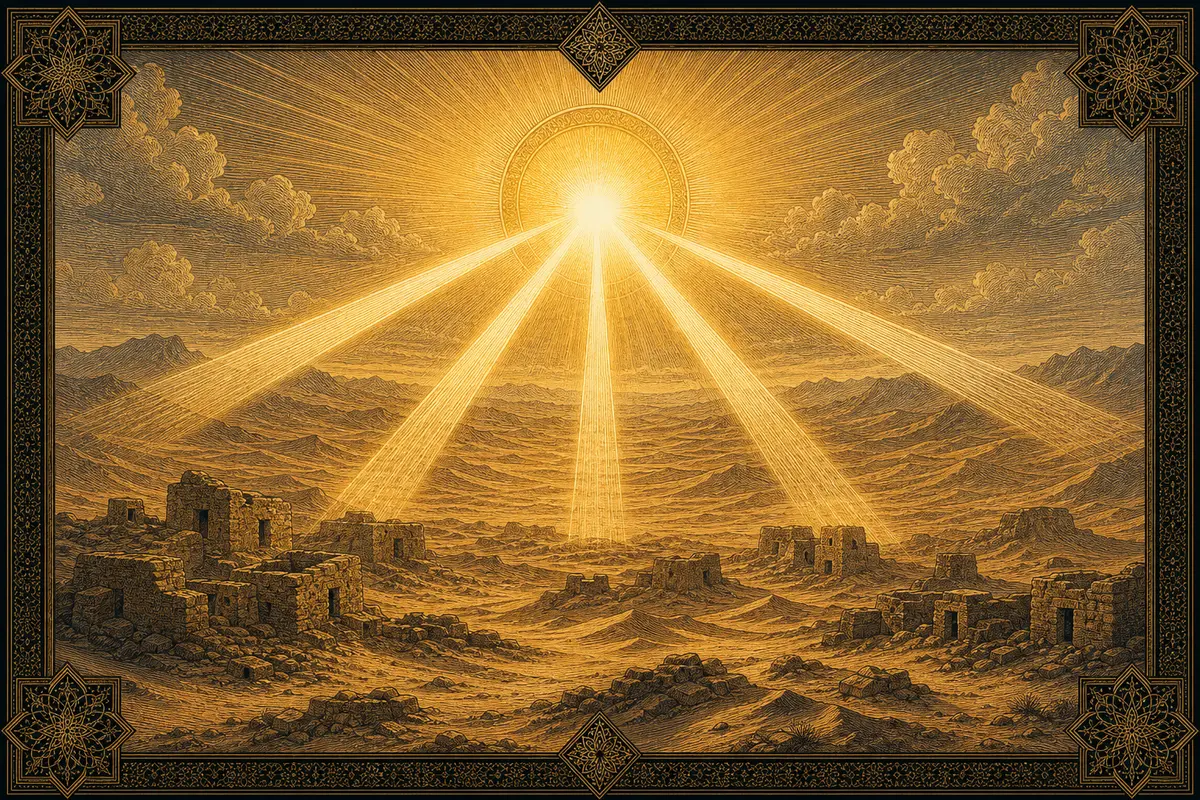
A blazing sun rising over a vast desert landscape, its light splitting into seven distinct rays that illuminate the barren ruins of ancient stone dwellings half-buried in sand
91:1 -- By the sun and its radiance: the first of seven cosmic witnesses called to the stand

There are only fifteen verses. You can recite the entire surah in under a minute. But in that minute, the Quran accomplishes something that volumes of moral philosophy have failed to do: it locates the precise mechanism of human success and human failure, names it, proves it with evidence drawn from the physical universe and from the archaeological record, and delivers a verdict so compressed that it has the force of a mathematical equation. Successful is he who purifies it. Failing is he who corrupts it. That is the thesis of Ash-Shams, and everything else in the surah -- the sun, the moon, the day, the night, the sky, the earth, the obliterated civilisation of Thamud -- exists to make those two lines inescapable. The Quran does not open this surah with an argument. It opens with an oath. Seven oaths, in fact -- the longest unbroken oath sequence in the entire Book. God swears by the sun and its radiance, by the moon as it follows, by the day as it reveals, by the night as it conceals, by the sky and its Builder, by the earth and He who spread it. Six cosmic phenomena. Six exhibits of divine engineering. And then the seventh -- the one the first six were building toward, the one that makes the jury lean forward -- the soul. And He who proportioned it. And inspired it with its wickedness and its righteousness. Not taught. Not commanded. Inspired. The Arabic word is alhamaha -- He breathed into it, He embedded within it, like firmware written into hardware before the device leaves the factory. The soul comes pre-loaded with the knowledge of what will corrupt it and what will save it. The Quran is saying that every human being already knows. The equipment is installed. The only question is what you do with it. And then, as if to show what happens when a whole civilisation chooses corruption over purification, the surah pivots -- without transition, without softening -- to Thamud. A people who denied. A people who followed their most wicked. A people who were warned, who watched the sign of God stand before them in the form of a she-camel, and who chose to hamstring it anyway. Their Lord crushed them for their sin, and leveled it. And He does not fear its sequel. Fifteen verses. The architecture of the soul. The destruction of a nation. And a God who does not flinch.

“Successful is he who purifies it. Failing is he who corrupts it.”
— God (the Quran's most compressed moral equation) 91:9-10
Spiritual Barometer
Force
strong
Tone
absolute
Urgency
urgent

The Daily Revelation Edition 91

Lead Story

SEVEN WITNESSES FOR THE PROSECUTION: How God Built the Longest Oath in the Quran to Deliver a Two-Line Verdict on Every Human Being Who Ever Lived

Start counting. In a book where God typically swears by one phenomenon -- the star, the pen, the morning, the fig -- Surah Ash-Shams opens with seven consecutive oaths. Nothing else in the Quran comes close. Seven witnesses summoned to the stand before the verdict is delivered. And the structure is not random. It is a deliberate narrowing, a telescopic zoom from the outermost reaches of the visible universe to the innermost architecture of the human self.

"By the sun and its radiance" 91:1. The sun -- the largest, most visible, most life-sustaining object in the human sky. The starting point is maximum scale, maximum light. Everything begins with radiance. The Arabic duha refers not merely to the sun's light but to its morning brightness, the specific quality of illumination at the moment the sun clears the horizon and floods the world. God opens His oath with the instant when darkness becomes impossible to maintain.

"And the moon as it follows it" 91:2. A subordinate witness. The moon does not generate its own light; it reflects the sun's. It follows -- talaha -- it comes after, it tracks, it is dependent. Already the surah is establishing a hierarchy: original light and reflected light, source and derivative, leader and follower. This will matter immensely when we reach the soul.

"And the day as it reveals it" 91:3. The day does not create light. It reveals what the sun produces. It is the medium through which radiance becomes visible. "And the night as it conceals it" 91:4. The night does not destroy light. It conceals what was already there. Two active forces -- revealing and concealing -- and neither of them creates or destroys anything. They merely determine what can be seen. The Quran is building a cosmic model of moral visibility: there are forces that expose truth and forces that hide it, but the truth itself remains constant underneath both.

"And the sky and He who built it" 91:5. Now the oath shifts from phenomena to their Maker. Not merely the sky, but He who built it -- wa ma banaha. The Arabic ma here carries a deliberate ambiguity between "what" and "who" that the classical grammarians debated for centuries. The sky is not simply a natural occurrence. It was engineered. It was built. By Someone. "And the earth and He who spread it" 91:6. The same construction. Not merely the ground beneath your feet, but the act of spreading it -- tahaha -- flattening it, making it habitable, turning raw creation into a surface where life can walk and build and plant. Six oaths. Three pairs. Light and its follower. Revelation and concealment. Sky and earth. The universe has been called to testify.

And then the seventh. The one everything has been building toward. "And the soul and He who proportioned it" 91:7. The Arabic sawwaha -- He balanced it, He proportioned it, He gave it its form and its faculties in perfect measure. The soul is not an accident. It is not a blank slate. It was proportioned -- calibrated, engineered with the same deliberation that built the sky and spread the earth. The soul is creation's masterpiece, and it is the final witness because it is the subject of the verdict.

Verse eight delivers the revelation that makes this surah one of the most psychologically profound passages in all of scripture: "And inspired it with its wickedness and its righteousness" 91:8. Fa-alhamaha fujuraha wa taqwaha. He inspired -- alhama, the same root as ilham, inspiration, the breathing-in of knowledge that does not require teaching. God did not merely create the soul with the capacity to learn right from wrong. He pre-installed the knowledge. Fujur -- wickedness, moral dissolution, the tearing-open of boundaries. Taqwa -- righteousness, God-consciousness, the careful guarding of limits. Both are named. Both are known. The soul arrives in the world already briefed on both possibilities.

This is the Quran's most radical psychological claim: no human being sins in ignorance of the fact that they are sinning. No human being does good without some inner recognition that they are doing good. The equipment is pre-installed. The firmware is loaded. You may override it, suppress it, drown it out with rationalisation and noise -- but it is there. It was there from the moment He proportioned you. And it is this -- this pre-loaded moral compass, this factory-installed conscience -- that makes the verdict in the next two verses not merely just, but inevitable.

91:1 91:2 91:3 91:4 91:5 91:6 91:7 91:8

The Daily Revelation Edition 91

Psychology

THE SOUL'S FIRMWARE: What Verse 91:8 Tells Modern Psychology About the Origin of Conscience

There is a debate in psychology that has persisted for centuries, long before psychology had a name. Is the human being born blank -- a tabula rasa, as Locke argued, waiting for experience to write upon it? Or does the human being arrive with something already written -- pre-installed moral intuitions, innate knowledge of right and wrong that precedes all teaching?

Verse 91:8 answers this debate with a single word: alhama. He inspired it. "And inspired it with its wickedness and its righteousness" 91:8. The soul did not learn wickedness from society. The soul did not learn righteousness from prophets. Both were placed inside it -- inspired into its very architecture -- by the same God who proportioned it. The Quran's position is not that human beings are born good and corrupted by the world. Nor is it that human beings are born evil and redeemed by revelation. It is that human beings are born knowing both -- loaded with the full spectrum of moral possibility, pre-equipped with the capacity to recognise each end of it.

The implications are staggering. If fujur and taqwa are both inspired -- both breathed into the soul by God -- then the moral life is not about acquiring knowledge you lack. It is about choosing between knowledge you already possess. The alcoholic who takes his first drink knows, at some level beneath his rationalisations, that he is choosing dissolution. The mother who rises at dawn to pray knows, at some level beneath her exhaustion, that she is choosing righteousness. Neither is acting on new information. Both are acting on alhama -- the inspiration that was loaded into them before they drew their first breath.

This is why the Quran's verdict in the next two verses requires no further argument: "Successful is he who purifies it. Failing is he who corrupts it" 91:9-10. The verdict is binary. The language is absolute. Qad aflaha man zakkaha. Wa qad khaba man dassaha. Success and failure. Purification and corruption. There is no middle ground because the soul was given no middle firmware. It knows what will elevate it and what will destroy it. The choice is therefore always fully informed, and the consequences are therefore always fully earned.

The Arabic zakkaha -- purifies it -- shares a root with zakat, the obligatory charity. Purification, in the Quranic framework, is not passive cleanliness. It is active cultivation. You purify the soul the way you purify wealth: by giving away what it clings to, by stripping from it the excess that weighs it down, by returning to the proportioned balance that God installed at the factory. Dassaha -- corrupts it -- literally means to bury it, to cover it, to push it down into the ground. The corrupt soul is not destroyed. It is buried alive. Its firmware is still running; its moral compass is still installed; but layer upon layer of rationalisation and self-deception have been piled on top of it until the signal can no longer be heard.

This is the Quran's psychology of sin in a single verse. You do not sin because you do not know better. You sin because you have buried what you know. The soul's firmware is still there, still broadcasting, still whispering fujur and taqwa in their correct categories. But the burial is thick. And the only way back is tazkiyah -- purification, excavation, the slow and painful uncovering of what was always there.

91:7 91:8 91:9 91:10

The Daily Revelation Edition 91

Investigation

THE THAMUD FILE: How a Civilisation That Carved Cities from Mountains Was Erased in a Single Morning

The surah could have ended at verse ten. The thesis was complete. The seven oaths had been sworn. The verdict had been delivered. Successful is he who purifies. Failing is he who corrupts. Case closed. But the Quran does not deal in abstraction when a concrete example will do. So the final five verses of Ash-Shams turn from the universal to the particular, from the soul in general to one specific civilisation that chose corruption -- and paid for it with total annihilation.

"Thamood denied in its pride" 91:11. The Arabic bi-taghwaha -- in its transgression, in its overreaching, in its pride -- locates the cause of denial not in intellectual disagreement but in moral excess. Thamud did not reject their prophet because his argument was weak. They rejected him because their pride was strong. The corruption of the soul that verse ten described in the abstract is now given a historical name, a geographical location, a date of destruction.

The Thamud were not primitive. They were engineers. The Quran describes them elsewhere as a people who carved dwellings from the mountains -- monumental architecture hewn from solid rock, the kind of construction that requires advanced tools, organised labour, generational ambition. The ruins at Mada'in Salih in modern Saudi Arabia preserve what they built: enormous facades cut into sandstone cliffs, tombs and halls that have survived millennia of wind and sun. These were people of immense capability. And that capability -- that esteem, in Maslow's framework -- is precisely what made their corruption so dangerous. They had the power to act on their worst impulses at civilisational scale.

"When it followed its most wicked" 91:12. The Arabic ashqaha -- its most wretched, its most vile. Every society has its worst element. The question that determines a civilisation's fate is not whether such people exist, but whether the civilisation follows them. Thamud did. The surah does not say Thamud was destroyed because one man sinned. It says Thamud was destroyed because the collective followed the one man who sinned most egregiously. The crime was communal. The corruption of the soul was not individual; it was institutional.

"The messenger of God said to them, 'This is the she-camel of God, so let her drink'" 91:13. Prophet Salih's warning is heartbreakingly simple. He does not ask them to build a temple. He does not demand they surrender their wealth. He asks them to leave an animal alone. Let her drink. That is the test. That is the entire moral examination set before one of the most powerful civilisations of the ancient world: can you share a water supply with a camel? The Quran is making a point about how low the bar was. God did not set Thamud an impossible standard. He set them the easiest test imaginable -- basic coexistence with a single, peaceful animal that He designated as His sign. And they could not do it.

"But they called him a liar, and hamstrung her" 91:14. Two crimes in one sentence. They denied the messenger -- fakadhdhabuhu -- they accused Salih of lying, not because they had counter-evidence but because his message threatened their hierarchy. And then they acted: fa-aqaruha -- they hamstrung the she-camel, they cut her tendons, they crippled and killed a defenceless animal that had been placed in their care as a divine trust. The word aqara is visceral in Arabic -- it implies deliberate, cruel incapacitation before slaughter. This was not an accident. This was not self-defence. This was the powerful destroying the vulnerable because they could, because their pride told them that nothing -- not a prophet, not a sign, not a camel -- had the right to exist on terms they did not control.

"So their Lord crushed them for their sin, and leveled it" 91:14. Fadamdama alayhim rabbuhum -- He crushed them, He flattened them, He brought down destruction that made no distinction between the rich and the poor, the leaders and the followers, the one who wielded the blade and the crowd that cheered. Fa-sawwaha -- and leveled it. The same root as sawwaha in verse seven, where God proportioned the soul. The same God who proportioned it now levels it. The verb that described creation's finest engineering is reused for creation's total demolition. What He built, He can flatten. What He proportioned, He can level. The symmetry is deliberate and devastating.

And then the final verse -- five words in Arabic that land like a stone door slamming shut: "And He does not fear its sequel" 91:15. Wa la yakhafu uqbaha. When God destroys, He does not look over His shoulder. He does not second-guess. He does not worry about the consequences, the political fallout, the archaeological legacy. He acts with the absolute sovereignty of a Being who created consequences and is not subject to them. This is the final line of the surah, and it is addressed not to Thamud -- they are already dust -- but to every listener. Every Qurayshi tribesman hearing these words in Mecca. Every reader encountering them fourteen centuries later. The God who crushed Thamud is still on the watch. And He does not fear the sequel.

91:11 91:12 91:13 91:14 91:15

The Daily Revelation Edition 91

Theology

THE GOD WHO DOES NOT FLINCH: What Verse 91:15 Reveals About Divine Justice

The final verse of Ash-Shams is one of the most quietly devastating lines in the entire Quran. "And He does not fear its sequel" 91:15. Five words. No elaboration. No qualification. No softening clause that reassures you God was reluctant, that it pained Him, that He hesitated. He does not fear the sequel. The destruction is done and the Destroyer is not troubled.

To understand why this verse matters, you have to understand what it is responding to. Human rulers -- every king, every general, every judge who has ever wielded power -- live in perpetual anxiety about consequences. A general who orders a bombardment worries about retaliation. A judge who passes a death sentence worries about appeal. A president who authorises a strike worries about public opinion, about history's verdict, about the political sequel. Power, in human hands, is always haunted by what comes after. Every exercise of force carries with it the fear that the force will circle back.

God, this verse declares, has no such concern. When He crushed Thamud, He was not taking a risk. He was not gambling that the punishment would deter others, or worrying that it might provoke a cosmic backlash. He acted with the certainty of a Being who invented causation and stands outside its chain. Wa la yakhafu uqbaha -- and He does not fear its consequence. The consequence belongs to the creation. The Creator is exempt.

But this is not -- and this distinction is critical -- a portrait of divine cruelty. Go back to the oath sequence. Before God mentions Thamud, before He describes the crushing, before He delivers the sentence, He swears seven oaths that are, in essence, a catalogue of mercy. The sun that gives light. The moon that guides the night traveller. The day that reveals. The sky that shelters. The earth that sustains. The soul that He proportioned and inspired with knowledge of right and wrong. All of these are gifts. All of these preceded the punishment by millennia. Thamud was not destroyed by a God who wanted to destroy. They were destroyed by a God who had given them everything they needed to avoid destruction -- including a prophet who stood in front of them and said, in the simplest possible language, let the camel drink -- and who watched them choose destruction anyway.

The fearlessness of verse 15 is not the fearlessness of a tyrant. It is the fearlessness of a Surgeon who has exhausted every treatment, who offered the patient every possible intervention, and who now performs the amputation without trembling -- not because He does not care, but because the alternative was letting the gangrene spread. Thamud's corruption, if left unchecked, would have infected everything it touched. The leveling was not vengeance. It was containment. And the God who performed it does not fear the sequel because He knows -- with the knowledge of a Being who sees all consequences simultaneously -- that the sequel was already accounted for.

For the listener in Mecca hearing these words for the first time -- a city whose leaders were at that very moment rejecting the Messenger of God, calling him a liar, threatening his followers -- verse 15 was not ancient history. It was a mirror held up to the present tense. The God who did not flinch when He crushed Thamud will not flinch when He judges Quraysh. And He will not flinch when He judges you. Not because He is merciless, but because His justice does not require your approval to be executed. That is the meaning of la yakhafu uqbaha. Not cruelty. Sovereignty.

91:14 91:15

The Daily Revelation Edition 91

Analysis

THE PURIFICATION EQUATION: Why the Quran Treats Moral Growth as Engineering, Not Magic

The two most important verses in Ash-Shams are also its shortest. "Successful is he who purifies it" 91:9. "Failing is he who corrupts it" 91:10. Two lines. Two fates. No third option. The Arabic is even more compressed: Qad aflaha man zakkaha. Wa qad khaba man dassaha. The particle qad at the opening of each -- an intensifier, a grammatical marker of certainty. This has already been decided. This is not a prediction. It is a fixed law. Aflaha -- he has succeeded, he has prospered, he has achieved the thing worth achieving. Khaba -- he has failed, he has lost, he has been disappointed. The finality is absolute.

But the verbs that determine which fate applies -- zakkaha and dassaha -- reveal something extraordinary about the Quran's model of moral development. Zakkaha means to purify, to grow, to cultivate. Its root is z-k-w, the same root as zakat, the obligatory alms. The connection is not incidental. Zakat purifies wealth by removing from it the portion that does not rightfully belong to you. Tazkiyah purifies the soul by removing from it the impulses that do not rightfully belong to who you were proportioned to be. Both are acts of subtraction, not addition. You do not purify by adding something new. You purify by stripping away what should not be there.

This is a fundamentally different model from the one most people carry. Most people think of moral growth as acquisition -- acquiring virtue, acquiring discipline, acquiring knowledge. The Quran's model is excavation. The virtue is already there. It was inspired -- alhamaha -- before you were born. The work of purification is not to build something from scratch but to uncover what was buried. It is archaeological, not architectural.

And the opposite -- dassaha -- confirms this model with devastating precision. Dassaha means to bury, to conceal, to push down. It is related to dassa, to insert something secretly, to hide it beneath layers. The corrupt soul is not a soul that lacks something. It is a soul that has buried something -- specifically, the moral firmware that God installed in verse eight. The wicked person does not fail because they were built defectively. They fail because they took the perfectly proportioned instrument they were given and shoved it underground, covering it with layers of rationalisation, habit, pride, and self-interest until the signal could no longer be detected.

The practical consequence of this model is radical. It means that every human being is, at this moment, either engaged in purification or in burial. There is no neutral state. You are either uncovering the truth that God breathed into you, or you are piling more dirt on top of it. The soul is not a static object. It is an ongoing project. Tazkiyah is a verb, not a destination. And the seven cosmic oaths that precede this verdict exist to tell you that the stakes of this ongoing project are as vast as the sun, as permanent as the sky, as fundamental as the earth beneath your feet. Your inner project of purification or corruption is not a private matter. It is a cosmic event. The universe was summoned as a witness to tell you so.

91:9 91:10 91:7 91:8

The Daily Revelation Editorial Edition 91

✸ ✸ ✸

Letter from the Editor: The Surah That Makes You the Subject of the Universe

I want you to notice something about the architecture of Ash-Shams that is easy to miss on a first reading. Seven oaths. Then two lines of verdict. Then five lines of evidence. The proportions are 7-2-5. But the seven oaths are not decoration. They are not rhetorical throat-clearing. They are the foundation upon which the verdict rests.

God swears by the sun. He swears by the moon. He swears by the day and the night and the sky and the earth. These are the six largest, most visible, most undeniable phenomena in the human experience. And then He swears by the soul. Your soul. My soul. The soul of the reader, the listener, the person standing in the back row of the mosque who thought this surah was about someone else. The soul is placed in a list with the sun. Let that land. God considers the moral architecture inside you to be as worthy of a cosmic oath as the star that lights the solar system.

This is either the most extraordinary compliment ever paid to a human being, or the most terrifying burden ever placed on one. Perhaps both. If the soul is as significant as the sun, then what you do with it is as consequential as what happens to the sky. Your purification is a cosmic event. Your corruption is a cosmic catastrophe. The Quran is not saying that your inner life matters in a vague, therapeutic sense. It is saying that your inner life belongs in the same sentence as the architecture of the heavens. The same God who built the sky proportioned you. The same seriousness applies.

And this is where the Thamud story becomes personal. Thamud was not an alien species. Thamud was us. Thamud was human beings with proportioned souls and pre-installed firmware who were given a simple test and failed it because their pride told them they were above the test. They followed their most wicked. They killed the sign. They were leveled. And the surah ends not with a lament for Thamud but with a statement about God: He does not fear the sequel. Meaning: this will happen again. Meaning: the test is ongoing. Meaning: the she-camel may look different in your generation -- it may be a prophet you ignore, a vulnerable person you harm, a truth you hamstring because it threatens your status -- but the test is the same. The soul knows. It always knew. The question is whether you will purify what you were given or bury it under the rubble of your own ambition.

Fifteen verses. Under a minute. But if you hear them -- really hear them -- you realise that the sun rising this morning was not just a natural event. It was a witness. And it was watching you.

For Reflection
Ash-Shams says your soul already knows its own wickedness and its own righteousness. Today, before you make a single decision, stop and listen. Not to advice. Not to the opinions of others. To the thing inside you that was proportioned and inspired before you were born. What is it telling you right now about the choice you are avoiding?
Supplication
O Allah, You proportioned my soul and inspired it with knowledge of its wickedness and its righteousness. I did not earn this gift. I did not ask for it. But I carry it. Help me to purify what You placed inside me rather than bury it. When I am tempted to follow the most wicked in the room -- the loudest voice, the most comfortable lie, the path that my pride prefers -- remind me of Thamud. Remind me that the test is always simpler than I make it. Let the camel drink. Leave the sign alone. Do not hamstring the truth because it inconveniences my ambition. Make me among those who succeed by uncovering what You installed, not among those who fail by burying it. And protect me from ever believing that You will not act -- because You do not fear the sequel. Ameen.
✸ ✸ ✸

The Daily Revelation Edition 91

Connections

THE COSMIC OATH TRADITION: How Ash-Shams Sits at the Centre of the Quran's Oath Surahs

Ash-Shams does not exist in isolation. It sits at the heart of a cluster of short Meccan surahs -- roughly Surahs 85 through 100 -- that share a distinctive rhetorical structure: divine oaths followed by moral verdicts. Understanding the pattern illuminates why Ash-Shams is the climax of the series.

Surah Al-Fajr (89) opens with oaths by the dawn, the ten nights, the even and the odd. Surah Al-Balad (90) swears by the city of Mecca. Surah Al-Layl (92), the very next surah after Ash-Shams, swears by the night and the day and the creation of male and female. Surah Ad-Duha (93) swears by the morning brightness and the still of night. In each case, God summons a cosmic phenomenon, makes it testify, and then delivers a teaching.

But Ash-Shams stands apart in three ways. First, the sheer number of oaths: seven, compared to the typical two or three. God is building His case with unprecedented thoroughness. Second, the progression from external to internal: the first six oaths are cosmic, the seventh is personal. No other oath surah makes this move with such deliberate telescoping. Third, the verdict is not about a future event or a specific group -- it is about every human soul that has ever existed or will ever exist. "Successful is he who purifies it. Failing is he who corrupts it" 91:9-10. This is universal law.

The neighbouring surahs complement Ash-Shams in ways that suggest deliberate arrangement. Al-Fajr (89) tells the story of what happens to civilisations that fail the test -- Aad, Thamud, Pharaoh -- in greater detail, then closes with the individual soul: "O tranquil soul, return to your Lord" 89:27-28. It moves from the collective to the individual. Ash-Shams reverses this: it starts with the individual soul (the verdict in 91:9-10) and then illustrates with the collective destruction of Thamud. The two surahs are mirrors of each other. Al-Layl (92), which immediately follows, takes the purification/corruption binary and expands it into a practical framework: "As for he who gives and is mindful... We will ease his way to ease". It is the action plan for the diagnosis Ash-Shams delivered.

Read together, Surahs 89 through 93 form a single sustained argument: civilisations rise and fall based on whether their members purify or corrupt their souls. The soul was engineered for success. The firmware is installed. The test is simple. The consequences are absolute. And the God who administers the test does not fear what comes after. This is the Quran's moral philosophy in its most concentrated form, and Ash-Shams is its thesis statement.

91:1 91:9 91:10 91:11 91:15

The Daily Revelation Back Page Edition 91

Today's Action
Today, perform one act of tazkiyah -- soul purification -- by subtracting something rather than adding something. Do not acquire a new virtue. Remove an existing vice. One lie you habitually tell. One unkindness you routinely commit. One excuse you always reach for. Identify it, name it, and stop doing it for twenty-four hours. You are not building something new. You are uncovering what was already proportioned inside you.
Weekly Challenge
For seven days, match the seven oaths of Ash-Shams to your daily routine. Day 1 (Sun): notice the radiance of something good in your life and give thanks. Day 2 (Moon): notice where you are following someone else's light instead of generating your own, and ask why. Day 3 (Day): reveal one truth about yourself that you have been hiding. Day 4 (Night): sit with one uncomfortable truth you have been concealing from yourself. Day 5 (Sky): look up and acknowledge the architecture above you that you did not build. Day 6 (Earth): touch the ground and acknowledge the foundation beneath you that you did not earn. Day 7 (Soul): sit in silence for ten minutes and listen to what your proportioned soul already knows about what you need to change.
Related Editions
Edition 89 The mirror surah -- same oath structure, same destroyed civilisations (including Thamud), but ends with the tranquil soul invited to Paradise. What Ash-Shams diagnoses, Al-Fajr resolves.
Edition 54 Contains an extended account of Thamud and the she-camel: 'They hamstrung the she-camel and defied the command of their Lord' (54:29). The same crime from a different angle.
Edition 7 The most detailed Thamud narrative in the Quran -- Salih's full dialogue with his people, the she-camel as a sign, and the earthquake that destroyed them (7:73-79).
Edition 11 'And to Thamud We sent their brother Salih. He said, O my people, worship God' (11:61) -- the fuller backstory to the compressed account in Ash-Shams.
Edition 92 The immediate sequel -- swears by night and day, then expands the purification/corruption binary into a practical framework of giving vs. hoarding. The action plan for Ash-Shams' diagnosis.
Characters in This Edition
Allah Salih People of Thamud Mankind Believers Disbelievers
Coming Next
NEXT EDITION: Surah Al-Layl -- The Night. From the sun's radiance to the night's covering. The Quran moves from the cosmic oath and the soul's firmware to the practical question: what do you actually DO with a purified soul? The answer involves your wallet, your ego, and the steep hill between the two.
Page 1 of 9
Ed. 90 Ed. 92