Edition 89 of 114 Mecca Bureau 30 Verses

The Daily Revelation

Revelation. Reported. Truth.
الفجر

Al-Fajr — The Dawn
Force: Strong Tone: Warning Urgency: Urgent

THE DAWN VERDICT: When God Swore by the Breaking Light and Put Civilisation on Trial

Surah Al-Fajr opens with God taking an oath by the dawn itself -- then prosecutes three of the most powerful civilisations in ancient memory, exposes the transactional psychology that makes humans misread every test they are given, and closes with an invitation so intimate it has made scholars weep for fourteen centuries: 'O tranquil soul, return to your Lord, pleased and accepted. Enter My Paradise.'


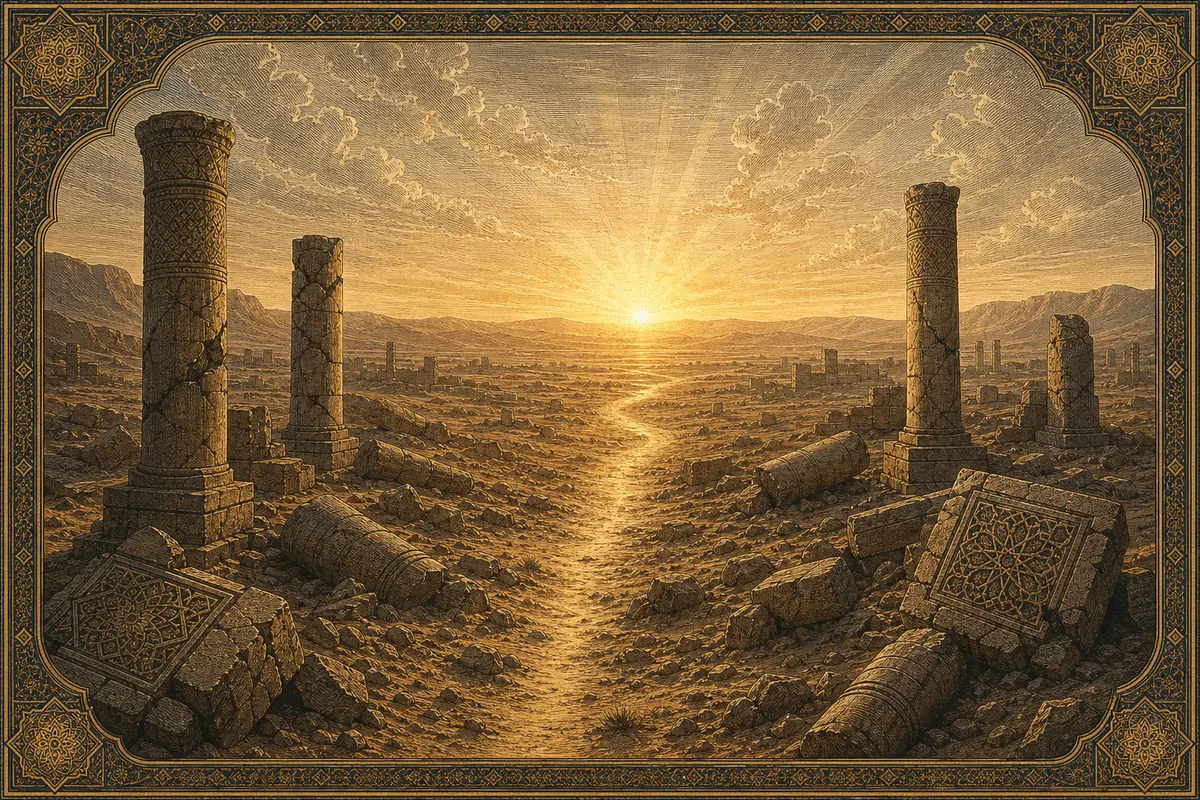
The first light of dawn breaking over a vast desert landscape, ruins of colossal pillars half-buried in sand in the foreground, a single path of golden light cutting between them toward the horizon
89:1 -- By the daybreak: God swears by the first light before delivering the verdict on civilisation

God does not take oaths lightly. When He swears in the Quran, it is never rhetorical decoration. It is the cosmic equivalent of a judge rising to deliver a verdict -- and in Surah Al-Fajr, the oath is quadruple. By the daybreak. By ten nights. By the even and the odd. By the night as it recedes. Four phenomena of time and light, stacked like evidence exhibits, before the question that silences every courtroom: 'Is there in this an oath for a rational person?' The prosecution then begins. Three civilisations are summoned from the archaeological record -- Aad, who built Iram of the Pillars, a city so extraordinary that nothing like it had ever been created in the land; Thamud, who carved their homes from solid rock in the valley; and Pharaoh of the Stakes, who pinned his power to the earth with monuments of oppression. All three committed excesses. All three spread corruption. And all three received the same verdict: 'So your Lord poured down upon them a scourge of punishment. Your Lord is on the lookout.' But the surah does not end with the ruins. It turns inward -- to the psychology that built those civilisations and then destroyed them. The Quran identifies, with clinical precision, the cognitive error at the heart of human failure: when God honours a person with wealth, he says 'My Lord has honoured me.' When God tests him with restriction, he says 'My Lord has insulted me.' Both responses are wrong. Both reveal the same disease -- a transactional theology that measures God's love by the size of the bank account. And then, after the prosecution, after the psychology, after the earth is levelled and Hell is brought forward, comes the ending that no reader forgets. Four verses. Addressed not to humanity in general, not to a prophet, not to a nation -- but to a single soul. 'O tranquil soul. Return to your Lord, pleased and accepted. Enter among My servants. Enter My Paradise.' The dawn that opened the surah was not just a time of day. It was a promise. After every night, light returns. After every trial, the tranquil soul goes home.

“But as for you, O tranquil soul. Return to your Lord, pleased and accepted. Enter among My servants. Enter My Paradise.”
— Allah 89:27-30
Spiritual Barometer
Force
strong
Tone
warning
Urgency
urgent

The Daily Revelation Edition 89

Lead Story

THE QUADRUPLE OATH: God Swears by Dawn, Night, and the Architecture of Time Before Asking One Question

The Quran contains approximately forty passages in which God swears an oath. In some, He swears by the sun. In others, by the stars, the wind, the fig, the olive, the pen. Each oath is calibrated to the subject that follows -- a cosmic exhibit presented before the verdict is read. But nowhere in the Quran is the oath more layered, more rhythmically compressed, or more philosophically demanding than in the opening five verses of Surah Al-Fajr.

"By the daybreak" 89:1. The Arabic is wal-fajr -- a single word that carries the weight of the entire surah's thesis. The dawn is not merely a time. It is a transition. It is the exact moment when darkness concedes to light, when the night's dominion ends and visibility returns. God begins by pointing at the hinge between blindness and sight, between ignorance and clarity. Everything that follows in this surah -- the collapsed empires, the exposed psychology, the final judgment, the invitation to paradise -- is framed as a dawn. A revelation. A moment when what was hidden becomes visible.

"And ten nights" 89:2. The scholars have debated which ten nights these are for fourteen centuries. The majority opinion, grounded in the commentary of Ibn Abbas, holds that these are the first ten nights of Dhul Hijjah -- the most sacred days in the Islamic calendar, the days of pilgrimage, the days in which, according to prophetic tradition, no righteous deed is more beloved to God. Others argue they are the last ten nights of Ramadan, which contain Laylat al-Qadr, the Night of Power. What is not debated is their function in the oath: they are not ordinary nights. They are nights charged with spiritual density, nights when the boundary between heaven and earth is thinner than usual, nights when history's most consequential acts of worship take place.

"And the even and the odd" 89:3. Here the oath moves from the specific to the mathematical. The even and the odd -- ash-shaf'i wal-watr -- encompass all of creation. Every number is either even or odd. Every pair has a counterpart; every singular thing stands alone. The scholars read this as a reference to the fundamental duality and unity woven into existence: creation comes in pairs, but God is One. The watr -- the Odd, the Singular, the Unique -- is one of God's own names. He swears by the structure of mathematics itself, the binary architecture that undergirds every atom and every galaxy, and buries within that oath a reminder: at the bottom of all duality, there is a unity. At the foundation of every pair, there is a One.

"And the night as it recedes" 89:4. The final element of the oath is motion. Not the night itself, but the night in the act of departing. The Arabic yas-ri carries the sense of travelling, journeying, moving through. The night does not simply end -- it travels away, yielding the stage to the dawn that opened the oath. The structure is circular: dawn, sacred nights, the fabric of existence, and then the night pulling back like a curtain. The oath begins with light arriving and ends with darkness departing. Between them, all of time and all of number are summoned as witnesses.

And then the question -- the only question that matters: "Is there in this an oath for a rational person?" 89:5. The Arabic dhi hijr means one who possesses intellect, discernment, the faculty of reason. God is not asking whether the oath is impressive. He is asking whether a thinking person can witness the dawn, contemplate the sacred nights, observe the even and the odd, and watch the night recede -- and still fail to recognise that these phenomena are testimony. That the universe is not accidental. That the patterns encoded in time and number are evidence of a Designer who, having arranged the cosmos with this degree of precision, might also have arranged human history with purpose, and might also have arranged a final reckoning with justice.

The question is rhetorical, but its implications are not. The rational person -- dhi hijr -- is exactly the person the rest of the surah will address. The empires that fell were not led by irrational madmen. They were led by engineers, architects, military strategists, builders of pillared cities and rock-carved civilisations. They had intellect. What they lacked was the willingness to let that intellect lead them to its logical conclusion: that the God who built the dawn also built the reckoning.

89:1 89:2 89:3 89:4 89:5

The Daily Revelation Edition 89

Special Investigation

IRAM OF THE PILLARS: The Lost Civilisation So Magnificent That God Said Nothing Like It Had Ever Existed

In the entire Quran -- across 6,236 verses that span the history of creation from Adam to the Last Day -- only one city receives this particular distinction: "The like of which was never created in the land" 89:8. Not Babylon. Not Egypt. Not Rome. The city that earned the Quran's singular superlative was Iram -- a place so obscure that for centuries Western scholars doubted its existence, and so extraordinary that God Himself used it as evidence in a prosecution.

"Have you not seen how your Lord dealt with Aad? Erum of the pillars. The like of which was never created in the land" 89:6-8. Three verses. A question, a name, and a verdict. The question -- alam tara, 'have you not seen' -- is directed at Muhammad, peace be upon him, and through him at every reader. It is an invitation to look at the archaeological record and draw a conclusion. God is saying: I am not asking you to take this on faith alone. Look at the evidence. Look at what remains of Aad.

The people of Aad were, according to the Quran, among the earliest post-Noahic civilisations. They appear in multiple surahs -- Al-A'raf, Hud, Ash-Shu'ara, Fussilat, Al-Ahqaf, Ad-Dhariyat -- always as a case study in the consequences of arrogance. But only here, in Al-Fajr, does the Quran describe what they built. Iram dhat al-imad -- Iram of the Pillars. The word imad refers to lofty columns, towering pillars, architectural structures of extraordinary height and ambition. This was not a village. It was a metropolis of columns -- a city whose defining feature was vertical engineering on a scale that had never been achieved before.

The classical commentators wrestled with the identity of Iram. Some, including Ibn Kathir, understood it as the name of the tribe's ancestor, with dhat al-imad describing either the tribe's physical stature or their tent pillars. But the dominant reading, supported by Al-Tabari and others, identifies Iram as a city -- a constructed marvel, a monument to human capability that stood in the Arabian Peninsula's southern desert. In 1992, archaeological excavations at Shisr in the Dhofar region of Oman uncovered the remains of an ancient trading hub with a fortified tower system, tentatively identified by some researchers as the site connected to the Iram legend. Whether or not that specific site is the Quranic Iram, the text's description -- pillared, unprecedented, unmatched -- points to a level of architectural achievement that the Quran treats as historically real and archaeologically verifiable.

The theological function of Iram in Al-Fajr is precise: it is Exhibit A in God's prosecution. The most magnificent city ever built, constructed by the most physically powerful people on earth, is presented not as a triumph but as a cautionary tale. The pillars that reached toward heaven did not save Aad from the God who built the heaven they were reaching toward. The unprecedented nature of their architecture -- the like of which was never created in the land -- is mentioned not to praise their engineering but to magnify the scale of the fall. The higher the civilisation, the louder the collapse.

Alongside Aad, two more civilisations are summoned to the witness stand. "And Thamood -- those who carved the rocks in the valley" 89:9. Where Aad built upward with pillars, Thamud built inward -- carving their dwellings directly into mountain rock, creating structures that would endure for millennia. The ruins at Mada'in Salih in northwestern Saudi Arabia -- vast rock-cut facades, tombs, and chambers carved from sandstone cliffs -- stand to this day as testimony. Thamud did not merely build structures. They embedded themselves in the geology of the earth, as if permanence itself could substitute for piety.

"And Pharaoh of the Stakes" 89:10. The Arabic dhi al-awtad -- Pharaoh of the Stakes or Pegs -- has been interpreted in several ways. Some scholars understand the stakes as the tent pegs of his vast military encampments, symbolising the reach and mobility of his army. Others read them as the stakes to which he pinned his victims -- instruments of torture and execution that defined his reign. Still others see a reference to the pyramids themselves, described metaphorically as pegs driven into the earth. Whatever the precise referent, the image is of a ruler whose power was anchored, staked, fixed into the ground with brute force -- a man who believed his authority was as permanent as the structures he built to embody it.

Three civilisations. Three engineering philosophies. Pillars reaching skyward. Chambers carved into rock. Stakes driven into earth. Upward, inward, downward. Every direction covered. Every material exploited. Every technology of permanence deployed. And all three received the same sentence: "Those who committed excesses in the lands. And spread much corruption therein. So your Lord poured down upon them a scourge of punishment" 89:11-13. The Arabic sawta adhab -- a whip of punishment, a lash of retribution -- is delivered not by an army or a natural disaster but by your Lord. The agent of destruction is personal, direct, sovereign. The same God who built the dawn dismantled the pillars.

89:6 89:7 89:8 89:9 89:10 89:11 89:12 89:13

The Daily Revelation Edition 89

Psychology

THE PROSPERITY TRAP: The Quran's Most Precise Diagnosis of Why Humans Misread Every Test God Sends Them

If you read nothing else in Surah Al-Fajr, read verses 15 and 16. They are, in the view of this correspondent, the two most psychologically devastating verses in the entire Quran -- not because they threaten, not because they warn, but because they hold up a mirror so clear that no reader can look away without seeing themselves.

"As for man, whenever his Lord tests him, and honors him, and prospers him, he says, 'My Lord has honored me.' But whenever He tests him, and restricts his livelihood for him, he says, 'My Lord has insulted me.'" 89:15-16

Read it again, slowly. God is describing a cognitive error so deeply embedded in human psychology that most people commit it without knowing it exists. The error is this: we interpret our circumstances as God's commentary on our worth. When things go well -- when the money flows, when the career ascends, when the health holds -- we assume God is pleased with us. When things go badly -- when the contract falls through, when the diagnosis comes, when the poverty tightens -- we assume God is punishing us. Both assumptions are wrong. And the Quran says so explicitly.

The key word in both verses is ibtala -- He tests. Not rewards. Not punishes. Tests. The honour and prosperity described in verse 15 are not God's endorsement. They are God's examination. The restriction described in verse 16 is not God's rejection. It is God's examination. The exam is the same in both cases. Only the test material differs. When a teacher gives one student an easy question and another a hard question, neither question is a statement about the teacher's feelings toward the student. Both are assessments of what the student will do with what they have been given.

The psychological precision here is extraordinary. The Quran is identifying what modern cognitive psychology would call a fundamental attribution error applied to divine agency. Humans have an almost irresistible tendency to attribute meaning to circumstances -- to read their material condition as a moral signal. The rich man assumes his wealth is proof of divine favour. The poor man assumes his poverty is proof of divine displeasure. The Quran dismantles both readings in two verses. You are not rich because God loves you. You are not poor because God hates you. You are being tested. What matters is not the exam paper. What matters is the answer you write on it.

The response the Quran documents in these verses reveals the deeper disease: transactional theology. The man who says "My Lord has honoured me" when he is wealthy is operating on the assumption that God's relationship with him is a transaction -- good behaviour produces prosperity, and prosperity proves good behaviour. The man who says "My Lord has insulted me" when he is poor is operating on the same assumption in reverse -- suffering proves divine rejection. Both are treating God as a vending machine: insert piety, receive wealth; receive poverty, conclude malfunction.

The Quran's refutation is immediate and brutal. "Not at all" 89:17. The Arabic kalla is one of the Quran's sharpest words of negation -- a flat, uncompromising rejection. Not at all. You are wrong. Your entire framework is wrong. And then, before the reader can recover, the Quran reveals what actually constitutes failure in God's economy -- and it has nothing to do with how much money you have: "But you do not honor the orphan. And you do not urge the feeding of the poor. And you devour inheritance with all greed. And you love wealth with immense love" 89:17-20.

Four charges. Not one of them is about worship in the conventional sense. Not one is about prayer or fasting or pilgrimage. They are all about how you treat other people and how you relate to money. The test of prosperity is not whether you thanked God for it -- though you should. The test of prosperity is what you did with it. Did you protect the orphan? Did you feed the poor? Did you refrain from devouring what was not yours? Did you keep wealth in its proper place -- as a tool, not a beloved? The surah moves from cosmic oaths to collapsed empires to this: the verdict on a human life is determined not by what God gave you, but by what you gave others with what God gave you.

This is why the three civilisations of verses 6 through 13 are not arbitrary examples. Aad, Thamud, and Pharaoh were not poor. They were fabulously, unprecedentedly, architecturally wealthy. They had pillars, carved mountains, stakes driven into continents. They passed the prosperity test -- in the wrong direction. They took God's test material -- power, wealth, engineering capability -- and instead of honouring orphans and feeding the poor, they "committed excesses in the lands and spread much corruption therein" 89:11-12. The empires fell not because they lacked resources but because they failed the test that resources represent.

89:15 89:16 89:17 89:18 89:19 89:20

The Daily Revelation Edition 89

Long-Form Feature

YOUR LORD IS ON THE LOOKOUT: The Single Sentence That Governs All of Human History

Between the collapsed empires and the psychology of wealth, the Quran inserts a single verse that operates as the surah's structural keystone. It is easy to miss -- five words in Arabic, sandwiched between the spectacle of divine punishment and the exposure of human self-deception. But it is the most important sentence in Al-Fajr, and arguably one of the most important sentences in the Quran: "Your Lord is on the lookout" 89:14.

The Arabic is inna rabbaka la-bil-mirsad. The word mirsad comes from the root ra-sa-da, meaning to observe, to watch, to lie in wait at a watchtower or an ambush point. A mirsad is a vantage point from which nothing passes unseen -- a sentinel's post, an observation tower, a place where every movement is tracked. God is not distracted. God is not elsewhere. God is stationed at the lookout, and nothing -- no excess, no corruption, no devoured inheritance, no neglected orphan -- passes without being recorded.

The placement of this verse is architecturally precise. It comes immediately after the punishment of Aad, Thamud, and Pharaoh -- "So your Lord poured down upon them a scourge of punishment" 89:13 -- and immediately before the psychological diagnosis of human transactional thinking in verses 15-16. It functions as the bridge between history and psychology, between what happened to civilisations and why it happened to individuals. The empires fell because your Lord was watching. The individual fails the test of wealth because your Lord is watching. The orphan is neglected, the poor are unfed, the inheritance is devoured -- and your Lord is watching. Always watching. From the lookout.

What makes this verse theologically devastating is its universality. It is not addressed to Aad. It is not addressed to Thamud. It is not addressed to Pharaoh. It is addressed to you. Rabbaka -- your Lord. The possessive pronoun makes it personal. The God who demolished civilisations that spread corruption is your God. The watchtower from which He observed their excesses is the same watchtower from which He observes yours. The scourge that fell on them is still available. The sentence has not been retired. The lookout is still manned.

The classical scholar Al-Qurtubi observed that this verse should be understood as both a warning and a comfort. For the oppressor, it is a warning: you are seen. For the oppressed, it is a comfort: your suffering is witnessed. The orphan whom nobody honours, the poor whom nobody feeds, the inheritor whose rights are devoured by greed -- their cases have not gone unnoticed. God is at the lookout. The file is open. The evidence is accumulating. And the same Lord who poured punishment on Pharaoh's stakes and Aad's pillars is keeping accounts of every dirham withheld from an orphan and every meal denied to a hungry person.

This is the verse that connects the cosmic to the domestic. The dawn of verse 1 and the lookout of verse 14 are the same theological reality viewed from different angles. The dawn reveals what was hidden in darkness. The lookout sees what humans try to conceal in their economic behaviour. Both are about visibility -- the fundamental Quranic principle that nothing, absolutely nothing, escapes observation. The empires thought their pillars would last forever. The wealthy man thinks his prosperity is proof of divine approval. The greedy inheritor thinks no one is counting. They are all wrong. Your Lord is on the lookout.

There is a reason this verse has been quoted more often in Islamic ethical literature than almost any verse of comparable length. It is the Quran's surveillance doctrine -- not in the Orwellian sense of oppressive monitoring, but in the prophetic sense of guaranteed accountability. The universe is not unattended. History is not random. And the moral ledger -- every orphan ignored, every poor person unfed, every inheritance stolen -- is being maintained by Someone whose observation post has no blind spots and whose memory has no deletions.

89:13 89:14

The Daily Revelation Edition 89

Eschatology

WHEN THE EARTH IS LEVELLED AND HELL IS BROUGHT FORWARD: The Day Remembrance Comes Too Late

The surah's final movement begins with a negation so abrupt it reads like a slap: "No" 89:21. The Arabic kalla -- the same sharp rejection that answered the transactional psychology of verses 15-16 -- appears again, slamming the door on every delusion, every excuse, every rationalisation that humans construct to avoid the reality of what is coming. No. Whatever you thought you could negotiate, whatever arrangement you imagined you had with the universe, whatever deal you believed your wealth or your status or your lineage had purchased for you -- no. It ends.

"No -- when the earth is leveled, pounded, and crushed" 89:21. The Arabic deploys three verbs in succession -- dukkat dukkan dukka -- a phonetic hammering that mirrors the physical reality being described. The earth, which Aad built pillars on, which Thamud carved homes into, which Pharaoh drove stakes through, is flattened. Every structure, every monument, every archaeological trace of every civilisation that ever claimed permanence is pounded into nothing. The ground that held their pillars and their rock-cut palaces and their pyramidal stakes is levelled as if nothing had ever stood on it. The very concept of real estate becomes meaningless.

"And your Lord comes, with the angels, row after row" 89:22. This is one of the Quran's most vivid images of the Day of Judgment -- God Himself arriving, attended by angels arranged in ranks, saffan saffa, row upon row, an order and precision that mirrors the cosmic architecture of the dawn that opened the surah. The God who swore by the daybreak now arrives at the final dawn -- the one after which there is no more night.

"And on that Day, Hell is brought forward" 89:23. The Arabic is ji'a yawma'idhin bi-jahannam -- Hell is brought, delivered, presented. It does not appear gradually. It does not creep over the horizon. It is produced as evidence is produced in a courtroom -- carried forward, placed before the assembly, made visible to everyone present. The Prophet Muhammad, peace be upon him, described it in a hadith as being dragged by seventy thousand reins, each held by seventy thousand angels. Whatever the precise mode, the image is of Hell as a physical reality that arrives on schedule, as punctual and undeniable as the dawn.

And then the line that haunts every reader of this surah: "On that Day, man will remember, but how will remembrance avail him?" 89:23. The remembrance comes. It comes with perfect clarity. On the Day when the earth is levelled and Hell is brought forward, every human being will remember -- every orphan they did not honour, every poor person they did not feed, every inheritance they devoured, every wealth they loved with immense love. The memory will be total, comprehensive, merciless in its precision. And it will be useless. Too late. The exam is over. The papers have been collected. Remembrance without the possibility of action is the definition of regret.

"He will say, 'If only I had forwarded for my life'" 89:24. The Arabic qaddamtu li-hayati -- if only I had sent ahead for my real life. The word hayat here does not refer to the worldly life that has just ended. It refers to the life that is beginning -- the eternal one. The man realises, at the moment when realisation can no longer produce action, that the life he thought was his real life was actually the preparation period. The real life is the one he is now entering -- and he sent nothing ahead for it. He spent his preparation period hoarding, devouring, neglecting, loving wealth with immense love, and now he arrives at the actual examination with an empty portfolio.

"On that Day, none will punish as He punishes. And none will shackle as He shackles" 89:25-26. Two verses that close the punishment arc with a finality that echoes the architectural precision of the opening oaths. God's punishment is described not merely as severe but as incomparable -- no earthly tyrant, no Pharaoh of the Stakes, no builder of pillars or carver of rock ever achieved a punishment that could be compared to what awaits on that Day. The civilisations that oppressed and were destroyed were themselves subject to a power that dwarfs their own. The punisher of punishers. The one who shackles those who shackled others. The ultimate accountability that renders all lesser accountabilities preliminary.

89:21 89:22 89:23 89:24 89:25 89:26

The Daily Revelation Edition 89

Spirituality

O TRANQUIL SOUL: The Four Most Tender Words God Ever Spoke -- And the Invitation That Closes the Prosecution

Everything changes in verse 27. The earth has been levelled. Hell has been brought forward. The man has cried out in useless regret. The punishment has been declared incomparable. And then, without transition, without warning, without any of the editorial machinery the Quran typically uses to shift between subjects, God turns from the general to the singular, from humanity to a soul, from judgment to invitation, and speaks four words that have made scholars, mystics, and ordinary believers weep for fourteen hundred years.

"But as for you, O tranquil soul" 89:27.

The Arabic is ya ayyatuha an-nafs al-mutma'inna. The nafs -- the soul, the self, the deepest identity of a human being -- is addressed directly, personally, by name, by its defining quality: mutma'inna. Tranquil. At rest. At peace. Not because the world around it is peaceful -- the earth has just been levelled and Hell has just arrived. But because the soul itself has achieved an internal stillness that is independent of external circumstances. The tranquil soul is tranquil not because the storm has passed but because something inside it has been resolved. The test of verses 15-16 -- the test of prosperity and restriction -- this soul passed it. When God honoured it, it did not say 'My Lord has honoured me' with the smugness of entitlement. When God tested it with restriction, it did not say 'My Lord has insulted me' with the bitterness of transactional disappointment. It understood, in both cases, that it was being tested. And it responded not with self-congratulation or self-pity but with trust. Tuma'nina -- tranquillity -- is the Quran's word for a soul that has stopped negotiating with God and started trusting Him.

"Return to your Lord, pleased and accepted" 89:28. The Arabic irji'i ila rabbiki radiyatan mardiyya contains two reciprocal participles that mirror each other like facing pages of a book. Radiya -- pleased, satisfied, content. Mardiyya -- pleasing, accepted, approved. The soul is pleased with its Lord, and the Lord is pleased with the soul. The relationship is mutual. The contentment flows in both directions. This is not a master summoning a servant. This is a reunion. The soul returns to its origin -- ila rabbiki, to your Lord -- and the homecoming is characterised not by judgment or interrogation but by mutual satisfaction. You are pleased with Me. I am pleased with you. Come home.

"Enter among My servants" 89:29. The word ibadi -- My servants -- carries in the Quran a dignity that no other title confers. To be called a servant of God is, in the Islamic tradition, the highest possible designation. The prophets are called ibad Allah. The angels are called ibad Allah. And now the tranquil soul is invited to join their company -- to enter among them, to take its place in the assembly of those who served and were accepted. The preposition fi -- in, among -- is intimate. You are not standing outside the circle looking in. You are entering it. You belong here.

"Enter My Paradise" 89:30. The final verse of the surah. The final word of the prosecution. After the oaths, after the empires, after the psychology, after the judgment, after the levelled earth and the ranked angels and the brought-forward Hell and the useless regret -- after all of that, the last sound the reader hears is an invitation. Not a sentence. Not a condemnation. An invitation. Udkhuli jannati -- enter My garden. The possessive is staggering: jannati, My Paradise. Not 'a' paradise. Not 'the' paradise. My paradise. God's own. The garden that belongs to the King of the Dawn, the Lord of the Lookout, the Destroyer of Aad and Thamud and Pharaoh, the Tester of all humanity -- that God is now saying, to one soul, this is Mine, and it is yours.

The movement of Surah Al-Fajr is, when viewed complete, the architecture of a dawn. It begins in the darkness of cosmic oaths and civilisational ruin. It passes through the grey exposure of human psychological failure. It arrives at the blazing light of the Day of Judgment. And it ends -- as every dawn must -- in full, warm, golden light. The soul goes home. Paradise opens. The night, at last, has receded. The dawn, at last, has arrived.

This is why the scholars wept. Not because the ending is unexpected -- the Quran regularly alternates between warning and promise. But because of the contrast. The soul addressed in verse 27 inhabits the same surah as the crushed earth and the brought-forward Hell. It breathes the same air as the man who cried 'If only I had forwarded for my life.' The tranquil soul is not in a different chapter. It is in the same chapter. The same dawn illuminates both the ruins of Iram and the gate of Paradise. The same God who poured punishment on the corrupt extends an invitation to the tranquil. The distance between sawta adhab -- a scourge of punishment -- and udkhuli jannati -- enter My Paradise -- is not measured in miles. It is measured in the state of the soul.

89:27 89:28 89:29 89:30

The Daily Revelation Editorial Edition 89

✸ ✸ ✸

Letter from the Editor: The Dawn Is Not a Time of Day -- It Is a Test Result

In thirty verses, Surah Al-Fajr takes the reader from the breaking of dawn to the breaking of civilisations to the breaking of the human ego to the breaking open of Paradise. It is one of the Quran's most structurally compressed chapters -- a complete arc from oath to invitation, from prosecution to pardon, from the archaeological record to the eschatological future, delivered in fewer words than most newspaper editorials.

What stays with me longest, after years of reading and rereading this surah, is the diagnosis in verses 15 and 16. Not because it is the most dramatic passage -- the lost civilisation of Iram is more spectacular, the final invitation to Paradise is more beautiful. But because it is the most uncomfortably accurate. I recognise myself in those verses. When my work succeeds, when the provision flows, when the health holds, there is a voice inside me -- quiet, automatic, barely conscious -- that whispers: God is pleased with me. And when the provision tightens, when the project fails, when the body breaks down, there is another voice -- equally quiet, equally automatic -- that whispers: God has abandoned me. Both voices are liars. And the Quran says so, with the sharpest negation in its vocabulary: kalla. Not at all.

The error is not gratitude in prosperity or complaint in hardship. The error is the causation we assign. The error is the theology we construct unconsciously -- the theology that reads God's treatment of us as a performance review rather than a test. The rich man is not rich because God approves of him. The poor man is not poor because God disapproves of him. Pharaoh was given more material power than almost anyone in human history, and God demolished him. The prophets were tested with poverty, exile, persecution, and death, and God elevated them to the highest stations of Paradise. The data does not support the transactional hypothesis. It never did.

And so the real question of Surah Al-Fajr is not 'What happened to Aad and Thamud and Pharaoh?' -- that is the illustration. The real question is verse 5: "Is there in this an oath for a rational person?" Can you look at the dawn, look at the ruins, look at your own psychological reflexes, and draw the correct conclusion? The conclusion is verse 14: "Your Lord is on the lookout." He is watching. Not the balance of your bank account. The balance of your soul. How you treat orphans. Whether you feed the poor. What you do with inheritance. How you relate to wealth. Those are the test answers. Those are what the Lookout is looking at.

The surah ends with the most beautiful dawn of all -- the dawn of the tranquil soul returning to its Lord. And the word mutma'inna -- tranquil, at rest, at peace -- is the answer to every question the surah has posed. How do you survive the test of prosperity without arrogance? Tuma'nina. How do you survive the test of restriction without despair? Tuma'nina. How do you avoid the fate of Aad, Thamud, and Pharaoh? Tuma'nina. How do you face the Day when the earth is levelled and Hell is brought forward? Tuma'nina. The tranquil soul is not the soul that escaped difficulty. It is the soul that passed through difficulty without losing its orientation. It is the soul that understood, in every season, that it was being tested -- and responded with trust rather than transaction.

The dawn breaks every morning. The question Surah Al-Fajr asks is: what does it reveal about you?

For Reflection
Read verses 15-16 again, slowly. In the last month, when something good happened to you, what was your first thought? When something difficult happened, what was your first thought? Were you interpreting circumstances as God's verdict on your worth -- or as God's test of your character? The difference between those two frameworks is the difference between the man who says 'if only I had forwarded for my life' and the soul that hears 'enter My Paradise.'
Supplication
O Allah, Lord of the Daybreak, You who swore by the dawn and the ten nights and the architecture of time itself -- we hear the oath and we believe it. Protect us from the error of verses 15 and 16 -- the error of measuring Your love by our bank accounts and Your displeasure by our hardships. You tested Aad with power and they failed. You tested Pharaoh with kingdoms and he failed. Do not let us fail the test of whatever You have given us. Make us among those who honour the orphan, who urge the feeding of the poor, who do not devour inheritance with greed, who do not love wealth with immense love. And when the earth is levelled and Hell is brought forward and remembrance can no longer change anything -- let us be among those You address as O tranquil soul. Let us return to You pleased and accepted. Let us enter among Your servants. Let us enter Your Paradise. You are on the lookout, and we ask to be found worthy of what You see. Ameen.
✸ ✸ ✸

The Daily Revelation Back Page Edition 89

Today's Action
Today, find one orphan, one poor person, or one person in financial difficulty in your community -- and do something concrete for them. Not a prayer. Not a thought. An action. A meal, a payment, a visit, a connection to resources. Verses 17-18 do not say 'you do not pray for the orphan.' They say 'you do not honour the orphan' and 'you do not urge the feeding of the poor.' The test is not sentiment. The test is action. Pass it today.
Weekly Challenge
For one week, track your internal response to every material gain and every material setback. When the paycheck arrives, when the deal closes, when the gift comes -- notice whether a voice inside you says 'God is pleased with me.' When the bill surprises you, when the plan falls through, when the wallet tightens -- notice whether a voice says 'God has forgotten me.' Write these responses down. At the end of the week, read verses 15-16 and ask yourself: how much of my theology is transactional? How much of my understanding of God is based on what He gives me rather than what He asks of me?
Related Editions
Edition 11 The extended narrative of Aad, Thamud, and Pharaoh -- the three civilisations Al-Fajr prosecutes in eight verses are given their full stories here, with prophets, warnings, and the details of destruction
Edition 26 Aad's prophet Hud and Thamud's prophet Salih deliver their warnings in extended dialogue -- the voices that spoke to the civilisations before the scourge of Al-Fajr 89:13 fell
Edition 7 The pattern of prophetic warning and civilisational destruction that Al-Fajr compresses into a few verses is laid out in full sequential detail across seven peoples
Edition 55 The mercy of God that Surah Al-Fajr's tranquil soul returns to -- Ar-Rahman is the extended meditation on the divine attribute that makes 'enter My Paradise' possible
Edition 36 Another surah that opens with oaths and moves through civilisational warnings to the Day of Judgment -- a structural parallel to Al-Fajr's oath-prosecution-eschatology architecture
Characters in This Edition
Allah Mankind People of Ad People of Thamud Firawn Believers Angels Muhammad
Coming Next
NEXT EDITION: Surah Al-Balad -- God swears by the city of Mecca and the man who inhabits it, then asks: did We not give him two eyes, a tongue, and two lips? The surah of the steep path -- what it costs to ascend, and why most humans choose the easy descent instead.
Page 1 of 9
Ed. 88 Ed. 90