Edition 88 of 114 Mecca Bureau 26 Verses

The Daily Revelation

Revelation. Reported. Truth.
الغاشية

Al-Ghashiyah — The Overwhelming
Force: Strong Tone: Warning Urgency: Important

THE OVERWHELMING: The Day That Strips Every Mask and Sorts Every Face

God opens with a question He already knows the answer to -- 'Has there come to you the news of the overwhelming?' -- then paints two portraits of the same Day: faces shamed and roasting, faces joyful and resting. Between the fire and the garden, between the thorns and the cushions, the surah pivots to the physical world and asks the most disarming question in the Quran: have you looked at a camel lately?


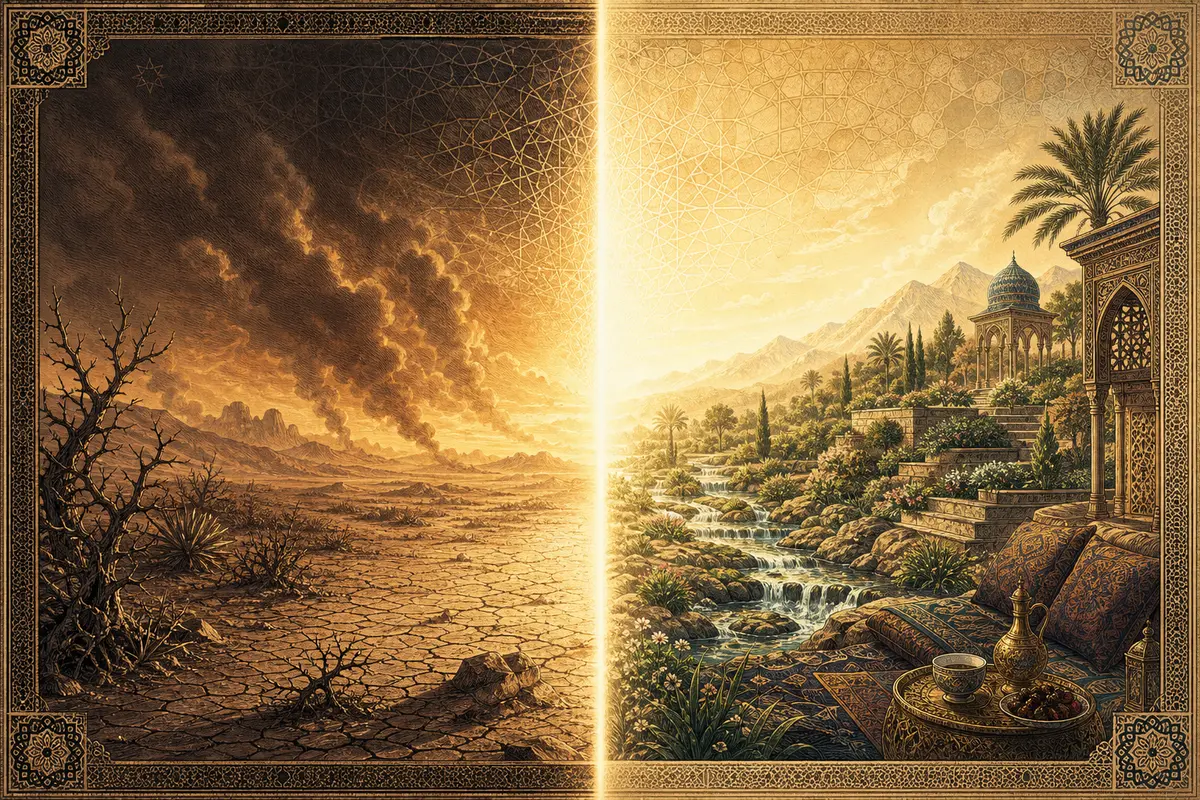
A vast desert landscape split by a line of blinding light -- on one side, faces turned downward in smoke and shadow; on the other, faces lifted in radiance, reclining on raised platforms amid flowing springs
88:1 -- The Overwhelming: one Day, two eternities, and the question that opens everything

The Arabic word is Ghashiyah. It means the thing that covers, envelops, overwhelms -- the event so total that nothing escapes it, no corner of existence is left untouched, no face is left unread. English struggles with it. 'The Overwhelming' captures the force but not the suffocation. 'The Enveloper' captures the coverage but not the terror. The Quran chose a word that does both. This is not an event you witness from a safe distance. It is an event that wraps around you. It finds you. It reads your face. And your face -- not your words, not your excuses, not your reputation, not your wealth -- your face tells the whole story. In 26 verses, Surah Al-Ghashiyah presents the starkest binary in the Quran: two sets of faces on the same Day, living two irreconcilable eternities. And then, remarkably, it pauses the eschatology, walks outside, and asks you to look at a camel. The structure is the sermon. The pivot is the point.

“Has there come to you the news of the overwhelming?”
— Allah (addressing Muhammad and, through him, all humanity) 88:1
Spiritual Barometer
Force
strong
Tone
warning
Urgency
important

The Daily Revelation Edition 88

Lead Story

TWO FACES, ONE DAY: The Quran's Most Brutal Split-Screen of Eternity

The surah opens with a question that is not really a question. "Has there come to you the news of the overwhelming?" 88:1. God is not asking whether Muhammad has heard a rumour. He is about to deliver the rumour Himself. The rhetorical question is a technique -- a way of seizing attention, of saying: what I am about to tell you is so important that I need to make sure you are awake before I begin.

And what follows is not an argument. It is a portrait gallery. Two sets of faces, painted in six verses each, hung side by side on the wall of Judgment Day.

The first gallery is hellfire. "Faces on that Day will be shamed" 88:2. Not angry. Not defiant. Shamed. The Arabic khashi'ah carries the weight of humiliation -- the downcast look of someone who has been exposed, who can no longer maintain the facade. And then the details arrive like hammer blows: "Laboring and exhausted" 88:3. "Roasting in a scorching Fire" 88:4. "Given to drink from a flaming spring" 88:5. "They will have no food except thorns" 88:6. "That neither nourishes, nor satisfies hunger" 88:7.

Notice the precision of the torture. It is not random suffering. It is a systematic inversion of every comfort a human being takes for granted. You had rest -- now you labour without end. You had cool water -- now you drink from fire. You had nourishing food -- now you eat thorns that leave you hungrier than before. The punishment is not merely painful. It is the precise negative image of the life you wasted. Every comfort you took for granted has been turned inside out.

Then the camera swings. "Faces on that Day will be joyful" 88:8. "Satisfied with their endeavor" 88:9. "In a lofty Garden" 88:10. The word aliyah -- lofty, elevated, high -- is not merely geographic. It is moral. These are people who lived on a higher plane, and now they reside on one. "In it you will hear no nonsense" 88:11. After all the noise of the world -- the gossip, the slander, the lies, the empty promises -- silence. Clean, golden silence. "In it is a flowing spring" 88:12. Not a flaming spring. A flowing one. The symmetry is surgical.

And then come the furnishings: "In it are raised beds" 88:13. "And cups set in place" 88:14. "And cushions set in rows" 88:15. "And carpets spread around" 88:16. The detail is deliberately domestic. This is not a palace described to overwhelm. It is a home described to comfort. Beds to rest on. Cups already poured. Cushions arranged. Carpets underfoot. The message is not extravagance. The message is: you are expected. Everything has been prepared. You were always coming home.

88:1 88:2 88:3 88:4 88:5 88:6 88:7 88:8 88:9 88:10 88:11 88:12 88:13 88:14 88:15 88:16

The Daily Revelation Edition 88

Investigation

THE PSYCHOLOGY OF SHAME: Why the Quran Reads Faces, Not Resumes

There is a reason the Quran does not say 'souls on that Day will be punished' or 'bodies on that Day will burn.' It says faces. "Faces on that Day will be shamed" 88:2. "Faces on that Day will be joyful" 88:8. The face is chosen because it is the one part of the human body that cannot lie.

In this life, we control our faces. We smile when we are angry. We look confident when we are terrified. We wear masks -- social masks, professional masks, spiritual masks. The face becomes the instrument of deception, the billboard on which we project whatever version of ourselves we want the world to see. But the Quran is describing a Day when the masks dissolve. The Ghashiyah -- the Overwhelming -- overwhelms not just the earth and sky, but the capacity to pretend. What is left when pretending becomes impossible? The face tells the truth.

Modern psychology has a term for this: affect display. The involuntary emotional expression that surfaces when cognitive control is removed. Under extreme stress, the face reverts to its authentic state. The muscles around the eyes contract in genuine distress. The jaw drops in real terror. The brow furrows without permission. The face becomes a document. And on the Day of the Overwhelming, God reads that document.

The shamed faces are not shamed because they are being punished. They are shamed because they finally see themselves clearly. The Arabic khashi'ah is the face of someone who has been caught -- not by an external authority, but by reality itself. They laboured in this life, but in the wrong direction. They exhausted themselves, but on the wrong project. "Laboring and exhausted" 88:3 is not describing their punishment in the fire. Some scholars, including Al-Hasan al-Basri, read this as describing their wasted effort in the worldly life -- all that energy, all that ambition, all that striving, and none of it counted. They arrive at the Overwhelming having worked hard their entire lives and having nothing to show for it. That is the real punishment. The fire is the environment. The shame is the suffering.

Contrast this with the joyful faces: "Satisfied with their endeavor" 88:9. The Arabic lisa'yiha radiyah means literally 'with its effort, pleased.' Not pleased with the reward. Pleased with the effort itself. These are people who look back on their life's work and feel no regret. The striving was the reward. The effort was the worship. The satisfaction predates the Garden. They arrive in Paradise already happy -- and the Garden is confirmation, not cause.

This is the Quran's deepest psychological insight in this surah: the afterlife does not create your emotional state. It reveals it. The shamed were already ashamed of what they had become -- they just did not know it yet. The joyful were already at peace with how they had lived -- and now they know it forever.

88:2 88:3 88:8 88:9

The Daily Revelation Edition 88

Feature

THE CAMEL PIVOT: Why God Interrupts the Apocalypse to Talk About Biology

Sixteen verses into a surah about Judgment Day, hellfire, and Paradise, the Quran does something extraordinary. It stops. It walks outside. And it asks you to look at a camel.

"Do they not look at the camels -- how they are created?" 88:17. The tonal shift is so abrupt that it has fascinated scholars for fourteen centuries. We have just been told about flaming springs and thorny food and lofty gardens and flowing water -- the furniture of eternity -- and suddenly we are in the desert, staring at an animal. Why?

The answer lies in the audience. This surah was revealed in Mecca, to a people who lived with camels the way modern urbanites live with automobiles. The camel was not exotic. It was ordinary. It was the animal you saw every day, watered every morning, rode to market, milked for breakfast, slaughtered for feasts. It was so familiar that you stopped seeing it. And that is precisely the point.

God is saying: the evidence for everything I have just described -- the Overwhelming, the sorting of faces, the fire, the Garden -- is not hidden in a distant galaxy or locked behind a mystical experience. It is standing in your courtyard, chewing its cud. The camel is a theological argument on four legs. Its ability to survive without water for weeks. Its capacity to carry loads that would crush a horse. Its padded feet that navigate sand. Its multiple stomachs that extract nutrition from the harshest vegetation. Every feature is an engineering decision. Every adaptation is a signature.

And then the camera lifts: "And at the sky -- how it is raised?" 88:18. "And at the mountains -- how they are installed?" 88:19. "And at the earth -- how it is spread out?" 88:20. Four questions. Four scales. The microscopic -- the anatomy of a single creature. The atmospheric -- the canopy above. The geological -- the anchors beneath. The planetary -- the surface underfoot. From the camel in the courtyard to the architecture of the cosmos in four verses.

The logic is devastating in its simplicity: if you cannot deny the design you see, how can you deny the Designer you do not? If the camel's engineering is self-evidently intentional, then the sky's elevation and the mountain's installation and the earth's spread are equally intentional. And if all of creation is intentional, then the Overwhelming is intentional too. The fire is not an accident. The Garden is not a metaphor. The sorting of faces is not a fantasy. It is the same Engineer, completing the project.

The pivot from eschatology to zoology is not a digression. It is the foundation. God is not asking you to believe in the unseen despite the evidence. He is asking you to believe in the unseen because of it. The camel you can see is the proof of the Day you cannot.

88:17 88:18 88:19 88:20

The Daily Revelation Edition 88

Analysis

THE LIMITS OF THE PROPHET: Why 'You Are Only a Reminder' Is the Most Liberating Verse in the Quran

After the fire, after the Garden, after the camels and the sky and the mountains and the earth -- after building a case so comprehensive that it stretches from the anatomy of a desert animal to the architecture of Judgment Day -- the Quran delivers its instruction. And the instruction is not what you would expect.

"So remind. You are only a reminder" 88:21.

Only. The word is innama -- a particle of restriction, of limitation. You are only this and nothing more. After everything God has just revealed -- the splitting of eternities, the sorting of faces, the engineering of creation -- the Prophet is told: your job is to remind. Not to convert. Not to compel. Not to force. Not to control. Remind.

And then, in case there was any ambiguity: "You have no control over them" 88:22. The Arabic musaytir means a dominator, a tyrant, an enforcer. Muhammad is explicitly told he is not one. The Prophet of God -- the man receiving direct revelation from the Creator of the universe -- is told that he has no authority to coerce belief. None. The most powerful message in human history is delivered by a man who is told, in the same breath, that he cannot make anyone accept it.

This is not a limitation born of weakness. It is a principle born of theology. Coerced belief is not belief. A faith imposed is not faith. The entire architecture of the Quran's moral system -- the fire, the Garden, the faces, the reckoning -- depends on the freedom to choose. If the Prophet could control hearts, the test would be meaningless. If belief could be enforced, the sorting of faces would be rigged. The limitation of the Prophet is the guarantee of the system's integrity.

"But whoever turns away and disbelieves" 88:23. "God will punish him with the greatest punishment" 88:24. The consequence is real. The punishment is real. But the choice must also be real. God does not outsource His authority to enforce. He retains it. "To Us is their return" 88:25. "Then upon Us rests their reckoning" 88:26.

The closing two verses are addressed not to humanity but to the Prophet himself, and through him, to every Muslim who has ever been frustrated by someone's refusal to believe: let it go. Not because it does not matter. But because it is not yours to settle. The return is to God. The reckoning is God's. Your job was to remind. If you did that faithfully, you have succeeded -- regardless of the response. The Prophet's success is not measured by conversion rates. It is measured by the clarity of the reminder. The rest belongs to the One who overwhelms.

88:21 88:22 88:23 88:24 88:25 88:26

The Daily Revelation Edition 88

Theology

THE ARCHITECTURE OF INVERSION: How Al-Ghashiyah Turns Every Earthly Comfort Inside Out

The structural genius of Al-Ghashiyah is not its content -- other surahs describe hellfire in greater detail, other surahs paint Paradise in richer colour. The genius is the inversion. Every element of punishment in the first gallery is the precise photographic negative of a corresponding element of reward in the second.

In the fire, they drink from a flaming spring: "Given to drink from a flaming spring" 88:5. In the Garden, there flows a clean spring: "In it is a flowing spring" 88:12. Same substance -- water. Same vessel -- a spring. But one burns and the other refreshes. The lesson is not about water. It is about the nature of reality in the afterlife: the raw materials are the same, but their character is determined by the character of the one who receives them.

In the fire, the food is thorns that neither nourish nor satisfy: "They will have no food except thorns. That neither nourishes, nor satisfies hunger" 88:6-7. In the Garden, there are cups set in place and cushions and carpets -- the accoutrements of a feast where everything satisfies: "And cups set in place. And cushions set in rows. And carpets spread around" 88:14-16. The damned eat and remain hungry. The blessed rest and remain satisfied. The inversion is total.

In the fire, the faces are "laboring and exhausted" 88:3. In the Garden, the faces are "satisfied with their endeavor" 88:9. Both groups worked. Both groups strove. But one group's labour was futile -- a treadmill of effort that produces nothing, an eternity of running without arrival. The other group's labour was rewarded -- they see, in the Garden, the fruit of everything they planted in their earthly life, and they are pleased.

This is not mere poetic symmetry. It is theological instruction. The Quran is teaching that the afterlife is not a foreign country. It is this life, revealed. The springs you drank from, the food you ate, the labour you performed, the face you wore -- all of it continues, but stripped of the ambiguity that made self-deception possible. In this life, the wicked can drink clean water and the righteous can go thirsty. The afterlife corrects the inversion. It does not create a new reality. It restores the original one.

Al-Ghazali himself wrote that the fire and the Garden are not rewards and punishments imposed from outside. They are the natural consequences of what the soul has become. The soul that cultivated cruelty becomes a landscape of thorns. The soul that cultivated worship becomes a garden with flowing springs. The Overwhelming does not assign fates. It reveals them.

88:3 88:5 88:6 88:7 88:9 88:12 88:14 88:15 88:16

The Daily Revelation Editorial Edition 88

✸ ✸ ✸

Letter from the Editor: The God Who Asks You to Look at a Camel

I have read Surah Al-Ghashiyah more times than I can count, and every time I arrive at verse 17, something shifts. The first sixteen verses are terrifying and beautiful in the way that eschatology always is -- fire and gardens, shame and joy, the grand machinery of eternal consequence. And then God says: look at the camels.

Not 'look at the angels.' Not 'look at My throne.' Not 'contemplate the hidden dimensions of reality.' Look at the camels. The most ordinary animal in the Arabian landscape. The creature you pass on the way to the market without a second glance. That one. Look at it. How it is created. How it works. How the engineering of its body solves problems that no human engineer has fully replicated.

There is something profoundly humble about a God who, in the middle of describing the apocalypse, asks you to look at livestock. It suggests that the evidence for His existence is not locked away in supernatural experiences available only to mystics. It is grazing in the field. It is standing in the sky. It is anchored in the mountains. It is spread under your feet. The Quran's argument for God is not esoteric. It is empirical. Open your eyes. The proof is already there.

And this, I think, is why the surah ends the way it does: "So remind. You are only a reminder" 88:21. The Prophet's job is not to perform miracles on demand or to force hearts open. His job is to point -- at the fire, at the Garden, at the camel, at the sky -- and say: look. The evidence is everywhere. The Overwhelming is coming. The faces will be sorted. But right now, today, in this life, the invitation is simply to look. To notice what you have been walking past. To see the design you have been ignoring.

The most devastating line in the surah, for me, is not about the fire or the punishment. It is this: "Laboring and exhausted" 88:3. Because I know that feeling. The feeling of working endlessly, of being busy constantly, of filling every hour with activity -- and suspecting, in the quiet moments before sleep, that none of it matters. That I am labouring on the wrong project. That I am exhausting myself for things that, on the Day of the Overwhelming, will neither nourish nor satisfy.

The antidote is verse 9: "Satisfied with their endeavor." That is the face I want to wear on the Day the masks come off. Not the face of someone who accumulated. The face of someone who invested -- in worship, in kindness, in truth, in patience -- and who looks back at the effort and says: I am pleased with what I did with the time I was given. That is the face of someone who looked at the camels. Who saw the signs. Who understood the reminder. And who oriented their labour accordingly.

The Overwhelming is coming. Your face is being prepared. The only question is which gallery it will hang in.

For Reflection
Read verse 3 and verse 9 side by side. 'Laboring and exhausted.' 'Satisfied with their endeavor.' Both describe people who worked hard. The difference is not effort -- it is direction. Take an honest inventory of your labour this week. How much of it was oriented toward the things that will matter on the Day of the Overwhelming? How much of it was oriented toward things that neither nourish nor satisfy?
Supplication
O Allah, You who will bring the Overwhelming and sort every face by its truth -- we ask You to make our faces among the joyful. When the masks dissolve and the pretending ends and every face tells its real story, let ours tell a story of worship, of sincerity, of effort directed toward You. Protect us from the laboring that leads nowhere and the exhaustion that earns nothing. Make our striving the kind that satisfies -- the kind we will look back on and be pleased with. Open our eyes to the camels and the sky and the mountains and the earth -- the signs You placed in plain sight for anyone willing to look. And when the reminder comes, let us be among those who heard it and responded. You are the One to whom we return. You are the One upon whom our reckoning rests. Make the reckoning gentle, and the return joyful. Ameen.
✸ ✸ ✸

The Daily Revelation Back Page Edition 88

Today's Action
Today, go outside and look -- really look -- at one element of the natural world. A tree. A bird. The sky. Running water. Do not photograph it. Do not post about it. Just stand there and observe it the way verses 17-20 instruct: how it is created, how it is raised, how it is installed, how it is spread out. Let the engineering speak. Let the design register. Then ask yourself: if this is intentional, what else is?
Weekly Challenge
For seven days, divide a page into two columns. Label the left column 'Laboring and exhausted' (88:3). Label the right column 'Satisfied with their endeavor' (88:9). Each evening, sort your day's activities into the two columns. Not by how tired they made you, but by whether they moved you closer to the face you want to wear on the Day of the Overwhelming. At the end of the week, calculate the ratio. Adjust accordingly.
Related Editions
Edition 56 The most detailed sorting of humanity into three groups on Judgment Day -- the forerunners, the people of the right, and the people of the left. Al-Ghashiyah's two-face binary expanded into a three-tier system.
Edition 78 Another Meccan surah that opens with a question about the 'great news' of the Hereafter and moves through natural signs to Judgment Day -- a structural twin to Al-Ghashiyah's question-signs-verdict pattern.
Edition 89 The surah immediately after Al-Ghashiyah -- continues the Meccan eschatological theme with oaths, civilisational ruins, and the psychology of the tranquil soul that passes the test Al-Ghashiyah describes.
Edition 55 The extended tour of Paradise's gardens, springs, and furnishings -- every comfort Al-Ghashiyah sketches in six verses is painted in full colour across 78 verses.
Edition 67 Another surah that uses the observable universe -- the sky, the earth, the birds -- as evidence for the God who will conduct the final reckoning. The same empirical theology Al-Ghashiyah deploys in its camel passage.
Characters in This Edition
Allah Muhammad Believers Disbelievers Mankind
Coming Next
NEXT EDITION: Surah Al-Fajr -- God swears by the daybreak and puts three collapsed civilisations on trial: Aad with their pillars, Thamud who carved mountains, Pharaoh with his stakes. The diagnosis: humans misread every test they are given. The cure: the four most tender words ever spoken to a soul -- 'O tranquil soul, return.'
Page 1 of 8
Ed. 87 Ed. 89