Edition 78 of 114 Mecca Bureau 40 Verses

The Daily Revelation

Revelation. Reported. Truth.
النبأ

An-Naba — The Announcement
Force: Strong Tone: Warning Urgency: Urgent

THE GREAT ANNOUNCEMENT: What Are They Asking About?

Opening the thirtieth and final section of the Quran, Surah An-Naba stages the ultimate confrontation between cosmic evidence and human denial — cataloguing the architecture of creation as prosecution exhibits, then unveiling the Day of Sorting with a specificity that makes evasion impossible


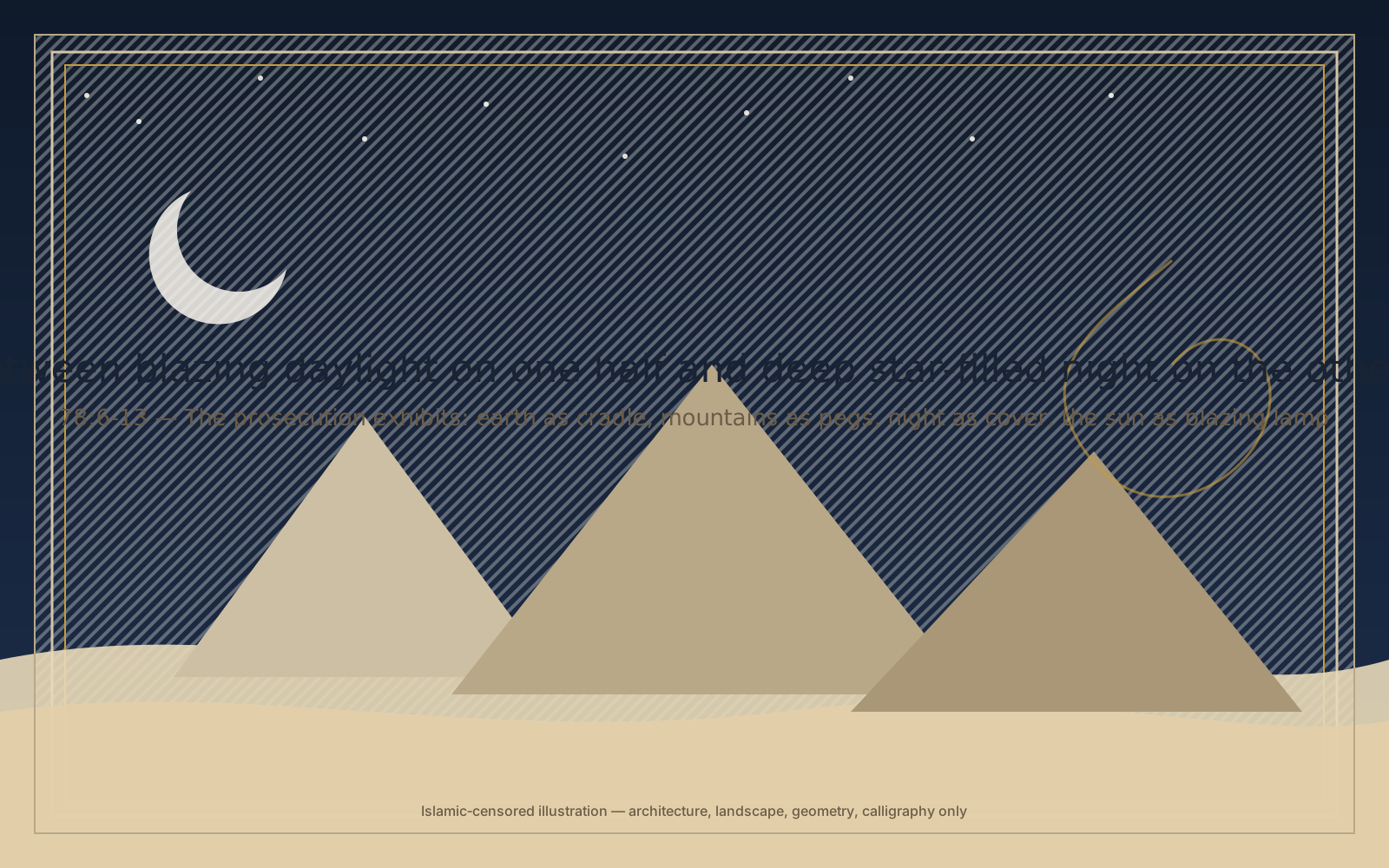
A vast desert landscape under a sky split between blazing daylight on one half and deep star-filled night on the other, with seven layered heavens faintly visible above and jagged mountain peaks anchored like pegs into the earth below
78:6-13 — The prosecution exhibits: earth as cradle, mountains as pegs, night as cover, the sun as blazing lamp

They were asking about it in the alleyways of Mecca. In the merchant stalls and around the evening fires, in the gatherings of Quraysh where men who traded in certainties — gold, camels, dates, reputation — found themselves confronted by the most unsettling proposition a human being can face: that death is not the end. That the bones will reassemble. That the account will be opened. That there is a Day of Sorting. They asked about it the way people ask about things they hope are not true — with nervous laughter, with deflection, with arguments that circled but never landed. And the Quran's response to their whispering was not to answer their question. It was to ask its own. What are they asking one another about? About the Great Event. About which they disagree. The question hangs over the first five verses like a magistrate's gavel raised but not yet fallen. And then, without waiting for their answer, God begins to present His evidence. Not theological argument. Not abstract philosophy. Evidence. The earth beneath their feet. The mountains that hold it in place. The sleep that restores their bodies each night. The darkness that covers them. The daylight that feeds them. The rain that grows their food. Item after item, exhibit after exhibit, the case is built — not from scripture but from the world they walk through every day. The prosecution rests on the defendant's own experience. And when the evidence is complete, the verdict arrives: the Day of Sorting has been appointed. The Trumpet will sound. The sky will crack open into gateways. The mountains will dissolve into mirage. And Hell — which has been lying in ambush this entire time — will become visible. Forty verses. The gateway to the final section of the Quran. The announcement they tried not to hear.

“The Day of Sorting has been appointed.”
— Allah 78:17
Spiritual Barometer
Force
strong
Tone
warning
Urgency
urgent

The Daily Revelation Edition 78

Lead Story

ABOUT WHAT DO THEY ASK? The Question That Opens the Final Act of the Quran

The Quran does not begin its final Juz with a declaration. It begins with a question. "What are they asking one another about?" 78:1. The Arabic amma yatasa'alun carries the texture of hushed, anxious inquiry — people interrogating each other in undertones, seeking reassurance that the thing they have been told is not real. And then the answer, delivered in two tight verses that function like a prosecutor naming the charge: "About the Great Event. About which they disagree" 78:2-3.

The Great Event — an-naba' al-azim — is the resurrection. The Day of Judgment. The accounting. The return. This is the subject the Meccans could not stop circling and could not bring themselves to accept. Their entire civilisational architecture was built on the assumption that death was final. Their poetry mourned the dead as gone. Their economics assumed a single lifetime of accumulation. Their morality, such as it was, operated within the boundaries of earthly consequence. And now a man stood among them — Muhammad, peace be upon him — telling them that every buried body would rise, every hidden deed would be displayed, and every soul would stand before a Judge who had been watching all along.

They disagreed. Not casually — the Arabic mukhtalifun suggests genuine, unresolved disputation. Some denied it outright. Some were unsure. Some suspected it might be true but found the implications unbearable. The disagreement itself was the problem. On a matter of this magnitude — whether death is the end or merely the intermission — uncertainty is not a neutral position. If the resurrection is real, then every decision you make in this life carries eternal weight. If it is not, then nothing ultimately matters beyond the grave. There is no middle ground. The Meccans were trying to occupy a middle ground that did not exist, and the Quran's opening question exposes the absurdity of that position.

Then comes the doubled warning, delivered with the force of a judge who has heard enough evasion: "Surely, they will find out. Most certainly, they will find out" 78:4-5. The repetition is not rhetorical decoration. It is intensification. The first kalla — surely — is a correction, a rebuke to the disagreement itself. You think this is debatable? It is not. The second thumma kalla — most certainly — elevates the rebuke to the level of absolute divine guarantee. The Great Event is not a hypothesis to be argued in Meccan salons. It is an appointment. And when it arrives, the disagreement will be settled — not by argument, but by experience.

What makes this opening remarkable is what it reveals about God's rhetorical strategy at the threshold of the Quran's final section. The thirtieth Juz — Juz Amma — is the section most Muslims memorise first, the section children learn before any other, the section recited most frequently in daily prayers. And God chose to open it not with a statement of power or a description of paradise, but with a question about the one thing humanity finds hardest to believe. The entire final act of the Quran is framed as an answer to the anxiety that death might not be the end. Everything that follows in Surahs 78 through 114 — every description of heaven and hell, every cosmic upheaval, every angel and trumpet — is an elaboration of the Great Event that the Meccans whispered about and could not resolve. The Quran resolves it for them. In forty verses. Starting now.

78:1 78:2 78:3 78:4 78:5

The Daily Revelation Edition 78

Special Investigation

THE EVIDENCE OF YOUR OWN WORLD: How God Built a Prosecution Case from Earth, Mountains, Sleep, and Rain

Having named the charge and warned of the verdict, the Quran does something extraordinary in verses 6 through 16. It does not argue for the resurrection through theology. It does not cite previous revelations. It does not invoke prophetic authority. Instead, it walks the defendants through their own daily experience and asks them to explain how all of this could exist without a Creator who is capable of doing it again.

The evidence is presented in rapid, staccato verses — eleven questions that function as prosecution exhibits, each one pointing at something the Meccans saw every day and took for granted. "Did We not make the earth a cradle?" 78:6. The Arabic mihad — cradle, or spread-out resting place — is intimate. The earth is not described as a stage or a platform. It is described as a cradle — something designed for a sleeping infant, shaped for comfort, built for protection. The implication is that the earth was prepared for you the way a mother prepares a bed for her child. You were expected. The accommodations were ready before you arrived.

"And the mountains pegs?" 78:7. The Arabic awtad means tent pegs — the stakes driven into the ground to prevent a tent from collapsing. The mountains are not decoration. They are infrastructure. They hold the earth in place the way pegs hold a tent against the wind. Modern geology would call them stabilisers of tectonic plates. The Quran, in a single word, described the function of mountains with a precision that seventh-century Arabia had no scientific framework to verify.

Then the exhibits turn personal: "And created you in pairs?" 78:8. Male and female. The biological complementarity that makes continuation of the species possible. "And made your sleep for rest?" 78:9. The nightly unconsciousness that repairs your body and restores your mind — a daily rehearsal, the scholars would later note, for death and resurrection. Every morning you wake is a small proof that the One who returns your consciousness after sleep can return it after death.

"And made the night a cover?" 78:10. The Arabic libas means garment. Night is not merely the absence of light. It is a covering draped over you — protective, concealing, designed for rest the way clothing is designed for the body. "And made the day for livelihood?" 78:11. The daylight hours are ma'ash — the time for earning, working, building, sustaining life. The alternation of night and day is not random. It is a schedule designed for a creature that needs both rest and activity.

The lens widens to the cosmic: "And built above you seven strong ones?" 78:12. The seven heavens — sab'an shidadan — described not as beautiful or vast but as strong. Structurally sound. Engineered to endure. "And placed a blazing lamp?" 78:13. The sun — sirajan wahhajan — a lamp that blazes, that radiates both light and heat. The word siraj is specifically a torch, a source of active illumination, not passive reflection. The sun does not merely glow. It burns. It drives the system.

And finally, the rain: "And brought down from the clouds pouring water? To produce with it grains and vegetation? And luxuriant gardens?" 78:14-16. The water cycle — clouds, rain, agriculture, gardens — presented as a single causal chain from sky to table. The God who sends rain down from compressed clouds to grow the grain you eat today is the same God who tells you He will raise you from compressed earth on a day you deny. The logic is seamless: if He can bring life from dead soil with water, He can bring life from dead bones with a word.

Eleven exhibits. Not one requires faith to observe. The earth, the mountains, your own body, your sleep, the night, the day, the sky, the sun, the rain, the grain, the gardens — all of it is visible, tangible, experienced daily. The prosecution's case is built entirely from the defendant's own world. God is not asking the Meccans to believe in something unseen. He is asking them to explain what they have already seen. And if they cannot explain how these things came to be without a Creator, they have no basis for denying that the same Creator can do it all again.

78:6 78:7 78:8 78:9 78:10 78:11 78:12 78:13 78:14 78:15 78:16

The Daily Revelation Edition 78

Long-Form Feature

THE DAY THE SKY CRACKS OPEN: What Happens When the Trumpet Sounds and the Mountains Become a Mirage

There is a hinge in Surah An-Naba — a single verse where the tone shifts from evidence to verdict, from creation to catastrophe, from the world you recognise to one you cannot. It arrives without transition, without softening, without the courtesy of a warning paragraph: "The Day of Sorting has been appointed" 78:17. Five words in English. Four in Arabic: inna yawm al-fasli kana miqatan. The Day of Sorting — al-fasl — is the day when everything mixed together in this life will be separated. Truth from falsehood. Righteous from transgressor. Claim from reality. And it has been appointedmiqatan — assigned a specific time, a fixed date on a calendar you cannot see. It is not a possibility. It is a schedule.

What follows is a four-verse description of cosmic dissolution that ranks among the most visually concentrated passages in the entire Quran. "The Day when the Trumpet is blown, and you will come in droves" 78:18. The Arabic afwajan — in droves, in waves, in groups — suggests not an orderly procession but a mass mobilisation, billions of resurrected souls surging toward the assembly point like floodwater converging on a valley. There is no individual arrival. There is no private audience. You come as part of a species-wide summons, shoulder to shoulder with every human being who has ever lived.

"And the sky is opened up, and becomes gateways" 78:19. The sky — the same seven strong heavens described three verses earlier as engineered for endurance — fractures. Not collapses, not disappears, but opens. The Arabic futihat is the passive of opening a door. The sky becomes abwab — doorways, gateways, portals. The barrier between the seen and the unseen, between the earthly and the celestial, is perforated. What was solid becomes passage. The architecture that held everything in place for the duration of human history now serves a different function entirely: it becomes the entrance to what comes next.

"And the mountains are set in motion, and become a mirage" 78:20. The mountains — the very pegs that stabilised the earth in verse 7 — are uprooted. The Arabic suyyirat means set moving, driven, marched. The mountains do not merely crumble. They are mobilised, like an army being redeployed, and then dissolved into sarab — mirage. The most solid, most permanent, most visually dominant features of the landscape become an optical illusion. What you thought was immovable turns out to be as insubstantial as heat shimmer on a desert road. The Quran is telling you: everything you thought was permanent was contingent. The mountains held because God held them. The sky endured because God sustained it. When He withdraws His sustaining will, the entire physical order reverts to vapour.

The psychological architecture of these four verses is devastating. In verses 6-16, God pointed at the created order and said: look at what I built. In verses 17-20, He points at the same created order and says: watch Me take it apart. The evidence for His power in creation becomes the evidence for His power in destruction. The same mountains that proved He could build prove that He can unbuild. The same sky that demonstrated structural engineering demonstrates structural dissolution. The prosecution's exhibits have become the demolition schedule.

For the Meccans standing in the shadow of the Kaaba, surrounded by the very mountains of the Hejaz that the Quran was describing, these verses must have landed with visceral force. They knew those mountains. They navigated by them, sheltered beside them, built their sense of permanence around them. And here was a revelation telling them that on a day already appointed — a day whose date was fixed before the mountains themselves were set in place — those same peaks would dissolve into heat haze. The landscape of their security would become a hallucination. And they would arrive at the assembly in droves, without the landmarks they had always relied on, in a world stripped of every familiar reference point.

This is the Quran's method of making the abstract visceral. The Day of Judgment is not described as a concept. It is described as the destruction of everything you considered solid. The philosophical question — is there accountability after death? — is translated into a physical experience: the mountains you can see from where you are standing right now will vanish. If that does not make the resurrection real to you, nothing will.

78:17 78:18 78:19 78:20

The Daily Revelation Edition 78

Investigative Report

HELL LYING IN AMBUSH: The Destination That Was Waiting All Along

The most terrifying verse in Surah An-Naba is not a description of torment. It is a description of posture. "Hell is lying in ambush" 78:21. The Arabic mirsad — ambush, lookout point, surveillance position — transforms Hell from a distant threat into a present predator. It is not waiting at the end of a long road. It is crouching. It is watching. It has been watching for the entire duration of human history, positioned on the route that the oppressors must travel, and it has never once shifted from its post. Hell, in this verse, is not a place you are sent to. It is a place you walk into — because it has been stationed directly in your path, and you were warned, and you kept walking.

"For the oppressors, a destination" 78:22. The Arabic ma'aban means a place of return — as though Hell is not a punishment imposed from outside but a homecoming, a destination the oppressors were always heading toward, whether they acknowledged the trajectory or not. Every act of transgression was a step on a road that leads to one address. The oppressors were not ambushed. They were arriving.

"Where they will remain for eons" 78:23. The Arabic ahqab — plural of huqb, an immensely long period, variously estimated by scholars as eighty years, or longer — stacked in the plural. Eons upon eons. The duration is described not with a number but with a word that means a timespan so vast it defeats counting. This is not a sentence. It is a geological age of consequence.

Then the sensory details, and they are precisely calibrated to negate every comfort the living world offers: "They will taste therein neither coolness, nor drink. Except boiling water, and freezing hail" 78:24-25. Two deprivations — no coolness, no drink — and two replacements. Where there should be refreshment, there is hamim — water heated to boiling. Where there should be relief, there is ghassaq — a word that carries connotations of intensely cold, putrid discharge. The torment is not monolithic heat. It is the oscillation between extremes — scalding and freezing, without the mercy of a middle temperature. The body is denied the possibility of acclimatisation. There is no getting used to it.

"A fitting requital" 78:26. Two words. Jaza'an wifaqan. The punishment fits. It corresponds. It is not arbitrary and it is not excessive. It is precisely proportional to the crime. And the crime is specified immediately: "For they were not anticipating any reckoning. And they denied Our signs utterly" 78:27-28. Two charges. First: they lived as though there were no accountability — no Day of Sorting, no tribunal, no review of accounts. Second: they denied the signs — the same exhibits presented in verses 6-16, the earth and mountains and sleep and rain that constituted God's case for His power. They saw the evidence and called it coincidence. They experienced the creation and denied the Creator.

Then the verse that seals the case with divine record-keeping: "But We have enumerated everything in writing" 78:29. The Arabic ahsaynahu kitaban — We have counted it, recorded it, written it down. Everything. Not most things. Not the major transgressions. Everything. Every denial. Every act of oppression. Every finger thrust into every ear. Every garment pulled over every head. The record is comprehensive, and it was being compiled in real time, and the defendants did not know it existed until this verse told them.

And then the sentence, delivered in the voice of divine authority addressing the condemned directly: "So taste! We will increase you only in suffering" 78:30. This is the only verse in the Quran where God explicitly promises an increase in punishment. Not a steady state of torment but an escalating one. The word adhab — suffering, punishment — will only intensify. There is no plateau. There is no point at which the worst has been reached. The trajectory is permanently upward. For those who denied the reckoning, the reckoning itself has no ceiling.

78:21 78:22 78:23 78:24 78:25 78:26 78:27 78:28 78:29 78:30

The Daily Revelation Edition 78

Feature

GARDENS AND VINEYARDS: The Reward That Reads Like the Mirror Image of the Punishment

After ten verses of escalating torment, the Quran executes a tonal shift so abrupt it functions as its own argument. "But for the righteous there is triumph" 78:31. The Arabic mafazan — triumph, success, the ultimate attainment — lands like cold water after a fire. The conjunction inna (surely, for) creates a hard break. The previous passage described what the oppressors receive. This one describes what the righteous receive. The two are presented side by side with no transitional commentary, no philosophical meditation, no gradual shift in mood. The Quran moves from boiling water to gardens in a single breath — because the Day of Sorting is exactly that: a binary. Two destinations. Two populations. Two outcomes. No middle ground.

The description of paradise in these verses is notable for what it emphasises. "Gardens and vineyards" 78:32. Agriculture. Growth. Living things. Where Hell was described as deprivation — no coolness, no drink — paradise is described as abundance. Cultivated gardens and grapevines, the ancient markers of settled prosperity. For a Meccan audience living at the edge of desert subsistence, gardens meant water, shade, food security, and civilisational permanence. The promise was not abstract. It was the answer to every material anxiety they carried.

"And splendid spouses, well matched" 78:33. The Arabic kawa'iba atraban describes companions of equal age and beauty — the emphasis on atrab (well-matched, of the same age) suggesting companionship, compatibility, the joy of being with someone perfectly suited to you. Where Hell was isolation and deprivation, paradise is intimacy and correspondence. The reward addresses not merely the body's needs but the soul's — the need for connection, for being known, for belonging with someone who matches you.

"And delicious drinks" 78:34. Where the oppressors received boiling water and freezing hail, the righteous receive ka'san dihaqan — a cup, brimming full, overflowing. The word dihaq implies abundance to the point of excess, a vessel so full it barely holds its contents. Against the deprivation of verse 24, this is extravagance. Against the oscillation between scalding and freezing, this is pure, uncomplicated pleasure. The Quran is constructing paradise as the exact inverse of hell — every torment negated, every deprivation answered, every extreme replaced with its gentle counterpart.

"They will hear therein neither gossip, nor lies" 78:35. This verse is the psychological centrepiece of the paradise description. After the physical rewards — gardens, companions, drinks — the Quran addresses the social environment. No laghw — idle talk, gossip, the verbal pollution that corrodes every human community. No kidhdhab — lying, falsehood, the fundamental betrayal of trust between people. Paradise is not merely a place of material abundance. It is a place where the air itself is clean of deceit. Where every word spoken is true, every conversation meaningful, every exchange free of the anxiety that someone is performing, pretending, or manipulating. For anyone who has lived in a world saturated with disinformation and social performance, this verse describes a rest more profound than any garden.

"A reward from your Lord, a fitting gift" 78:36. The Arabic ata'an hisaban — a gift, reckoned, calculated, proportional. Just as the punishment was described as wifaqan (fitting) in verse 26, the reward is described as hisaban (sufficient, reckoned). The symmetry is exact. God's justice operates identically in both directions. The punishment was not arbitrary, and neither is the reward. Both are precisely calibrated to what was earned. The universe, in the Quran's telling, is a place of perfect accounting — where every deed, whether it leads to boiling water or brimming cups, receives exactly its due.

78:31 78:32 78:33 78:34 78:35 78:36

The Daily Revelation Edition 78

Analysis

THE DAY WHEN NONE CAN ARGUE: How the Final Four Verses Close Every Exit

The closing movement of Surah An-Naba — verses 37 through 40 — is a masterpiece of rhetorical closure. Having presented the evidence (6-16), pronounced the verdict (17-20), described the sentences for both the condemned (21-30) and the acquitted (31-36), the surah now seals the case. And it does so by removing every possible avenue of appeal, every remaining argument, every last exit through which a denier might escape.

"Lord of the heavens and the earth, and everything between them — The Most Merciful — none can argue with Him" 78:37. The verse establishes jurisdiction. The Judge is not a local magistrate whose authority might be challenged on territorial grounds. He is the Lord of everything — heavens, earth, and all that exists between them. His sovereignty is total. His jurisdiction is universal. And then the qualifier that silences every courtroom: la yamlikuna minhu khitaban — none possess the right to address Him, to plead, to debate, to cross-examine. The trial is not adversarial. There is no defence counsel. There is no objection. There is no appeal. The God who described Himself as Ar-Rahman — the Most Merciful — in the same breath in which He stripped everyone of the right to speak, is telling you that His mercy is already factored into the verdict. You do not need to argue for leniency. The leniency is already there. It was there from the beginning — in the mercy that named itself before naming its power. But it does not change the verdict.

"On the Day when the Spirit and the angels stand in row. They will not speak, unless it be one permitted by the Most Merciful, and he will say what is right" 78:38. Even the angels — the beings closest to God, the executors of His will, the inhabitants of the seven strong heavens described in verse 12 — even they do not speak without permission. The Spirit — identified by most scholars as Jibril, the greatest of the angels — stands in row like a soldier at inspection. The entire celestial hierarchy is silenced. If the angels cannot speak without authorisation, what basis does a human being have for assuming they will be permitted to negotiate?

And then the two verses that close not merely the surah but the entire arc of the announcement: "That is the Day of Reality. So whoever wills, let him take a way back to his Lord" 78:39. The Day of Reality — al-yawm al-haqq — the day when every illusion is stripped away and only what is real remains. The mirage mountains are gone. The cracked sky exposes what was always behind it. The ambushing Hell reveals what was always waiting. And reality, unfiltered, is all that is left. The invitation that follows is not a command. It is worse than a command. It is an option: whoever wills. The door is open. The path back to God is visible. The evidence has been presented. The verdict has been described. The paradise and the hell have been detailed. Now choose. The Quran does not compel. It informs, it warns, it presents, and then it steps back and says: faman sha'a — whoever wills.

"We have warned you of a near punishment — the Day when a person will observe what his hands have produced, and the faithless will say, 'O, I wish I were dust'" 78:40. The final verse is the most psychologically devastating in the surah. The punishment is qarib — near. Not distant. Not theoretical. Near. Close enough that the warning is urgent, not philosophical. And when it arrives, the confrontation will be personal: each person will see what his hands have producedma qaddamat yadahu — the accumulated output of a lifetime, laid out for inspection. Not what he intended. Not what he planned. Not what he believed about himself. What he actually did. What his hands actually produced. The gap between self-image and divine record, which every human being maintains during their lifetime, will collapse on that day. And the faithless — seeing the record, seeing the truth, seeing reality unfiltered for the first time — will utter the most defeated sentence in the Quran: "O, I wish I were dust."

Not paradise. Not forgiveness. Not a second chance. Dust. The faithless will wish they had never been created at all. They will envy the dirt beneath their feet, which has no soul, no accountability, no record, no Day of Sorting. This is the Quran's final word on denial: it does not end in defiance. It ends in the wish for non-existence. The Great Event that they whispered about in verse 1 — the one they could not agree on, the one they hoped was not real — has arrived. And the only response they can muster is the desire to be nothing at all.

78:37 78:38 78:39 78:40

The Daily Revelation Editorial Edition 78

✸ ✸ ✸

Letter from the Editor: The Gateway to the Final Act

There is a reason every Muslim child learns Juz Amma first. There is a reason the thirtieth section of the Quran — the shortest surahs, the most concentrated language, the most immediate imagery — is the section that enters the memory before any other. And there is a reason that this final section opens not with the gentlest of its contents but with Surah An-Naba: forty verses that compress the entire argument of the Quran into a single prosecutorial arc.

Question. Evidence. Verdict. Sentence. Acquittal. Warning. That is the structure. And it mirrors the structure of the Quran itself — a book that asks humanity what it believes, presents creation as evidence, describes the Day when accounts are settled, details the consequences for both outcomes, and then steps back and says: whoever wills. The entire revelation, distilled into forty verses and placed at the gateway to its final section. An-Naba is the Quran's table of contents for the endgame.

What strikes this editor most forcefully is the surah's method of argumentation. God does not appeal to faith. He does not ask the Meccans to believe in something they cannot see. He asks them to explain what they can see. The earth they walk on. The mountains they navigate by. The sleep that takes them every night and returns them every morning. The rain that grows their food. The sun that lights their day. He builds His case for resurrection from the materials of ordinary experience — because if you can explain how all of this works without a Creator, then perhaps you have grounds for denying the return. And if you cannot explain it — if the cradle and the pegs and the blazing lamp and the pouring water defy every alternative explanation — then you have already conceded the case. A God who can build this world can certainly rebuild its inhabitants.

The symmetry between Hell and Paradise in this surah is surgical. Boiling water versus brimming cups. Eons of torment versus gardens and vineyards. No coolness versus abundant shade. No drink versus overflowing refreshment. Gossip and lies versus truth and silence. The Quran is not describing two random outcomes. It is describing two precisely calibrated responses — each one the mirror image of the other, each one fitted exactly to what was earned. The universe of An-Naba is a universe of perfect accounting. Nothing is wasted. Nothing is arbitrary. Nothing escapes the record.

And then the final verse — the one that should keep every reader awake tonight. The faithless, standing before their record, will not argue. They will not rage. They will not attempt one last defence. They will say: I wish I were dust. This is not defiance. This is the total collapse of defiance. It is the recognition, arrived at too late, that existence with accountability is unbearable for those who lived as though there were none. They would rather have never existed at all than face what they produced.

Surah An-Naba is the announcement. The surahs that follow — An-Nazi'at, Abasa, At-Takwir, Al-Infitar, and onward to An-Nas — will elaborate, will detail, will expand. But the announcement has been made. The Great Event is real. The Day of Sorting is appointed. Hell is lying in ambush. Paradise is waiting for the righteous. And the record of everything you have ever done is being compiled as you read this sentence. What are you going to do about it?

For Reflection
Surah An-Naba asks you to look at the world around you — the ground beneath your feet, the sky above your head, the sleep that takes you each night, the morning that returns you — and to recognise these not as coincidences but as exhibits. Evidence of a Creator who built everything with purpose and will hold you accountable for how you used it. Today, pick one of the eleven exhibits in verses 6-16 — the earth, the mountains, the rain, the night, the sun — and sit with it for five minutes. Not as scenery. As testimony. What is it telling you about the One who made it?
Supplication
O Allah, Lord of the heavens and the earth and everything between them, You who appointed the Day of Sorting before You laid the foundations of the world — do not let us be among those who whisper about the Great Event without believing it. Do not let us live as though there were no reckoning, deny Your signs while walking on Your earth, sleeping in Your night, eating from Your rain. You have enumerated everything in writing. Let our record, when it is opened, be one we can bear to look at. Make us among the righteous for whom there is triumph — gardens, not fire; brimming cups, not boiling water; truth, not gossip. And when the Day comes and the mountains dissolve and the sky cracks open and the angels stand in silent rows, let us not wish to be dust. Let us wish only to be Yours. Ameen.
✸ ✸ ✸

The Daily Revelation Back Page Edition 78

Today's Action
Tonight before you sleep, pause and consider verse 78:9 — 'And made your sleep for rest.' You are about to enter a state of temporary unconsciousness from which you expect to return. You do this every night without anxiety, trusting that morning will come. Ask yourself: if God can return your consciousness after sleep, why do you doubt He can return it after death? Let that question accompany you into the night.
Weekly Challenge
Read verses 78:6-16 once each day this week, but each day focus on a different exhibit. Monday: the earth as cradle. Tuesday: mountains as pegs. Wednesday: sleep as rest. Thursday: the night as garment and the day for livelihood. Friday: the seven strong heavens and the blazing lamp. Saturday: the rain and the grain. Sunday: look back at the whole sequence and ask — could all of this exist without a Creator? And if not, what does that mean for the Day of Sorting?
Related Editions
Edition 50 Another Meccan surah built around the resurrection argument — opens with the disbelievers' astonishment that a warner came from among themselves and that the dead will be raised
Edition 56 The Event — the most detailed description of the three groups on the Day of Judgment: the forerunners, the people of the right, and the people of the left
Edition 75 The Resurrection — a direct companion to An-Naba, addressing the same denial with even more intimate imagery of bones being reassembled
Edition 81 When the Sun Is Wrapped Up — the cosmic dissolution described in 78:19-20 is expanded into a twelve-verse catalogue of the world's unravelling
Edition 82 When the Sky Breaks Apart — directly echoes 78:19, elaborating on the sky cracking open and the angels recording every deed
Characters in This Edition
Allah Disbelievers Believers Angels Mankind
Coming Next
NEXT EDITION: Surah An-Nazi'at — the angels who pull souls from bodies, the story of Moses confronting Pharaoh compressed into eleven breathless verses, and the question that haunts every denier: 'Are you a more difficult creation, or the sky?' The Day of Sorting moves from announcement to execution.
Page 1 of 9
Ed. 77 Ed. 79