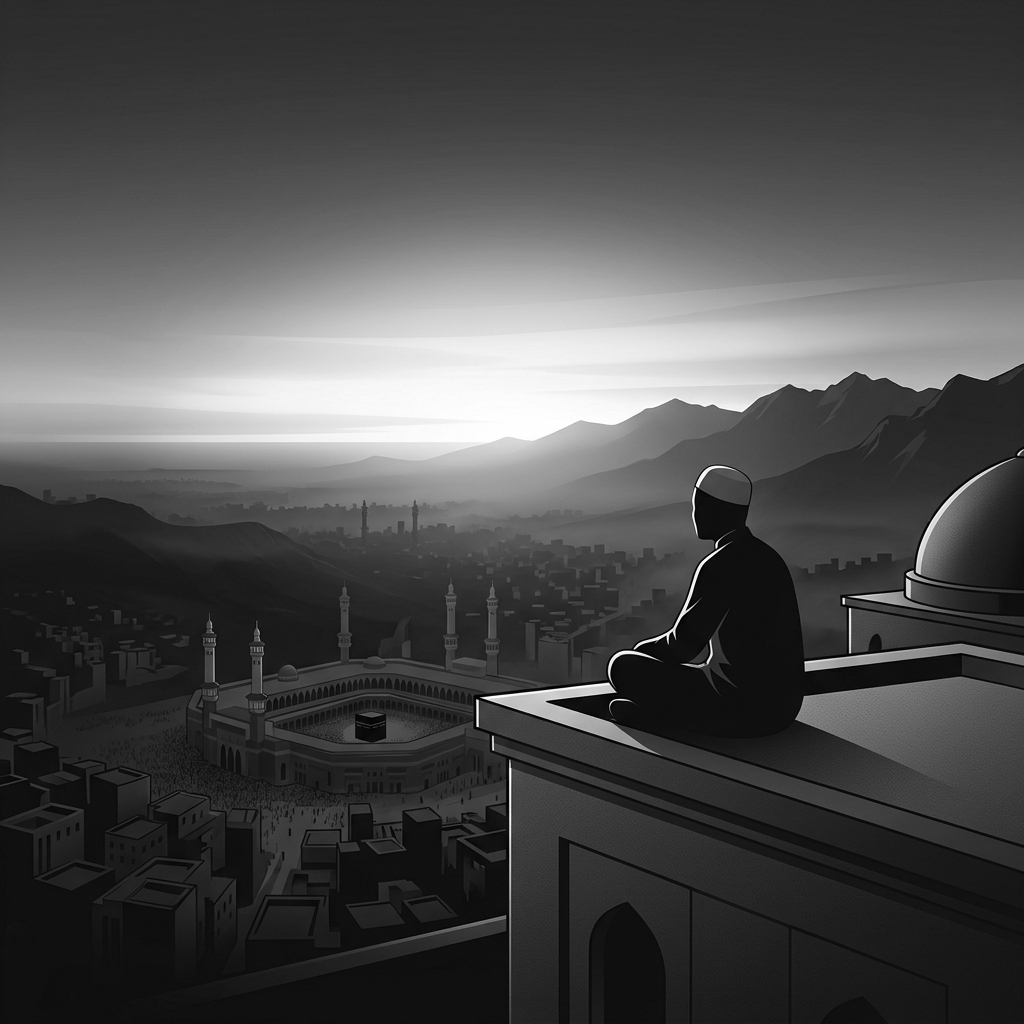
To understand Ad-Duha, you must first understand the silence that preceded it. You must place yourself inside the experience of a man who had, in a single cataclysmic night in a mountain cave, been seized by an angel, crushed against the angel's chest until he could not breathe, and told to recite words he had never heard in a language that transcended language. A man who came down from that mountain trembling so violently that he begged his wife Khadijah to cover him with blankets, who was not sure whether he had been visited by God or by madness. And who, over the weeks and months that followed, slowly came to trust the voice. Slowly came to believe that the words pouring into him were not his own. Slowly began to speak them aloud to his people, at enormous personal cost -- mockery, exile, the loss of social standing, the loss of protection, the slow strangulation of his livelihood and his safety.
And then the voice stopped.
The scholars narrate what happened next with remarkable specificity. An old woman of the Quraysh -- some traditions name her as Umm Jamil, the wife of Abu Lahab -- saw Muhammad in the streets and said to him, with the satisfaction of someone delivering a killing blow: Your devil has forsaken you. She did not say your God. She said your devil -- your shaytan, the spirit they believed was whispering to him. Even the insult was a weapon: by calling the source of revelation a devil, she was reframing his entire prophetic mission as demonic possession. And by noting its departure, she was declaring the possession over. He was cured. The show was finished. The fraud was exposed not by investigation but by absence. His own source had quit on him.
Try to imagine the psychology of that moment. Muhammad had no miracles he could point to. He had no army. He had no institutional backing. He had no seminary, no lineage of prophets he could invoke as family credentials. He had a voice that spoke to him from the unseen -- and that voice had gone silent. Every morning he woke and listened. Nothing. Every night he waited. Nothing. The cave on Mount Hira, where the first words had come, was still there. The mountain was still there. The sky was still there. But the connection -- the single thread tying an illiterate merchant in a desert town to the Creator of the universe -- had gone slack.
Into that exact psychological state -- the abandonment, the doubt, the mockery from without and the silence from within -- the first two verses of Ad-Duha descend like the first light of a morning that a prisoner did not believe would come: "By the morning light. And the night as it settles" 93:1-2.
The oath is not decorative. God swears by two things: the brightness of morning and the stillness of night. He is pointing at the most fundamental rhythm in the human experience of time -- the daily cycle of darkness and light, the fact that night is always temporary, the fact that dawn always follows. He is saying, before He says anything else: look at the world I made. Look at the pattern I embedded in it. The sun does not fail to rise because it set. The day does not cease to exist because the night arrived. Darkness is not the end of light; it is the prelude to light. And the silence you have been living in -- the fatrah, the pause, the terrible waiting -- is not the end of revelation. It is the night before the dawn.
And then, with verse three, God addresses the wound directly. No preamble. No theological scaffolding. Just the raw, intimate assurance that a person in anguish needs to hear: "Your Lord did not abandon you, nor did He forget" 93:3.
The Arabic is devastating in its simplicity. Ma wadda'aka rabbuka wa ma qala. Your Lord -- not a distant God, not a cosmic force, but your Lord, the personal possessive, the God who belongs to you and to whom you belong -- has not said goodbye (wadda'a, from the root meaning to bid farewell, to take leave) and has not come to hate you (qala, to detest, to be displeased with). These are the two fears the silence had planted. That God had left. That God was angry. Ad-Duha names both fears and denies both, in a single line, with the authority of the Being who is the only one qualified to answer the question.
This is not a theological treatise on the nature of divine presence. This is a God who noticed that His servant was hurting and came to tell him, personally, that the hurt was a misunderstanding. The silence was real. The abandonment was not.