Edition 30 of 114 Mecca Bureau 60 Verses

The Daily Revelation

Revelation. Reported. Truth.
الروم

Ar-Rum — The Romans
Force: Strong Tone: Compassionate Urgency: Urgent

THE PROPHECY THAT CAME TRUE: God Bets on Geopolitics — and Wins

Surah Ar-Rum opens with the most historically verifiable prophecy in the Quran — the defeated Roman Empire will reverse its fortunes within a decade — then pivots from geopolitics to cosmology, from marriage to money, from fitrah to the corruption spreading across land and sea


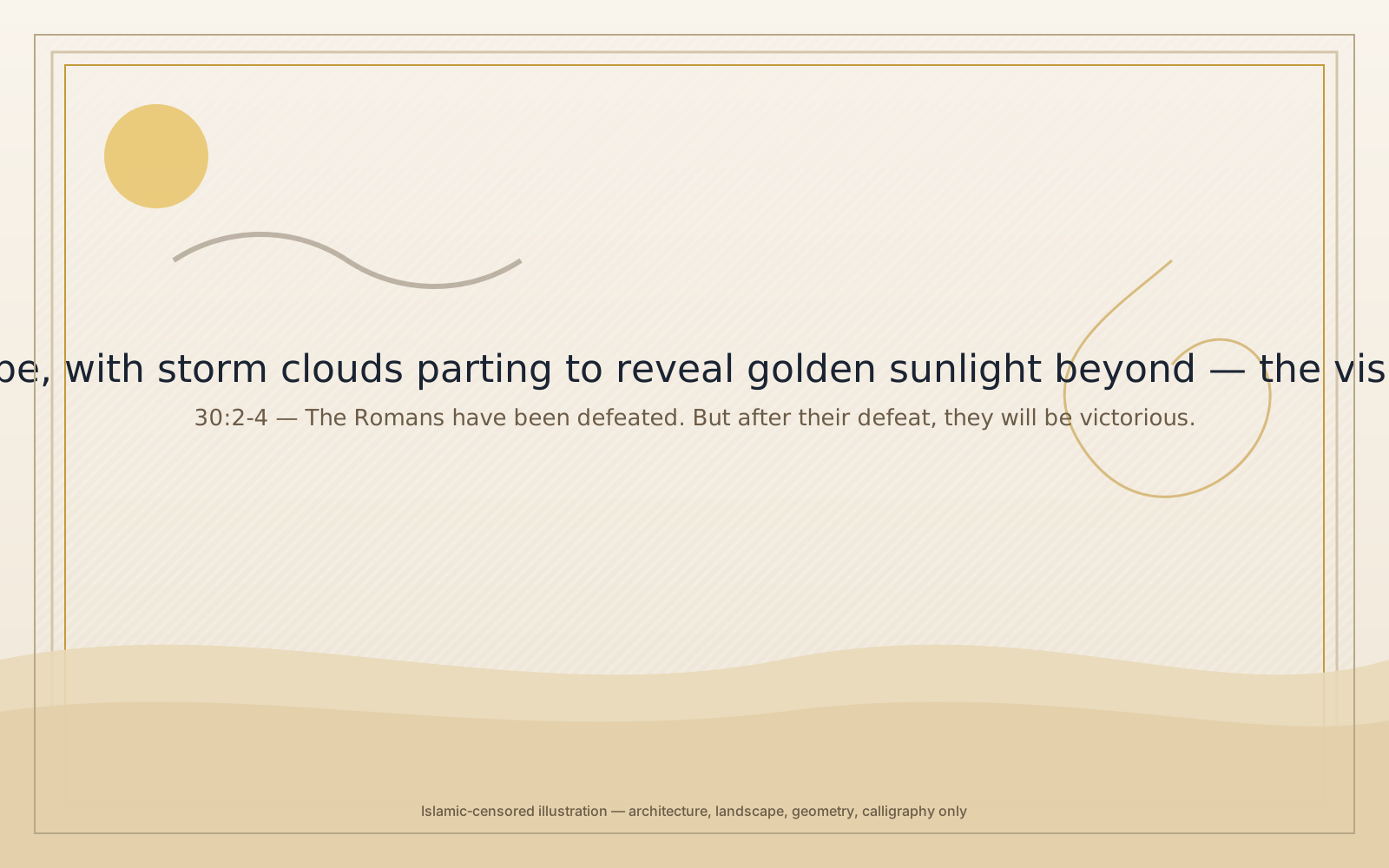
A crumbling Roman column in a desert landscape, with storm clouds parting to reveal golden sunlight beyond — the visual tension between defeat and imminent victory
30:2-4 — The Romans have been defeated. But after their defeat, they will be victorious.

In the year 614 CE, the Sasanian Persian Empire crushed the Eastern Roman forces at Antioch and swept through Jerusalem, seizing the True Cross and leaving the Byzantine state on the verge of collapse. In Mecca, the pagan Quraysh celebrated. The fire-worshipping Persians had defeated the Christian Romans, the People of the Book — and to the Meccans, this was proof that scripture-based religion was losing. The Prophet Muhammad's community, already persecuted and marginalised, faced a theological crisis layered atop a political one: if God's people could be destroyed by God's enemies, what did that say about God's plan? Into this moment, God delivered six Arabic words that would become the most audacious geopolitical prediction in religious history: the Romans have been defeated, but they will be victorious — within a few years. The Arabic 'bid' sineen' means three to nine years. In 622, Emperor Heraclius launched his counter-offensive. By 627 — thirteen years after the prophecy, well within the outer limit — Rome had decisively defeated Persia. The Quran's bet on geopolitics paid out. And then, having established its credibility through a prophecy anyone could verify, Surah Ar-Rum spends its remaining fifty-four verses making claims that cannot be verified until the Day of Judgment.

“So devote yourself to the religion of monotheism — the natural instinct God has instilled in mankind. There is no altering God's creation. This is the true religion, but most people do not know.”
— God 30:30
Spiritual Barometer
Force
strong
Tone
compassionate
Urgency
urgent

The Daily Revelation Edition 30

Lead Report

THE ROMAN GAMBIT: Six Verses That Staked God's Credibility on a Superpower's Comeback

Alif, Lam, Meem. Three letters. Then the bombshell.

"The Romans have been defeated. In a nearby territory. But following their defeat, they will be victorious. In a few years" 30:2-4. No hedging. No ambiguity. No prophetic fog. God names the empire, states the current fact, predicts the reversal, and specifies the timeframe. This is not allegory. This is a falsifiable claim.

The historical context is critical. In 614 CE, the Sasanian Persians under Khosrow II routed the Byzantine forces and conquered Jerusalem, Syria, and Egypt. The Eastern Roman Empire — the largest Christian state on earth — appeared finished. In Mecca, the pagan Quraysh saw a propaganda opportunity. The Persians were not People of the Book. They were Zoroastrians — fire-worshippers, polytheists in the loose taxonomy of the Meccan worldview. Their victory over the scripture-following Romans seemed to validate the pagan position: the old gods were winning.

For Muhammad's small, besieged community, the geopolitical news was devastating on multiple levels. The Romans were, at minimum, fellow monotheists — closer to the Islamic position than the Persians. Their collapse raised an uncomfortable question: if God did not protect His own people, how could Muhammad's followers expect protection?

The Quran's response is not defensive. It is offensive. It does not explain why the Romans lost. It predicts they will win. And it does so in language so specific that Abu Bakr, the Prophet's closest companion, is reported to have wagered camels with a Meccan pagan named Ubayy ibn Khalaf on the outcome — one of the few recorded instances of a Companion betting on a Quranic prophecy. Abu Bakr won.

The Arabic phrase bid' sineen — translated as "a few years" — is linguistically precise. Classical Arabic grammarians confirm that bid' refers to a number between three and nine. The prophecy was revealed around 615 CE. The Byzantine counter-offensive under Emperor Heraclius began in 622 and achieved decisive victory at the Battle of Nineveh in 627 — twelve years from revelation to fulfilment, comfortably within the linguistic range.

But the Quran is not interested in the military details. It is interested in what the victory means: "The matter is up to God, in the past, and in the future. On that day, the believers will rejoice. In God's support. He supports whomever He wills. He is the Almighty, the Merciful" 30:4-5.

Notice the theological architecture. The prophecy is not about Rome. It is about God's sovereignty over history. Empires rise and fall not by their own strength but by divine decree. The Romans did not lose because they were weak. They lost because God willed it. They will not win because Heraclius is brilliant — though he was. They will win because God promised it. The geopolitical fact is merely the vehicle. The theological claim is the cargo: God governs history, and His promises do not fail.

"The promise of God — God never breaks His promise, but most people do not know" 30:6. This verse is the hinge of the entire surah. Everything before it is evidence. Everything after it is argument built on that evidence. God has just made a prediction that anyone, believer or not, can verify within a decade. He has staked His credibility on geopolitics. And now He is going to use that credibility to make claims about creation, about human nature, about the afterlife, about the Day of Judgment — claims that require faith precisely because they cannot be checked against a map.

The prophecy is the down payment. The rest of Ar-Rum is the invoice.

30:1 30:2 30:3 30:4 30:5 30:6

The Daily Revelation Edition 30

Investigation

THE OUTER LAYER AND THE HEREAFTER: Why the Quran Says Most People Know Only the Surface of This World

Immediately after the prophecy, God delivers one of the Quran's sharpest diagnoses of human civilisation: "They know an outer aspect of the worldly life, but they are heedless of the Hereafter" 30:7.

The Arabic word is zahir — the outer, the apparent, the surface. Not the depth, not the meaning, not the purpose. The Quran is not accusing people of ignorance. It is accusing them of superficiality. They know things. They know trade routes and crop yields and military strategy and architectural engineering. The civilisations that preceded them — and the Quran immediately invokes those precedents — "were more powerful than them, and they cultivated the land and developed it more than they developed it" 30:9. Previous peoples were not stupid. They were accomplished. They built. They cultivated. They developed. And they are gone.

The indictment is not against knowledge. It is against incomplete knowledge. They mastered the zahir — the surface physics of existence — while remaining ghafileen, heedless, about the Hereafter. They could engineer an aqueduct but could not contemplate their own mortality. They could chart the stars but could not read them as signs. The data was available. The interpretation was refused.

"Do they not reflect within themselves?" 30:8. The question is devastating because it locates the failure not in external circumstance but in internal neglect. The evidence for God's existence and purpose is not hidden in scrolls or locked in temples. It is within themselves. The capacity for reflection is built into the human architecture. The failure to use it is a choice, not a limitation.

Then comes the historical reckoning. "Have they not travelled the earth and seen how those before them ended up?" 30:9. The ruins are visible. The archaeological evidence of divine judgment is not theoretical — it is physical, geographical, accessible to anyone who travels. The Meccan trade caravans passed through the remains of destroyed civilisations regularly. The Nabataeans at Petra. The Thamud at Mada'in Salih. The evidence was not in books. It was on the road.

God then compresses the entire historical pattern into a single verse: "Then, evil was the end of those who committed evil. That is because they rejected God's revelations, and used to ridicule them" 30:10. The mechanism is clear. The civilisations did not fall because they lacked technology or resources. They fell because they ridiculed the very revelations that could have saved them. Mockery preceded collapse. Derision preceded destruction. The outer knowledge they had mastered could not compensate for the inner knowledge they had mocked.

This is the Quran's civilisational thesis, stated here with uncommon clarity: every empire that has ever fallen was brought down not by external enemies but by internal heedlessness. The Persians did not destroy Rome. Rome's spiritual vacancy made it vulnerable. And Persia, for all its military triumph, would itself collapse within two decades of this surah's revelation — consumed by the very Arab-Muslim expansion that the Meccan pagans thought impossible.

The surah then pivots from history to eschatology in a seamless turn: "God originates creation, and then repeats it. Then to Him you will be returned" 30:11. The empires come and go. Creation itself comes and goes. The only constant is the return — the meeting with the One who started it all. Those who mastered the outer layer of the world and ignored everything beneath it will discover, on the Day the Hour takes place, that the surface was never the story.

30:7 30:8 30:9 30:10 30:11 30:12 30:13 30:14 30:15 30:16

The Daily Revelation Edition 30

Science & Creation

THE SIGNS CATALOGUE: Marriage, Language, Colour, Sleep, Lightning, and the Case for God Written in the Ordinary

Beginning at verse 20, Surah Ar-Rum undertakes one of the Quran's most sustained and methodical enumerations of divine signs. Six consecutive passages, each introduced by the identical phrase "wa min ayatihi" — and of His signs — build a cumulative case for God's existence and sovereignty not from the miraculous but from the mundane. This is not a catalogue of wonders. It is a catalogue of the ordinary, re-examined until it becomes extraordinary.

The first sign is creation itself: "And of His signs is that He created you from dust; and behold, you become humans spreading out" 30:20. The trajectory from mineral to consciousness, from dust to civilisation, from inert matter to beings who argue about their own origins — this is not presented as a miracle requiring special evidence. It is presented as a fact requiring explanation. You exist. You came from earth. The gap between those two states demands an author.

The second sign is marriage: "And of His signs is that He created for you mates from among yourselves, so that you may find tranquility in them; and He planted love and compassion between you" 30:21. The verse is remarkable for its psychological precision. It does not describe marriage as a legal contract or a social arrangement or a reproductive mechanism — though it is all of these. It describes marriage as a sign of God. The specific claim is that the emotional architecture of human bonding — mawaddah (love) and rahmah (compassion) — was planted by God between partners. Love is not an accident of chemistry. It is a deliberate divine installation. The word ja'ala — He planted, He placed — implies intentional engineering.

The third sign is staggering in its scope: "And of His signs is the creation of the heavens and the earth, and the diversity of your languages and colors" 30:22. In a single verse, the Quran moves from cosmology to linguistics to ethnicity. The heavens and the earth are a sign. But so are the differences among humans — their languages, their skin colours. Diversity is not an accident of geography or a problem to be solved. It is a sign to be read. The Arabic ikhtilaf — diversity, variation, difference — is presented as evidence of God's creative range, not as a source of hierarchy. The verse makes no distinction between languages or colours. It catalogues them all as ayat — signs — for those who know.

The fourth sign is sleep: "And of His signs are your sleep by night and day, and your pursuit of His bounty" 30:23. The rhythm of consciousness and unconsciousness, of labour and rest, of waking pursuit and nightly surrender — this daily cycle is a sign for those who listen. Every night, every human being experiences a rehearsal of death and resurrection. You lose consciousness. You lose control. You enter a state indistinguishable, to your own awareness, from non-existence. And then you wake. If you can accept this nightly annihilation and restoration without philosophical crisis, the Quran asks, on what basis do you reject the final one?

The fifth sign is weather: "And of His signs is that He shows you the lightning, causing fear and hope. And He brings down water from the sky, and with it He revives the earth after it was dead" 30:24. Lightning produces two simultaneous emotions — fear and hope. Fear of destruction, hope of rain. The same phenomenon, in the same instant, generates terror and gratitude. This emotional duality is, for the Quran, a sign of divine design. Nature does not produce simple responses. It produces complex ones — and that complexity points to an intelligence behind the system.

The sixth sign is cosmic stability: "And of His signs is that the heaven and the earth stand at His disposal. And then, when He calls you out of the earth, you will emerge at once" 30:25. The heavens and the earth do not maintain themselves. They stand because He sustains them. And when the command comes — the same kun fayakun principle — the earth will release its dead as effortlessly as it releases its seeds.

Six signs. Dust to humanity. Love between partners. Diversity of tongues and colours. The rhythm of sleep. The duality of lightning. The stability of the cosmos. None of them are miracles in the traditional sense. All of them are miracles in the Quranic sense — ordinary phenomena that, under sustained attention, reveal an intelligence so pervasive it has become invisible. The Quran's argument is not that God can be found in the extraordinary. It is that God can be found in everything, if you know how to look.

30:20 30:21 30:22 30:23 30:24 30:25 30:26 30:27

The Daily Revelation Edition 30

Theology

FITRAH: The Verse That Says You Were Born Knowing God

Verse 30 of Surah Ar-Rum is one of the most consequential theological statements in the entire Quran — a single sentence that has shaped Islamic jurisprudence, philosophy, psychology, and education for fourteen centuries.

"So devote yourself to the religion of monotheism — the natural instinct God has instilled in mankind. There is no altering God's creation. This is the true religion, but most people do not know" 30:30.

The word is fitrah. And it changes everything.

Fitrah — from the root fa-ta-ra, meaning to originate, to create, to split open — is the Quran's term for the innate disposition with which every human being is born. Not a blank slate. Not a fallen nature. Not a corrupted inheritance from a sinful ancestor. A fitrah — a factory setting, divinely installed, that inclines the soul toward monotheism, toward recognition of its Creator, toward the moral architecture that the Quran calls the true religion.

The theological implications are enormous. If every human being is born with an innate orientation toward God, then disbelief is not the default state that must be overcome by evidence. Belief is the default state that must be overcome by corruption. The burden of proof, in the Quranic framework, does not rest on the believer to prove God exists. It rests on the denier to explain how the fitrah was damaged.

The Prophet Muhammad, peace be upon him, elaborated on this verse in one of his most famous traditions: "Every child is born upon the fitrah. It is his parents who make him a Jew, a Christian, or a Zoroastrian." The hadith does not say every child is born Muslim in the institutional sense. It says every child is born with the fitrah — the natural recognition of one God — and it is subsequent conditioning that redirects that recognition toward other frameworks. The child's initial software is monotheistic. Culture is the patch that overrides it.

This has profound consequences for how the Quran understands human accountability. If awareness of God is hardwired, then the claim of total ignorance is inadmissible. You may have been conditioned away from the fitrah. You may have been raised in an environment that suppressed it. But the Quran insists that the original code is never fully deleted — only buried. And the function of revelation, prophets, signs, and the Quran itself is not to install new software but to restore the original.

The verse then makes a claim of startling finality: "There is no altering God's creation." The fitrah cannot be manufactured, and it cannot be permanently destroyed. It can be ignored, suppressed, distorted, overlaid — but not altered at the level of creation. It is as much a part of the human being as the capacity for language or the need for food. You may choose not to speak. You may choose not to eat. But the capacity — the need — remains.

This is why the Quran repeatedly uses the word dhikr — remembrance — to describe its own function. It is not teaching. It is reminding. The soul already knows. The Quran is the alarm clock for a fitrah that has been put to sleep by the noise of the world.

"This is the true religion, but most people do not know." The phrase al-deen al-qayyim — the true, upright, self-sustaining religion — is not Islam as a label. It is Islam as a disposition: the natural submission of the created to the Creator, the gravitational pull of the soul toward its origin. Most people, the verse concedes, do not know this. They have mistaken the overlay for the original. They have confused the cultural patch for the factory setting.

But the fitrah remains. Under every layer of conditioning, beneath every cultural distortion, behind every intellectual objection — the fitrah waits. And every sign the Quran has catalogued in the preceding verses — dust to humanity, love in marriage, diversity of languages, the rhythm of sleep, the duality of lightning, the stability of the heavens — is addressed not to the conditioned mind but to the fitrah beneath it. The signs do not create belief. They reactivate it.

30:28 30:29 30:30 30:31 30:32

The Daily Revelation Edition 30

Economy & Ethics

USURY VERSUS CHARITY: The Economic Verse That Inverts the Logic of Multiplication

Buried between the fitrah verse and the environmental warning, Surah Ar-Rum delivers one of the Quran's most economically subversive statements — a verse that quietly demolishes the foundational assumption of interest-based finance.

"The usury you practice, seeking thereby to multiply people's wealth, will not multiply with God. But what you give in charity, desiring God's approval — these are the multipliers" 30:39.

The verse operates on two levels simultaneously. On the economic level, it states a fact that would seem counterintuitive to any merchant in Mecca or any financier on Wall Street: lending at interest does not multiply your wealth in God's accounting. The money grows on paper. The balance increases. The lender becomes richer by the metrics the world uses. But in the divine ledger — the only ledger that survives death — the multiplication did not happen. Interest is a mirage of growth. The numbers change. The spiritual account does not.

Charity, by contrast, does multiply. The Arabic al-mud'ifun — the multipliers — is applied not to the interest collectors but to the charitable givers. The money leaves your hand. The balance decreases. By every worldly metric, you are poorer. But in God's accounting, you have multiplied — not your wealth, but your worth. The investment that yields returns in eternity is the one that costs you something in time.

This is not merely a moral instruction. It is a redefinition of what multiplication means. In conventional economics, multiplication is mechanical — principal times rate times time. In Quranic economics, multiplication is relational — generosity times sincerity times divine response. The formula has a variable that no spreadsheet can model: God's approval.

The verse is strategically placed. It follows the fitrah verse — the claim that humans are hardwired for monotheism — and precedes the environmental warning of verse 41. The sequence is deliberate: your nature inclines toward God (fitrah), your economics should reflect that inclination (charity over usury), and your failure to align with that inclination produces corruption in the earth (ecological and moral degradation). The three verses form a chain: spiritual disposition, economic behaviour, environmental consequence.

The broader economic ethics of the surah extend to verse 38: "So give the relative his rights, and the destitute, and the wayfarer. That is best for those who seek God's presence. Those are the prosperous" 30:38. Prosperity is redefined. The prosperous are not those who have accumulated the most but those who have distributed most faithfully. Rights — haqq — are not favours. They are obligations. The relative, the destitute, the wayfarer do not receive charity from your surplus. They receive their rights from your obligation. The language is legal, not sentimental.

Taken together, these verses construct an economic vision that is fundamentally incompatible with the interest-based model that dominates global finance. Wealth that grows through interest is not growing in God's sight. Wealth that diminishes through charity is multiplying in God's sight. The economy of Ar-Rum inverts the economy of the world — and insists, with the same confidence that predicted the Roman victory, that its accounting is the one that will prove accurate on the Day when all accounts are settled.

30:37 30:38 30:39 30:40

The Daily Revelation Edition 30

Environment

CORRUPTION ON LAND AND SEA: The Quran's Earliest Environmental Warning

In an era when environmental degradation was not a scientific concern but a theological one, the Quran issues a warning so sweeping it reads like a headline from the twenty-first century: "Corruption has appeared on land and sea, because of what people's hands have earned, in order to make them taste some of what they have done, so that they might return" 30:41.

The Arabic fasad — corruption, decay, disorder — is applied simultaneously to land and sea. Not metaphorically. Not in one domain that symbolises another. Both. The terrestrial and the marine environments are described as corrupted, and the cause is identified with unflinching directness: bima kasabat aydin-nas — because of what people's hands have earned. Human action is the cause. Environmental degradation is the effect.

Fourteen centuries before climate science, before oceanic acidification research, before satellite imagery of deforestation, the Quran places the blame for ecological corruption squarely on human behaviour. The verse does not describe a natural process. It describes a moral one: the environment decays because humans have earned its decay through their actions. The ecological and the ethical are fused. You cannot separate what you do to the earth from what you do to your soul.

But the verse's most provocative claim is its statement of divine purpose: the corruption exists "in order to make them taste some of what they have done, so that they might return." Environmental degradation is not merely a consequence. It is a corrective. God allows the corruption to materialise — to become tangible, tasteable, visible on land and sea — so that humans confront the physical reality of their moral choices. The drought is a message. The depleted fishery is a memo. The dying coral is a sign. And the purpose of the sign is not punishment but return — la'allahum yarji'un — that they might come back. Come back to the fitrah. Come back to the covenant. Come back to the balance that the surah has been describing since verse one.

The verse that follows drives the point home with historical force: "Say, 'Roam the earth, and observe the fate of those who came before. Most of them were idolaters'" 30:42. The connection between idolatry and ecological collapse is not accidental. When humans worship the created instead of the Creator — when they treat natural resources as their own property rather than as divine trust — the exploitation becomes limitless. Idolatry, in the Quranic framework, is not merely a theological error. It is the root cause of environmental destruction. A society that does not recognise a transcendent authority above its own desires has no internal mechanism to restrain its consumption.

Read in sequence with the usury verse that precedes it, the environmental verse completes a devastating chain of logic: interest-based economics extracts wealth from the vulnerable for the benefit of the powerful (30:39). This extractive mentality extends from human relationships to the human relationship with the earth (30:41). And the earth — land and sea alike — bears the physical evidence of the moral corruption that produced it. The environment is not separate from the economy. The economy is not separate from the soul. And the soul is not separate from God.

Ar-Rum diagnosed the sickness in the seventh century. The twenty-first century is living the symptoms.

30:41 30:42 30:43

The Daily Revelation Editorial Edition 30

✸ ✸ ✸

Letter from the Editor: The Surah That Reads Like Tomorrow's News

There is a particular kind of power in a prediction that comes true. It does not merely validate the specific claim. It validates the source. If I tell you it will rain tomorrow and it does, you will listen more carefully when I tell you what will happen next week.

Surah Ar-Rum understood this. It opens with a prediction so specific, so publicly verifiable, so tied to the observable geopolitics of its era, that within a decade every person in Mecca could confirm whether the Quran had told the truth. The Romans would win. They did. God's promise does not fail. It did not.

And then — with its credibility established on terms the sceptics themselves could not deny — the surah pivots. It moves from the testable to the untestable. From the defeat and victory of empires to the creation of the human being from dust. From geopolitics to marriage. From the Roman-Persian war to the diversity of human languages and colours. From history that has already happened to a Judgment Day that has not happened yet.

The rhetorical strategy is breathtaking. The prophecy about Rome is not the point of the surah. It is the key that opens the door. Once you accept that this text predicted the fall and rise of a superpower with a specificity no human author could have managed, you are left with an uncomfortable question: what else might it be right about?

The fitrah? That every human being is born with an innate disposition toward God, and that all subsequent disbelief is a deviation from the factory setting? The economics? That interest-based wealth does not multiply in God's sight, and that charity is the only genuine investment? The environment? That corruption on land and sea is the physical consequence of moral corruption, and that the earth itself is a witness to human excess?

These are not small claims. They are civilisational ones. And they are delivered by a text that has just proven, in six verses, that it knows how the world works better than the world knows itself.

The surah ends where every surah of this kind must end: with patience. "So be patient. The promise of God is true. And do not let those who lack certainty belittle you" 30:60. It is a peculiar closing for a chapter that began with such confidence. Why would a surah that opens by predicting a superpower's victory need to counsel patience? Because the larger promise — the Hereafter, the Judgment, the return — has not yet been fulfilled. The Roman prophecy was the appetiser. The main course is still being prepared. And between the proof and the fulfilment, there is a lifetime of patience to be lived.

Ar-Rum is the surah for anyone who has ever demanded evidence. Here is your evidence: six verses, one geopolitical prediction, one verifiable outcome. Now — the surah asks, with the calm of a text that has already won its argument — are you prepared to take the rest on trust?

For Reflection
The Quran proved it could predict the future with the Roman prophecy. It then used that credibility to make claims about your nature (fitrah), your money (usury vs. charity), and your planet (corruption on land and sea). Which of these three claims do you most resist — and why? Is your resistance based on evidence, or on the discomfort of what acceptance would require you to change?
Supplication
O Allah, You predicted the victory of Rome when no one believed it possible, and it came true. You described our fitrah before we could name it, and we recognise it in ourselves. You warned of corruption on land and sea before we had the science to measure it, and we see it now with our own eyes. Grant us the honesty to accept the evidence You have placed in the world and in ourselves. Protect us from the superficiality that knows the outer layer but ignores the Hereafter. Make our charity real and our interest-seeking small. And when the patience You command grows difficult, remind us: Your promise is true, Your promise has always been true, and the proof is on the record. Ameen.
✸ ✸ ✸

The Daily Revelation Back Page Edition 30

Today's Action
Identify one sign from the six catalogued in 30:20-25 that you experienced today — the fact of your own existence, the love in a relationship, the diversity of voices around you, the gift of sleep last night, a change in weather, or the stability of the ground beneath your feet. Pause for thirty seconds and treat it not as background noise but as evidence. The signs were always there. The attention was not.
Weekly Challenge
Audit your financial life through the lens of 30:39 this week. Identify one source of income or investment that operates on interest — money growing from money, without labour or risk. Then identify one act of charity you have been postponing. The Quran says the first does not multiply with God. The second does. Adjust accordingly.
Related Editions
Edition 2 The prohibition of usury expanded — 2:275-281 develops the economic ethic that 30:39 introduces in a single verse
Edition 7 The pre-temporal covenant and the fitrah — 7:172 asks 'Am I not your Lord?' and the fitrah answers 'Yes'
Edition 18 The clash of empires and the refuge of faith — the cave dwellers who escaped civilisational corruption
Edition 21 The signs of God in creation and the prophetic mission — parallel catalogues of divine evidence
Edition 36 Dead earth revived as proof of resurrection — Ya-Sin 36:33 and Ar-Rum 30:19 use the same agricultural metaphor for the same theological claim
Edition 55 The most extensive meditation on God's signs in creation — the catalogue that Ar-Rum begins, Ar-Rahman completes
Characters in This Edition
Allah Muhammad Believers Disbelievers Romans Mankind Idolaters
Coming Next
NEXT EDITION: Surah Luqman — A father sits down with his son and delivers the most concentrated parenting manual in the Quran. Do not associate partners with God. Establish prayer. Enjoin what is right. Bear what befalls you with patience. And do not turn your face away from people in arrogance. Five commands. One conversation. A lifetime of guidance.
Page 1 of 9
Ed. 29 Ed. 31