By the star as it goes down.
One celestial object. One moment of descent. That is how God chooses to open the most extraordinary eyewitness account in the Quran. Not with a command. Not with a story. With an oath -- sworn on a star at the precise instant it falls below the horizon, that liminal second when light crosses from visible to invisible, from known to unknown. Everything that follows will live in that same liminal space: the territory between what human beings can see and what only prophets are permitted to witness.
"Your friend has not gone astray, nor has he erred. Nor does he speak out of desire. It is but a revelation revealed" 53:2-4. Four verses. Four defensive statements. God does not call Muhammad His messenger here, or His prophet, or His servant. He calls him sahibukum -- your companion, your friend, the man you grew up with, the man you know. The word is deliberately intimate. God is not introducing a stranger. He is reminding Quraysh that the man they are calling insane is the same man they trusted with their deposits, called al-Amin -- the Trustworthy -- and consulted in their disputes. He has not changed. What changed is that he now speaks with the authority of heaven, and they cannot bear it.
The defense is surgical: he has not strayed from the path (not lost), he has not been deceived (not gullible), he does not speak from personal desire (not ambitious). These are the three accusations Quraysh rotated through -- madness, manipulation, self-interest. God addresses all three in three verses and moves on, because the real story is not the accusation. The real story is what Muhammad saw.
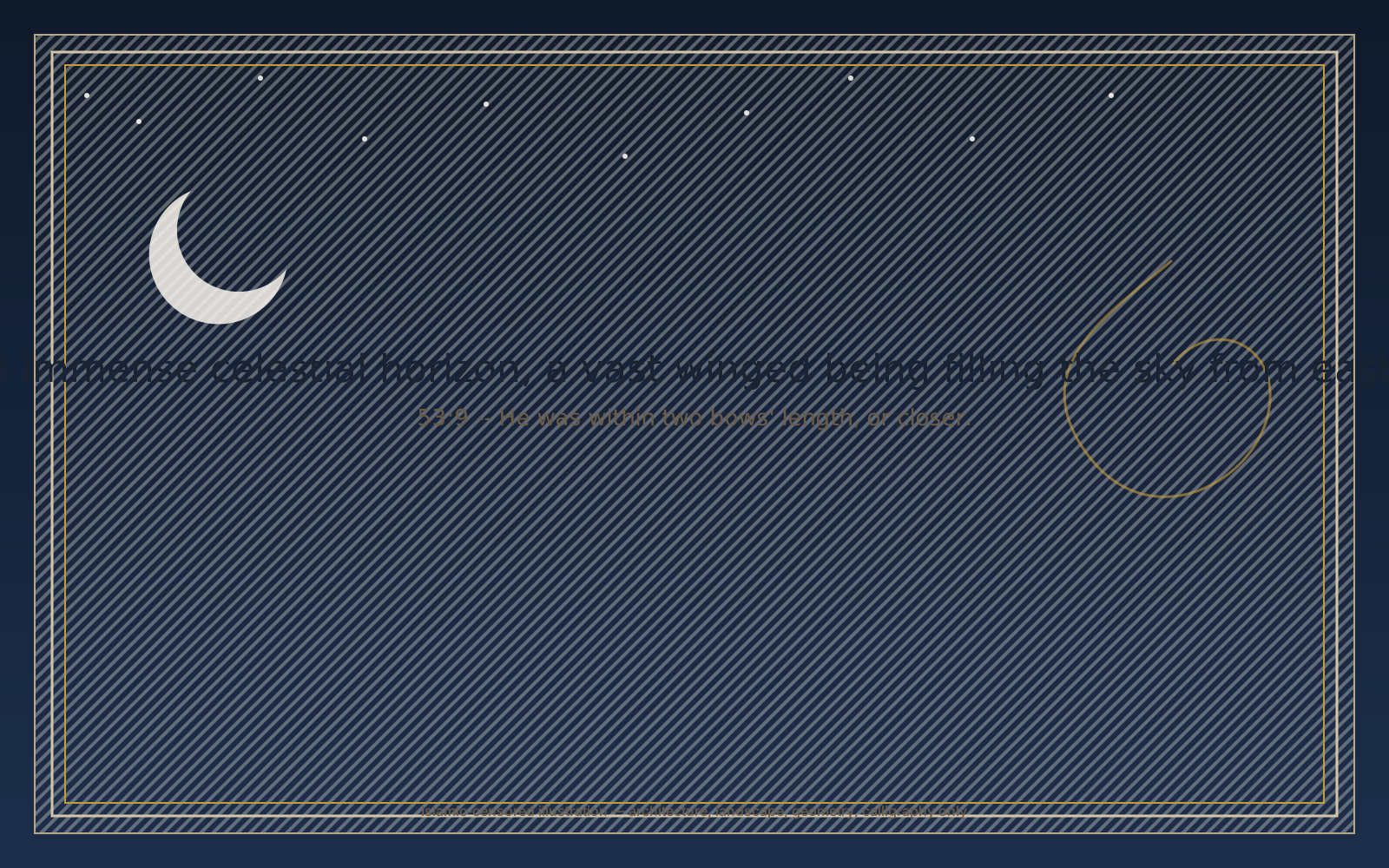
"Taught to him by the Extremely Powerful. The one of vigor. He settled. While he was at the highest horizon" 53:5-7. Jibril. The angel of revelation, identified not by name but by attribute -- shadid al-quwa, the one of overwhelming power. He appeared to Muhammad in his true form. Not the human shape he usually took. His actual angelic form, which the hadith traditions describe as filling the entire horizon from east to west, six hundred wings catching light that had no earthly source.
And then the most intimate measurement in scripture: "Then he came near, and hovered around. He was within two bows' length, or closer" 53:8-9. Two bows' length. The Arabic qaba qawsayn is a precise measurement from archery -- the distance between the tips of two bows placed end to end, approximately three to four arm-lengths. This is the distance between Muhammad and the boundary of the unseen world. Three feet. Perhaps less. Or closer, the Quran adds, as though even its own measurement might be insufficient.
"Then He revealed to His servant what He revealed" 53:10. What was revealed? The Quran does not say. The content of that transmission -- what passed between the divine realm and the human heart at a distance of two bows' length -- is sealed. The Arabic construction fa-awha ila abdihi ma awha is deliberately opaque: He revealed what He revealed. The veil is drawn precisely where curiosity is most intense. God tells you the distance. He tells you the experience was real. He tells you the heart did not lie. But He does not tell you what was said. Some knowledge is transmitted only to its intended recipient.
"The heart did not lie about what it saw" 53:11. Not the eyes -- the heart. The Arabic fu'ad is the innermost core of perception, deeper than intellect, deeper than emotion. Muhammad's vision was not optical. It was cardiac. His heart saw what his eyes could not have processed, and it did not fabricate. This is God's certificate of authenticity -- not for the mind's interpretation, but for the heart's direct perception of reality beyond the material.
And then, as if to say that one vision was not enough to settle the matter: "He saw him on another descent. At the Lotus Tree of the Extremity. Near which is the Garden of Repose" 53:13-15. A second sighting. This time at Sidrat al-Muntaha -- the Lote Tree of the Uttermost Boundary, the point beyond which no creature, not even Jibril, may pass. Classical tradition places this at the threshold of the divine presence itself, the frontier where creation ends and the Creator's unmediated reality begins. Muhammad went there. He saw the tree. He saw what covered it -- and the Quran, once again, declines to specify: "As there covered the Lotus Tree what covered it" 53:16. Colours without names. Light without source. Forms without category. The language of the Quran, which can describe Paradise in botanical detail, reaches the Lote Tree and falls silent.
"The sight did not waver, nor did it exceed. He saw some of the Great Signs of his Lord" 53:17-18. Muhammad's vision held. It did not wander to the spectacle. It did not transgress the boundary. He saw exactly what he was meant to see -- the greatest signs of his Lord -- and maintained the discipline of a servant who knows his place even at the threshold of infinity. This is not the testimony of a visionary lost in ecstasy. It is the report of a witness whose precision God Himself vouches for.