Edition 69 of 114 Mecca Bureau 52 Verses

The Daily Revelation

Revelation. Reported. Truth.
الحاقة

Al-Haqqah — The Reality
Force: Strong Tone: Warning Urgency: Immediate

THE REALITY: When the Universe Itself Becomes a Witness Stand

A three-word opening question — 'The Reality. What is the Reality? What will make you understand what the Reality is?' — launches the Quran's most relentless prosecution of civilizations that thought consequences were optional.


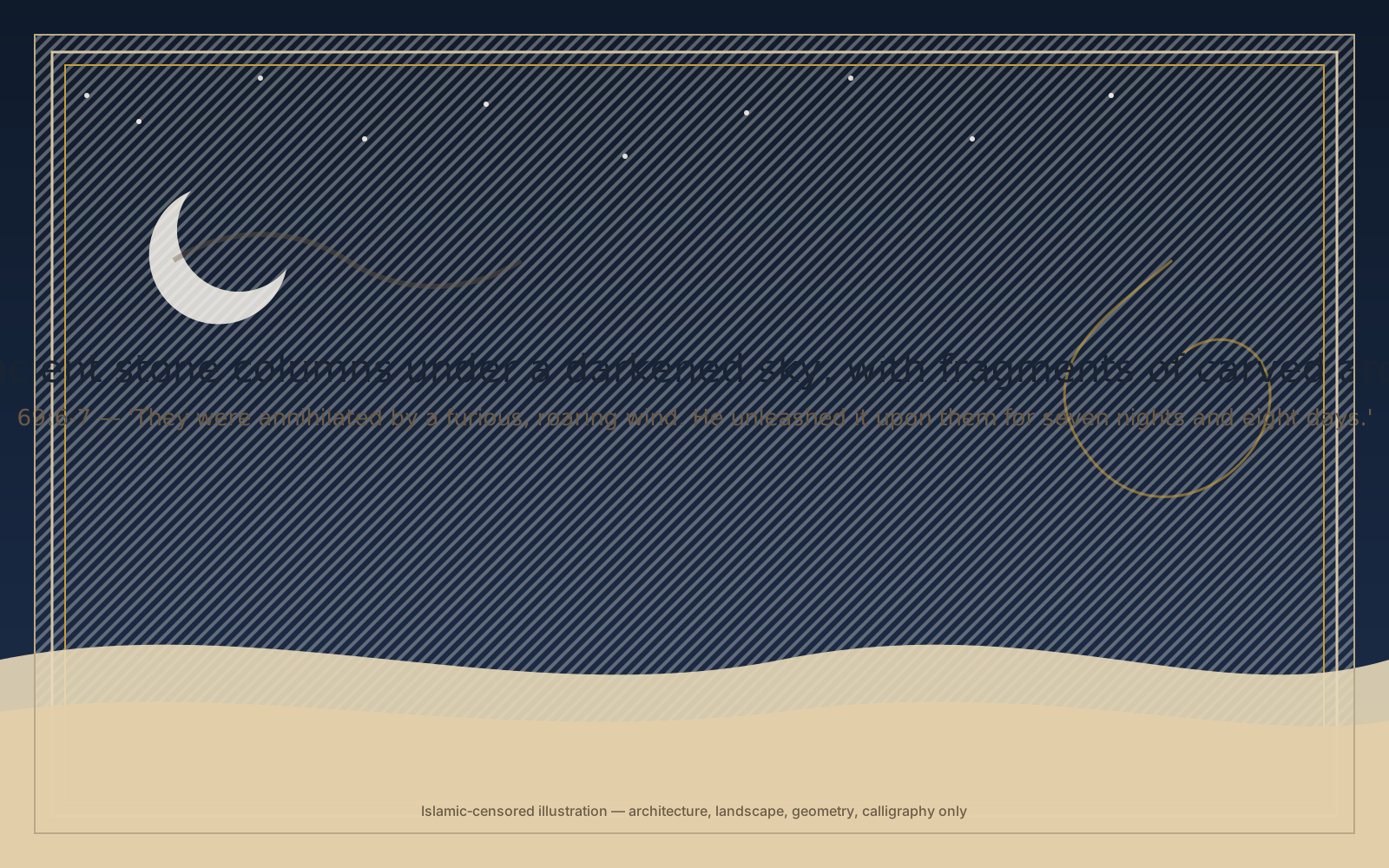
A colossal sandstorm consuming the ruins of ancient stone columns under a darkened sky, with fragments of carved architecture suspended mid-air in the howling wind
69:6-7 — 'They were annihilated by a furious, roaring wind. He unleashed it upon them for seven nights and eight days.'

The Quran has many names for the Day of Judgment. The Hour. The Catastrophe. The Overwhelming. The Deafening Blast. But in its sixty-ninth chapter, it chooses a word that cuts deeper than all the others: Al-Haqqah — The Reality. Not a metaphor. Not a warning label. The thing itself. The moment when every illusion is stripped away and existence is reduced to what it actually is. The chapter opens not with a statement but with a question asked three times in escalating intensity — as though even language struggles to contain what it is trying to describe. Then, before the cosmic events begin, the Quran does something startling: it takes us backward, into the archaeological record, and asks us to examine the ruins of civilizations that once believed they were exempt from this Reality. Thamud. Aad. Pharaoh. The cities of Lot. Noah's contemporaries. Five case studies in denial, each destroyed by a different instrument — an overwhelming blast, a roaring wind, an overpowering grip, an overturning, a flood. The evidence, the Quran implies, is not hidden. It is lying in the desert, half-buried in sand, waiting for anyone with ears that retain what they hear.

“The Reality. What is the Reality? What will make you understand what the Reality is?”
— God (opening the case) 69:1-3
Spiritual Barometer
Force
strong
Tone
warning
Urgency
immediate

The Daily Revelation Edition 69

Lead Story

FIVE CIVILIZATIONS, FIVE VERDICTS: The Quran's Archaeological Argument for Accountability

The first question a skeptic asks about divine judgment is always the same: where is the evidence? If God punishes civilizations that defy Him, where are the bodies? Where are the ruins? Where is the proof that consequence is not merely a theological abstraction but a historical fact?

Al-Haqqah answers this question not with theology but with geography. Beginning in verse four, the chapter presents what amounts to a prosecutor's exhibit list — five destroyed civilizations, named and catalogued, each annihilated by a distinct mechanism that matches the character of their transgression. This is not abstract eschatology. This is forensic.

The first exhibit is Thamud. "As for Thamood, they were annihilated by the Overwhelming" 69:5. The Arabic word used here — al-taghiyah — suggests something that exceeds all bounds, an overwhelming catastrophe that obliterated them completely. Thamud were the people who carved their homes into mountains, who looked at solid rock and saw permanence. Their punishment came as a force that overwhelmed even stone. The very material they trusted to protect them became their tomb. Archaeological sites in northwestern Arabia — Mada'in Saleh, the rock-hewn facades still standing in the desert — serve as the physical footnote to this verse. The buildings survived. The builders did not.

The second exhibit is Aad, and here the Quran provides a level of detail that borders on the cinematic: "And as for Aad; they were annihilated by a furious, roaring wind. He unleashed it upon them for seven nights and eight days, in succession. You could see the people tossed around, as though they were stumps of hollow palm-trees" 69:6-7. Seven nights. Eight days. The specificity is deliberate. This is not a vague reference to divine displeasure. This is a weather report from the end of the world. The Quran wants you to count the days. It wants you to see the bodies — not as abstractions, but as physical forms, hollowed out and thrown about like dead wood. And then the devastating follow-up: "Can you see any remnant of them?" 69:8. The question is rhetorical and it is not. Look around you. Where is Aad? They were, by Quranic account, a people of extraordinary physical strength and monumental architecture. And they are gone so completely that the question of their remnants answers itself in silence.

The third exhibit compresses multiple civilizations into a single verse: "Then Pharaoh came, and those before him, and the Overturned Cities steeped in sin" 69:9. Pharaoh — the archetype of political tyranny, the ruler who declared himself divine. The Overturned Cities — traditionally understood as the cities of Lot's people, communities whose moral corruption became so total that the earth itself rejected them. And those before them — an unnamed multitude, a geological layer of failed civilizations stretching back beyond recorded memory. All of them, the Quran says, shared one thing: "But they disobeyed the messenger of their Lord, so He seized them with an overpowering grip" 69:10. Different eras. Different geographies. Different specific sins. But the same structural failure — the refusal to listen to the messenger sent to them — and the same structural consequence.

The fifth case study is Noah's flood, and it is rendered with a remarkable shift in tone. Where the previous destructions were described from the outside — we observed Aad being tossed like palm stumps, we surveyed the absence of Thamud's remnants — Noah's flood is described from the survivor's perspective: "When the waters overflowed, We carried you in the cruising ship" 69:11. The pronoun shifts. Suddenly, the audience is addressed as participants, not spectators. You were there. You survived. And the purpose of that survival is made immediately explicit: "To make it a lesson for you — so that retaining ears may retain it" 69:12. The entire archaeological argument — Thamud, Aad, Pharaoh, the Overturned Cities, the Flood — culminates in this: these are not bedtime stories. They are evidence. And the evidence is useless unless someone is willing to hear it.

The phrase "retaining ears" is worth pausing on. The Quran does not say understanding minds or believing hearts. It says ears that retain — organs of reception that hold what they receive rather than letting it pass through. The destroyed civilizations did not lack information. They had messengers. They had warnings. They had, in some cases, miracles performed before their eyes. What they lacked was retention. They heard and they forgot. They saw and they looked away. The ruins in the desert are evidence not of God's cruelty but of humanity's extraordinary capacity to ignore what it has been told.

69:1 69:2 69:3 69:4 69:5 69:6 69:7 69:8 69:9 69:10 69:11 69:12

The Daily Revelation Edition 69

Cosmic Affairs

THE DAY THE SKY CRACKS OPEN: Al-Haqqah's Account of the Cosmic Dismantling

If the first movement of Al-Haqqah is archaeological — looking backward at ruined civilizations — the second movement is cosmological, looking forward to the moment when the universe itself is dismantled. And the transition between these two movements is a single trumpet blast.

"Then, when the Trumpet is sounded a single time. And the earth and the mountains are lifted up, and crushed, with a single crush" 69:13-14. The language is deliberately compressed. One sound. One action. The Quran does not describe a gradual apocalypse, a slow-motion collapse of systems. It describes an instantaneous event — a single sonic trigger that lifts the entire physical world and reduces it to rubble in one motion. Mountains, the Quran's recurring symbol of permanence and stability, are not eroded or worn down. They are lifted and crushed. The verb implies something picked up and slammed down, the way a potter might destroy a failed vessel. Nothing is left standing. Nothing is left recognisable.

"On that Day, the Event will come to pass. And the heaven will crack; so on that Day it will be frail" 69:15-16. There is something deeply unsettling about the word frail applied to the sky. The heavens — which in Quranic cosmology are built as a firm structure, raised without pillars, maintained by divine will — are described on this Day as wahiya, a word suggesting something so weakened it can barely hold itself together. The sky does not shatter dramatically. It cracks. It sags. It becomes frail, as though the structural integrity of the cosmos itself has been withdrawn. The universe, Al-Haqqah suggests, is not destroyed from outside. It simply has its support removed, and it collapses under its own weight.

Then the scene shifts upward, and the Quran provides one of its most architecturally precise descriptions of the divine order: "And the angels will be ranged around its borders, while eight will be carrying the Throne of your Lord above them that Day" 69:17. The borders of what? The cracked and frail heaven. The angels are positioned at the edges of a collapsing cosmos, maintaining formation even as the physical universe disintegrates around them. And above them — above the angels, above the cracking sky, above the crushed mountains and the lifted earth — eight bearers carry the Throne. The number is specific. Not seven, not twelve, not an innumerable host. Eight. In a scene of total cosmic dissolution, the Quran pauses to count the bearers of the Throne, as though to make clear that even in the dismantling of everything, the divine order is precise, numerical, architectural.

And then the most psychologically devastating verse in the sequence: "On that Day you will be exposed, and no secret of yours will remain hidden" 69:18. After the cosmic spectacle — the trumpet, the crushed mountains, the cracked sky, the angelic formations — the camera suddenly turns inward. All of that destruction, all of that cosmic re-engineering, was preamble. The real event is not the collapse of the universe. It is the exposure of the human being. Every secret. Every hidden intention. Every act committed in darkness and every thought harboured in silence. The physical universe had to be dismantled because it was the last place left to hide. When the mountains are gone and the sky is cracked open, there are no shadows left. No corners. No privacy. You are exposed — the Arabic tu'raduna carries the sense of being presented, put on display, brought forward for examination — and nothing remains concealed.

This is the genius of Al-Haqqah's structure. It moves from the macro to the micro, from the geological to the personal, from the destruction of mountains to the exposure of secrets. The cosmic events are not the point. They are the preparation. The universe is torn apart so that the human soul can be read.

69:13 69:14 69:15 69:16 69:17 69:18

The Daily Revelation Edition 69

Investigation

TWO BOOKS, TWO ETERNITIES: The Right Hand and the Left Hand That Decide Everything

In the courtroom of Al-Haqqah, there is no jury, no defense attorney, no procedural ambiguity. There is only a book — your book, the record of your life — and the hand it is placed in. Right or left. That is the entire verdict. And the Quran dramatises both outcomes with a psychological precision that has haunted commentators for fourteen centuries.

The right-hand recipient speaks first, and his words are not a prayer or a declaration of faith. They are an invitation: "Here, take my book and read it" 69:19. This is a person who wants to be seen. Who wants his record examined. Who offers his life's ledger to anyone willing to look, with the confidence of someone who kept honest accounts. And then the explanation for that confidence: "I knew I would be held accountable" 69:20. Not I hoped. Not I believed. I knew. The Arabic zannantu here carries the weight of certainty that governed action. This person lived as though the audit were coming. Not with the paralysing fear of a criminal expecting arrest, but with the steady discipline of someone who understood that every choice was being recorded and that one day the records would be opened.

The reward is described with sensory concreteness: "So he will be in pleasant living. In a lofty Garden. Its pickings are within reach" 69:21-23. The phrase "its pickings are within reach" is a small, almost domestic detail in the middle of a cosmic drama, and it is devastating in its intimacy. After the trumpet blast and the cracked sky and the crushed mountains, after all the grandeur and terror of the Day of Judgment, the Quran describes paradise in terms of fruit you do not have to stretch to pick. Comfort. Ease. The absence of strain. And the welcome that awaits: "Eat and drink merrily for what you did in the days gone by" 69:24. The days gone by — al-ayyam al-khaliya — the days that have passed, the earthly life that is now over. Paradise, Al-Haqqah tells us, is the harvest of seeds planted in time. What you did then determines what you eat now.

And then the left hand. And the Quran achieves something extraordinary here — it gives the condemned person not a scream but a lament. Not rage but regret. The left-hand recipient does not curse God or protest injustice. He turns inward, and what comes out is the most psychologically authentic monologue of despair in the entire Quran: "I wish I was never given my book. And never knew what my account was. If only it was the end" 69:25-27. Three consecutive wishes, each more devastating than the last. First: I wish I had never seen the evidence against me. Second: I wish I had never learned the total. Third: I wish death were final — I wish there were nothing after this, I wish the grave were the end, I wish annihilation were an option. This is a person who, faced with the reality of eternal consequence, wishes for the one thing the Quran has spent sixty-nine chapters explaining does not exist: a universe without accountability.

Then come the two lines that strip away every earthly illusion: "My money cannot avail me. My power has vanished from me" 69:28-29. These are not the words of a poor man or a powerless one. These are the words of someone who had both wealth and authority — and who, in the only moment that mattered, discovered that neither currency is accepted. The Arabic sultan in verse 29 means not just power but authority, legitimacy, the kind of influence that moves systems and commands obedience. It has vanished. Not been taken away — vanished, as though it were never real, as though the power he wielded on earth was a hallucination that the Reality has now corrected.

The judgment that follows is merciless in its specificity: "Take him and shackle him. Then scorch him in the Blaze. Then in a chain which length is seventy cubits tie him up" 69:30-32. Seventy cubits — approximately thirty-five metres of chain. The Quran measures the punishment. It counts the links. And then it explains why — and the explanation is not what you might expect. It is not idolatry. It is not murder. It is two things: "For he would not believe in God the Great. Nor would he advocate the feeding of the destitute" 69:33-34. Disbelief and indifference. The refusal to acknowledge God and the refusal to feed the hungry. The Quran places these two failures side by side, as though they are equivalent — as though ignoring the Creator and ignoring the creation's most vulnerable members are the same structural sin. And perhaps they are. Perhaps the person who cannot see God in His majesty is the same person who cannot see a hungry human being as worthy of his attention.

The passage closes with the social consequence: "So he has no friend here today. And no food except scum. Which only the sinners eat" 69:35-37. No friend. In a chapter that began with the destruction of entire civilizations, the ultimate punishment is described not as fire or chains but as isolation. The person who refused to feed others is left with food no one would willingly eat. The person who refused to acknowledge any relationship with God or with the poor finds himself in a place defined by the total absence of relationship. He has no friend. That is the final line of the verdict, and it lands harder than the fire.

69:19 69:20 69:21 69:22 69:23 69:24 69:25 69:26 69:27 69:28 69:29 69:30 69:31 69:32 69:33 69:34 69:35 69:36 69:37

The Daily Revelation Edition 69

Analysis

THE PSYCHOLOGY OF 'IF ONLY IT WAS THE END': Why the Quran's Most Terrifying Verse Is Not About Fire

Of all the descriptions of suffering in the Quran — the fire, the boiling water, the garments of pitch, the chains and the iron hooks — none achieves the psychological devastation of three words spoken by the person who receives his book in his left hand: "If only it was the end" 69:27. In Arabic: ya laytaha kanat al-qadiyah — if only it were the final judgment, the termination, the full stop. If only death were truly death.

This is not a wish for mercy. It is not a plea for forgiveness or a request for a second chance. It is something far more radical and far more psychologically revealing: it is a wish for non-existence. The person speaking has just seen his record. He has just learned the verdict. And his response is not to argue or to beg but to wish that the entire structure of reality — the afterlife, the accountability, the continuation of consciousness beyond death — simply did not exist. He wants the void. He wants nothing. He wants the atheist's universe, the materialist's promise that death is a full stop and that the atoms scatter and the story ends. He wants that now, at the one moment in existence when it has been proven, beyond all doubt, that such a universe is not the one he inhabits.

The psychological precision of this is extraordinary. The Quran is not describing a person who was always wicked or who never thought about consequences. It is describing a person who is now, in the moment of ultimate clarity, confronted with the full weight of a lifetime of self-deception. The money he accumulated — "My money cannot avail me" 69:28 — was not just wealth. It was a theology. It was his operating theory that acquisition equals security, that the person with the largest account is the person most insulated from consequence. And the power he wielded — "My power has vanished from me" 69:29 — was not just authority. It was his substitute for submission. Why bow to an unseen God when you can command visible men? Why depend on divine provision when you can provision yourself?

What Al-Haqqah is describing, with clinical accuracy, is the collapse of a worldview. Not a worldview that was never examined — these are not the words of an ignorant person. These are the words of someone who built an entire life on a set of assumptions — money provides security, power provides control, death provides escape — and who is now watching every one of those assumptions disintegrate in real time. The money does not help. The power is gone. And death, the final exit strategy, turns out to be a door, not a wall.

The great scholar Al-Ghazali wrote extensively about what he called ghurur — self-delusion, the human capacity to construct elaborate justifications for what we know, somewhere beneath the justifications, to be wrong. Al-Haqqah's left-hand monologue is the ultimate portrait of ghurur exposed. Every layer of self-protection has been stripped away. The social status that insulated him from criticism on earth does not accompany him past the grave. The wealth that bought him comfort and compliance cannot purchase a single degree of relief. The authority that allowed him to reshape the world according to his preferences has no jurisdiction here. He stands, for the first time in his existence, without any buffer between himself and the truth about himself.

And the truth, the Quran tells us, is structural. His two crimes are not random: "He would not believe in God the Great. Nor would he advocate the feeding of the destitute" 69:33-34. These are not two separate failures. They are the same failure expressed in two directions — upward and outward. The person who does not acknowledge the God above him is the same person who does not acknowledge the human being below him. The vertical refusal (to look up in worship) produces the horizontal refusal (to look around in compassion). Disbelief and indifference are, in Al-Haqqah's moral architecture, twins. And together, they produce the ultimate consequence: "He has no friend here today" 69:35. The person who refused all relationships — with God, with the poor, with truth — ends in a place defined by the total absence of relationship. He is, at last, completely alone. And alone, Al-Haqqah suggests, is the one thing that no human being, however powerful, was designed to endure.

69:25 69:26 69:27 69:28 69:29 69:33 69:34 69:35

The Daily Revelation Edition 69

Special Report

NOT A POET, NOT A SOOTHSAYER: The Quran's Most Aggressive Defense of Its Own Authenticity

The final movement of Al-Haqqah performs a manoeuvre that is rare in sacred scripture: it turns the lens on itself. After fifty-two verses of destroyed civilizations, cosmic dissolution, and the two-book judgment, the Quran suddenly addresses the most fundamental question that any audience in seventh-century Mecca would have been asking: who is actually speaking? Is this divine revelation, or is it the words of a man — a poet, a fortune-teller, a fabricator?

The defense begins with an oath: "Indeed, I swear by what you see. And by what you do not see" 69:38-39. The oath encompasses the entirety of existence — the visible and the invisible, the material world and everything beyond it. God swears by the totality of His creation, seen and unseen, as though marshalling the entire cosmos as a character witness. And then the declaration: "It is the speech of a noble messenger" 69:40. The messenger here, most commentators agree, is either Muhammad as the vehicle of revelation or the Angel Gabriel as its deliverer. In either reading, the key word is noblekarim — a messenger of dignity and honour, not a charlatan or a showman.

Then come the two negations, each aimed at a specific accusation that was circulating in Meccan society: "And it is not the speech of a poet — little do you believe. Nor is it the speech of a soothsayer — little do you take heed" 69:41-42. The Quran is not merely denying these charges. It is diagnosing the psychology behind them. The accusation of poetry and the accusation of soothsaying represent two different strategies of dismissal. Calling Muhammad a poet was a way of saying: this is beautiful language, nothing more — art, not revelation. It acknowledged the power of the Quran's rhetoric while neutralising its authority. Calling him a soothsayer was a way of saying: this is supernatural, perhaps, but from the wrong source — from jinn, not from God. It acknowledged the otherworldly quality of the message while discrediting its origin. The Quran addresses both — you dismiss it as poetry because you will not believe, and you dismiss it as soothsaying because you will not pay attention. The problem is not in the message. The problem is in the audience.

And then the definitive claim: "It is a revelation from the Lord of the Worlds" 69:43. No qualification. No hedging. Not a revelation from a lesser deity or an angelic being operating independently. From the Lord of the Worlds — Rabb al-Alamin — the same phrase used in the opening verse of Al-Fatiha, the same title that frames the entire Quran. The message and its source are identified with absolute clarity.

What follows is perhaps the most startling passage in the entire chapter — a hypothetical scenario in which the messenger himself is placed under threat: "Had he falsely attributed some statements to Us. We would have seized him by the right arm. Then slashed his lifeline. And none of you could have restrained Us from him" 69:44-47. The Quran is imagining a scenario in which its own prophet fabricates revelation — and describing, in visceral physical detail, what would happen. Seized by the right arm. The lifeline — the aorta, the watin — severed. And no one, no follower, no army, no human alliance, could intervene. This is not defensive rhetoric. This is the Quran staking its authenticity on the prophet's life. If Muhammad were lying, God says, he would already be dead. The fact that he stands before you, alive, delivering this message, is itself the proof that the message is genuine.

The theological implications are immense. The Quran is asserting that prophetic fraud is not merely sinful — it is physically impossible within the divine system. God does not allow His name to be used falsely and then wait for an afterlife punishment. The intervention would be immediate, lethal, and unstoppable. The prophet's survival is, in Al-Haqqah's logic, a form of ongoing authentication. Every day he lives and speaks is another day the message is verified.

The chapter closes with a sequence that moves from certainty to grief to transcendence: "Surely, it is a message for the righteous. And We know that some of you will reject it. And it is surely a source of grief for the unbelievers. Yet it is the absolute truth. So glorify the name of your Lord, the Magnificent" 69:48-52. The phrase "the absolute truth"haqq al-yaqin — is the highest category of certainty in Arabic epistemology. Not knowledge by report, not knowledge by observation, but knowledge by direct experience, the certainty that comes from reality itself. The Quran, Al-Haqqah declares in its final verses, is not merely true. It is truth — the same truth that the chapter's opening word promised. Al-Haqqah. The Reality. And the Reality, it turns out, has been speaking all along.

69:38 69:39 69:40 69:41 69:42 69:43 69:44 69:45 69:46 69:47 69:48 69:49 69:50 69:51 69:52

The Daily Revelation Edition 69

Connections

THE ARCHITECTURE OF ACCOUNTABILITY: How Al-Haqqah's Three Movements Build the Quran's Most Complete Case

Al-Haqqah is fifty-two verses long — shorter than many Meccan chapters, a fraction of the length of the great Medinan suras. And yet it constructs what is arguably the most architecturally complete argument in the entire Quran. Three movements, three types of evidence, one verdict. Past, future, present. Ruins, apocalypse, authentication. History, eschatology, epistemology. Each movement answers a different objection, and together they leave no exit.

The first movement (verses 1-12) answers the objection from history: Has God ever actually punished anyone? Yes. Thamud. Aad. Pharaoh. The Overturned Cities. Noah's contemporaries. The evidence is physical. The ruins exist. The absence of those civilizations is itself testimony. You can go to the desert and stand where Aad stood and observe that you are standing alone. The Quran treats archaeological evidence with the same seriousness that a prosecutor treats forensic evidence — here are the bodies, here is the cause of death, here is the pattern that connects them all. Each civilization was warned. Each civilization refused. Each civilization was destroyed by a mechanism calibrated to its specific form of arrogance.

The second movement (verses 13-37) answers the objection from the future: But that was the past. What about us? When is our judgment? Al-Haqqah describes the Day of Judgment not as a distant theological abstraction but as a sensory event — the trumpet sound, the mountains crushed, the sky cracked, the angels positioned, the secrets exposed, the books distributed. And then it dramatises the two possible outcomes with the voices of the recipients themselves. You hear the joy of the right-hand holder and the despair of the left-hand holder. You are not told about judgment. You are placed inside it. The future, in Al-Haqqah's telling, is not uncertain. It is as detailed and specific as the past.

The third movement (verses 38-52) answers the objection from epistemology: But how do we know any of this is true? How do we know this book is from God and not from a clever man? The Quran responds with an oath that encompasses all of reality, a categorical rejection of the poet and soothsayer accusations, a claim of direct divine origin, and a hypothetical scenario in which prophetic fraud results in immediate divine execution. The authentication is not gentle. It is not a philosophical argument for the existence of God. It is a claim backed by the prophet's life: if this were false, the speaker would be dead.

The three movements, taken together, close every escape route. You cannot dismiss accountability by pointing to the absence of historical evidence — the ruins are there. You cannot dismiss it by claiming the future is unknowable — the chapter describes it in architectural detail. You cannot dismiss it by questioning the source — the Quran defends its own authenticity with a test that can only be passed by a genuine prophet. Past evidence. Future certainty. Present authentication. Al-Haqqah is not a chapter that tries to persuade. It is a chapter that surrounds.

And the frame — the word Al-Haqqah itself — holds everything together. The Reality. Not a version of events. Not an interpretation. Not a perspective. The reality — the thing itself, stripped of every comfortable distortion. The destroyed civilizations experienced it too late. The cosmic events will impose it on everyone simultaneously. The Quran delivers it now, in advance, as a mercy disguised as a warning. The question that opens the chapter — "What will make you understand what the Reality is?" 69:3 — is answered by the chapter itself. Fifty-two verses. That is what it takes to make you understand. Whether you retain it, the Quran says, depends on whether you have "retaining ears" 69:12.

69:1 69:2 69:3 69:12 69:13 69:14 69:15 69:18 69:38 69:43 69:51

The Daily Revelation Editorial Edition 69

✸ ✸ ✸

Letter from the Editor: The Chapter That Removes Every Hiding Place

There are chapters of the Quran that comfort. There are chapters that legislate, chapters that narrate, chapters that describe paradise in terms so vivid you can almost taste the fruit. Al-Haqqah is not one of those chapters. Al-Haqqah is the chapter that looks you in the eye and tells you there is nowhere left to hide.

Not behind the past — because the past is full of civilizations that thought they were exempt, and their ruins are still visible. Not behind the future — because the future is described here with such specificity that it reads less like prophecy and more like a correspondent's report filed in advance. Not behind doubt — because the chapter ends by defending the authenticity of its own source with a test no fabricator could survive.

And not behind yourself. That is the verse that stays with me longest: "On that Day you will be exposed, and no secret of yours will remain hidden" 69:18. We are, all of us, professional hiders. We hide our intentions behind our words, our selfishness behind our generosity, our fear behind our certainty. We curate ourselves for public consumption and reserve the unedited version for the privacy of our own minds. Al-Haqqah says: that privacy is temporary. There is a Day when the editing stops and the raw footage plays.

But the chapter is not cruel. Read it carefully and you will notice that the right-hand recipient is described first — joy before grief, paradise before punishment, hope before warning. And the right-hand person's distinguishing characteristic is not extraordinary piety or miraculous achievement. It is this: "I knew I would be held accountable" 69:20. He lived with awareness. That is all. He did not pretend the audit was not coming. He did not build his life on the assumption that money would save him or that power would shield him or that death would end the conversation. He simply knew — and knowing, he acted accordingly.

The left-hand person's tragedy is not that he was evil beyond redemption. It is that he built his life on two refusals: he would not acknowledge God, and he would not feed the hungry. He refused to look up and he refused to look around. And in the end, he was left with no one — no friend, no ally, no companion. The Quran's harshest punishment, in this chapter, is not fire. It is isolation. It is the perfect, permanent aloneness of a person who refused every relationship that mattered.

Al-Haqqah asks us one question, really. Not whether we believe in the Day of Judgment — that is too abstract. It asks whether we are living as though our book is being written. Because it is. Right now. Every choice, every act of compassion or indifference, every secret entertained or rejected — it is all going into the record. And one day, the record will be placed in a hand. Yours. The only question is which hand.

For Reflection
Al-Haqqah names two crimes that condemn the left-hand recipient: refusing to believe in God and refusing to feed the hungry. Today, ask yourself honestly — not about the first, which is between you and God, but about the second: when was the last time you personally ensured that someone who was hungry was fed? Not through an organisation or an automated donation, but with your own hands, your own attention, your own presence?
Supplication
O Allah, You are Al-Haqq — the Truth, the Reality, the One whose existence makes all other existence real. On the Day when every secret is exposed and every record is opened, let our books be placed in our right hands. Let us be among those who say with confidence, 'Here, take my book and read it.' Protect us from the despair of those who wish they had never been born, who discover too late that money cannot help and power has vanished. Make us people who believed when belief required courage, and who fed the hungry when feeding them required sacrifice. Do not leave us friendless on the Day when friendship is the only currency that remains. And give us retaining ears — ears that hold what they hear, that do not let Your warnings pass through like wind through hollow wood. You are the Magnificent, and we glorify Your name. Ameen.
✸ ✸ ✸

The Daily Revelation Back Page Edition 69

Today's Action
Today, feed someone. Not through an app. Not through a recurring donation. With your hands. Buy a meal for a person who needs one, or cook something and deliver it yourself. Al-Haqqah places the refusal to feed the destitute beside the refusal to believe in God as the two defining failures of the condemned. Take that pairing seriously. Your relationship with the hungry is, in the Quran's moral architecture, a mirror of your relationship with God.
Weekly Challenge
Read Al-Haqqah once each morning this week — it takes less than five minutes. On Monday, focus on the destroyed civilizations (verses 4-12) and ask: what am I building that I think will last forever? On Wednesday, focus on the two books (verses 19-37) and ask: which hand would my book be placed in today? On Friday, focus on the authentication (verses 38-52) and ask: do I treat this Quran as the absolute truth, or as one perspective among many? Let the chapter's three movements work on you across the week.
Related Editions
Edition 7 Extended narratives of the destroyed civilizations — Thamud, Aad, Lot's people, and Noah — that Al-Haqqah references in compressed form
Edition 11 Detailed accounts of the same five destroyed nations, with dialogue between prophets and their people
Edition 55 The complement to Al-Haqqah — where this chapter emphasises accountability and judgment, Ar-Rahman emphasises mercy and bounty
Edition 36 Another Meccan chapter defending the Quran's divine origin, with the famous opening: 'Ya-Sin. By the Wise Quran. You are one of the messengers'
Edition 71 The full story of Noah, whose flood Al-Haqqah references in a single verse (69:11) — the expanded case file behind the brief exhibit
Characters in This Edition
Allah Disbelievers Believers Muhammad People of Ad People of Thamud Firawn Nuh People of Lut Angels Mankind
Coming Next
NEXT EDITION: Surah Al-Ma'arij — A questioner demands the imminent torment. It arrives. The chapter that maps the ascending stairways to God, the fifty-thousand-year Day, and the anatomy of human impatience. What happens when humanity asks for punishment and then cannot bear the answer.
Page 1 of 9
Ed. 68 Ed. 70